The MA Fine Art Online team explore 'thoughtful, generous and alive’ research-led teaching
22 July 2026
This article was written by MA Fine Art (Online) Course Leader Josie Cockram.
One of our students recently wrote about how she felt “part of something thoughtful, generous and alive” on the course. The generosity she describes is down to our team of artist academics, whose ambitious and innovative research informs and enlivens all our teaching as we work together in community online.
As Course Leader of Falmouth’s online MA Fine Art programme, I am very proud to work with a team of academics whose research has such reach and resonance within international discourse. Each of these artists brings practice-based knowledge and professional networks to enrich students’ experience.
Artwork: Dr Robyn Cook (1)
Dr Robyn Cook is Associate Professor of Design Ecologies and Tutor on our summer module, Sustainable Strategies. Her practice, research and teaching examine how design is entangled with the mesh of systemic power, investigating how language, economics and technology enforce forms of domination. This critical focus drives projects including the UKRI-funded Unequal Stories, which addressed gender inequality and the ethnographies of contested urban spaces.
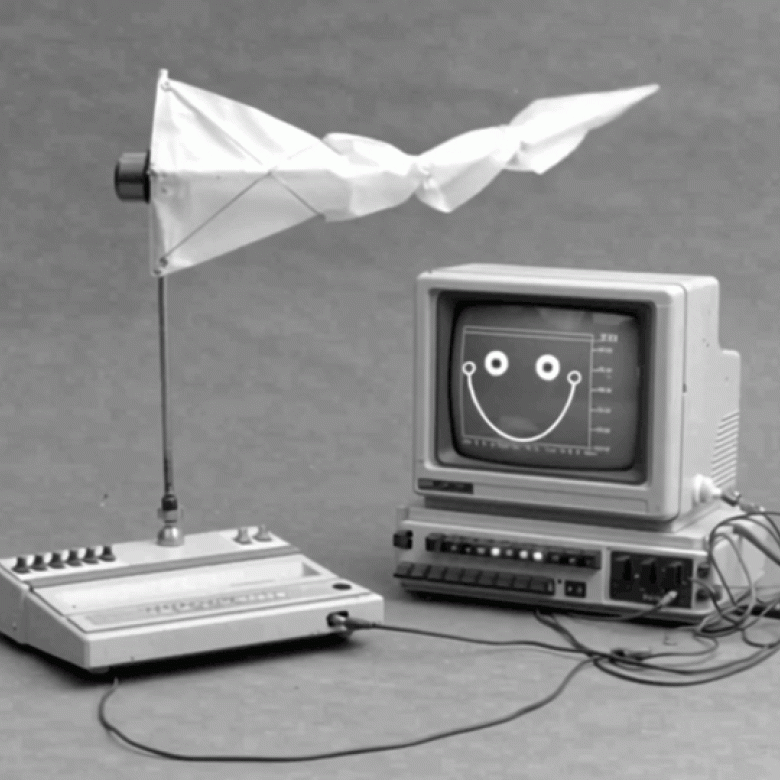
“My current projects include ‘Nose Fear’ – a parody electroclash band, testing whether academic rigour can survive art-punk absurdity – and ‘A Barometer of Unease’. The latter is a live, location-sensitive index inspired by Lyall Watson’s Biological Beaufort Scale that maps real-time wind conditions to a personal scale of systemic anxiety, ranging from mild restlessness to ultimate collapse.”
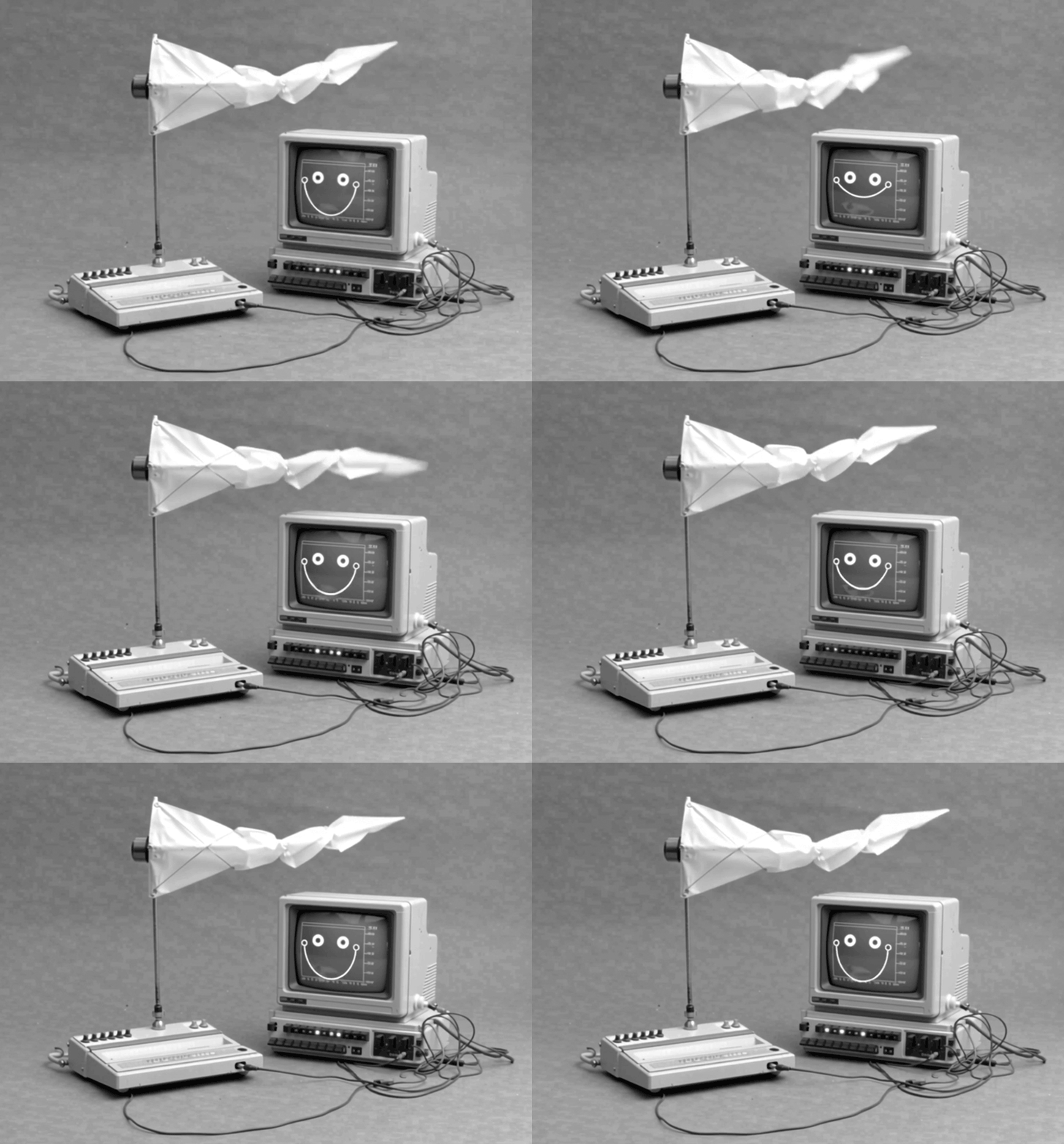
Flora Bowden also works as Tutor on Sustainable Strategies. Her PhD research at the Royal College of Art has explored questions of time and change in the space of the image, informed by the visual language of deep time as well as contemporary materials. Working across painting, drawing and printmaking, her current practice-based research explores the materiality of paint, using poured processes on linen to investigate questions of movement, flux and time within image-making.
“My work is often informed by art history and representations of women. I am interested in examining variability and vulnerability as well as endurance in the space of the image, and in bringing my material concerns and investigations into dialogue with abstract forms as well as figurative representations.”
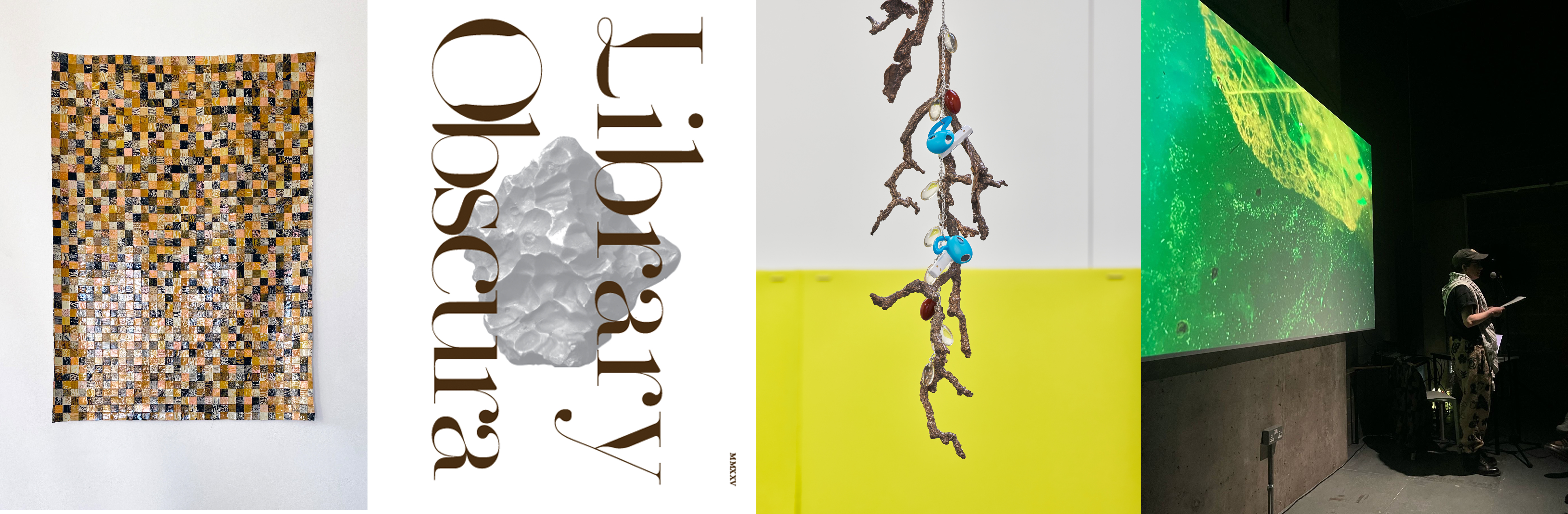
Artworks: Flora Bowden, Maria Christoforidou, Kate Fahey, Lucy Sames (2,3,4,5)
Maria Christoforidou, Senior Lecturer on campus and Tutor online, works collaboratively with The AfroSea Collective (Libita Sibungu, Maria Christoforidou, Angeline Morrison, Caroline Deeds, Catherine Lucktaylor) who presented their first publication Library Obscura at Hypatia Trust Penzance, supported by University of Exeter as part of the Reimaginings Art Commission programme. Maria was also recently commissioned by Tate St. Ives to present a research lecture on intersectional programming for Global Majority communities and projects in Cornwall.
“My research has mostly artistic outcomes that move through collaboration seeking healing and untethering from the capitalist legacies of colonialism; climate solution is health solution. Radical imagination and speculative fiction work as critical tools for challenging and expanding canons, practices, archives and minds."
Dr Kate Fahey, Deputy Course Leader and Module Lead, has recently worked on residency at Cove Park and been selected for This 26 at the Royal Scottish Academy in Edinburgh. In 2025, her solo exhibition ‘beyond, beneath, Beside’ at Tea Houses Kilkenny, explored the Arts and Craft movement in Ireland, the context of the Tea Houses and their proximity to the River Nore. Kate published some of her research for this project in an article for The Nore Review.
“My research is an exploration of meaning-making outside of scientific and rational knowledge systems. Through moving image, sound, language, print, the voice and sculptural practice, I investigate embodied, esoteric, folkloric and more-than-human ways of knowing.”
Artwork: Luke Dowd (6)
Dr Lucy Sames, Acting Module Lead, Tutor and Supervisor, was awarded her PhD ‘Wet Rest: excess as liquid praxis in art and curating’ by Northumbria University in 2022. She is on the editorial board for Journal of Art & Writing (JAWS) and is currently working on her monograph ‘Wet Rest’ to be published by Punctum New York. Other recently published writing includes an introduction to Bridget Crone's ‘Liquid Bodies Liquid Worlds’ in The Edinburgh Companion to Curatorial Futures (Edinburgh University Press, 2026); ‘Froath on the Sea’ in Aqueous Humours Fluid Ground (Matt’s Gallery, 2025); 'Dark, Sloshing', script for an audiowork with Sonia Levy (Gingko, 2025); and ‘The Outside is Already Inside’ in Journal of Writing in Creative Practice (2024).
“My research proposes a feminist, queer and posthuman concept of ‘excess’ modulated by the materiality and metaphor of the liquid, and inviting disruptive, embodied and collective modes of creative practice.”
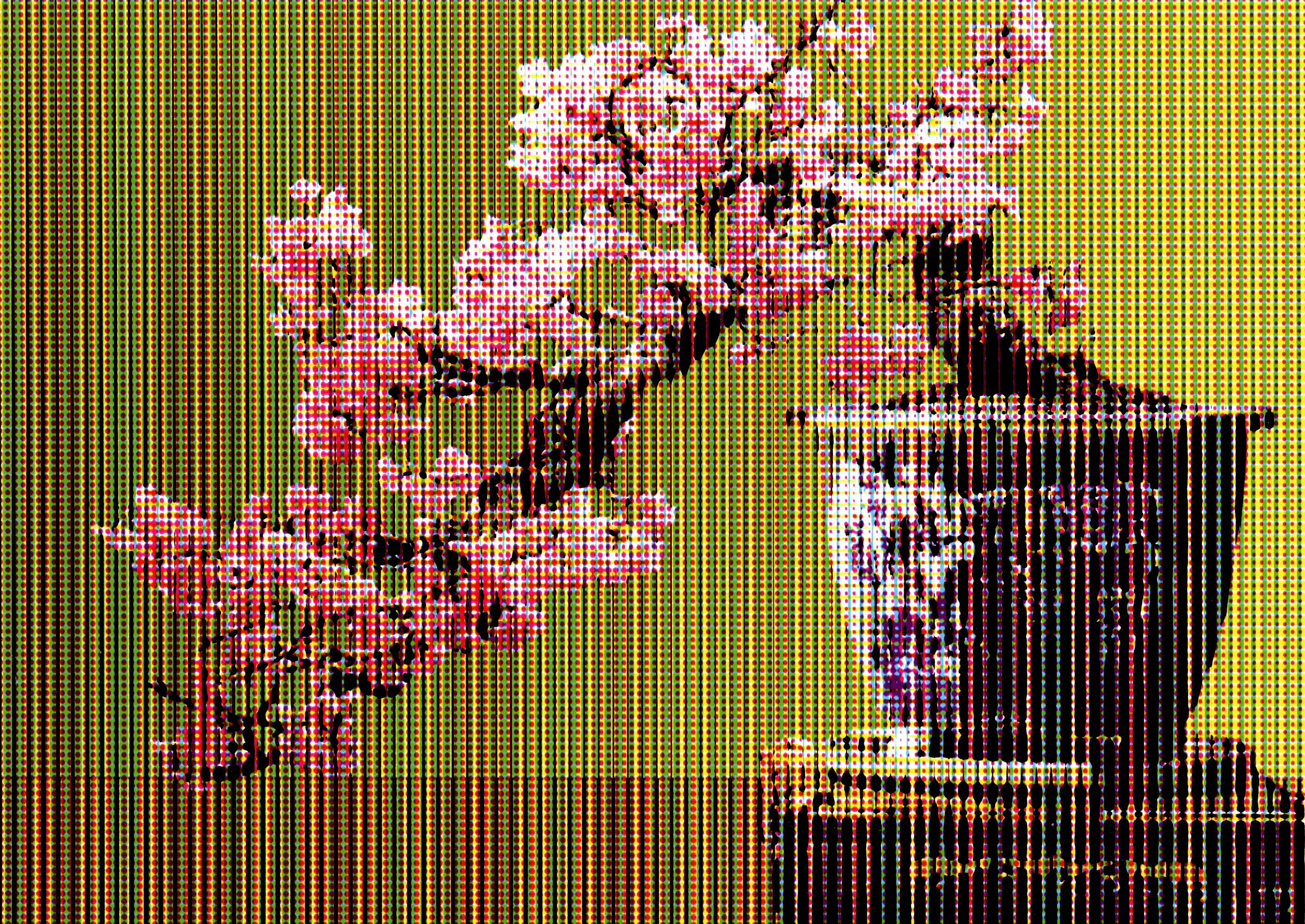
Luke Dowd, Tutor on two of our modules, understands his work to be a painting practice, whether it appears as a publication, a photograph or a print. He is currently working on a new series of compositions which he will scan and compile into two self-published publications: The Dishes and Bonsai. He is also developing individual images into paintings on canvas through image transfer techniques and screen printing.
“These images are drawn from my own photographs (of my dishes, sometimes those of friends), internet research, and sometimes through AI generated constructions and variations. They are made by passing the paper through the printer multiple times using a range of dot and line patterns like those used in traditional printing. I often break the image into a colour set which corresponds to either RGB or CMYK.”


Charlie Duck, Senior Lecturer on campus and Supervisor online, makes work that is speculative, open-ended and process-led. Prioritising making as a form of research, he uses material exploration and cumulative learning to test possibilities rather than working towards fixed outcomes. He recently returned from a month-long residency at Centro de las Artes de San Agustín, Oaxaca, Mexico, supported by CAST, Cornwall.
This year, he has been selected for the Freelands Foundation Two Together residency at Porthmeor Studios and will curate an exhibition at Falmouth Art Gallery in December.
“This will be the first institutional group exhibition I've curated and will bring together a range of artists working internationally, all of whom subvert assumptions and expectations of clay as a utilitarian and functional medium.”
Dr Jo Griffin, Lecturer and Module Lead, is an artist and interdisciplinary researcher whose interest in experiential encounters with large-scale technological structures has led her to hunt submarines in Scottish lochs and explore stories of lost spacecraft through a Fellowship at the NASA Space Science Lab at the University of California, Berkeley. Her recent work, however, is more grounded.
“I have begun to work on a series of drawings to document trees growing on the exposed uplands of Dartmoor National Park in the UK: low, gnarled, robust trees, usually standing alone, mostly hawthorn, rowan, oak and holly. The drawings are a way to build familiarity with the trees, and an archive. It is the beginnings of a project I want to expand to a collaborative documentation through geolocated drawings, at a moment when the treescape will potentially alter with the planting of thousands of new trees.”
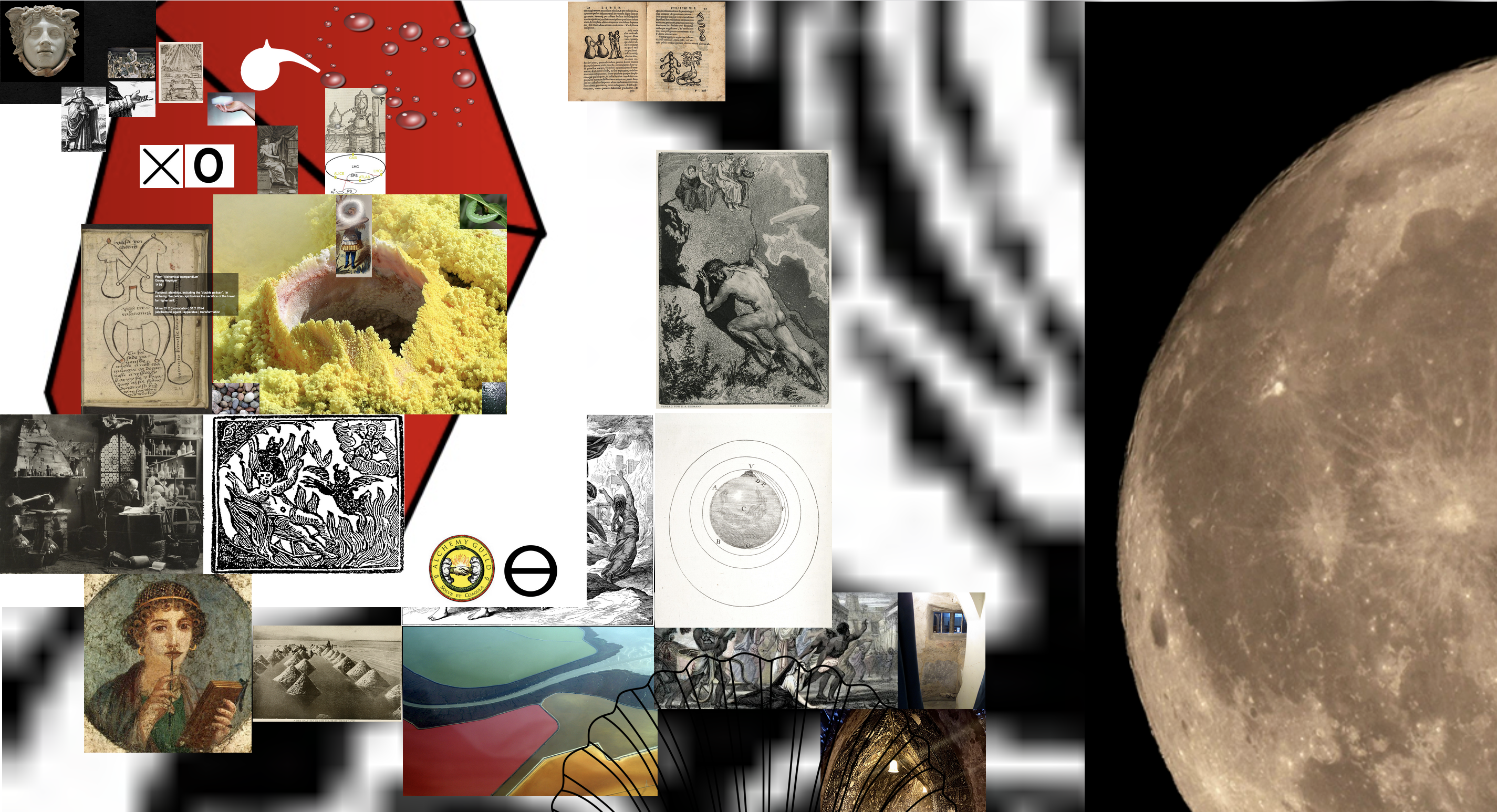
Artwork: Mary Anne Francis (9)
Dr Mary Anne Francis, Tutor and Supervisor, has long focused her research on challenging the conventions of art’s authorship in pursuit of progressive ideas about subjectivity and cultural form. Building on decades of publication and exhibition, recent work across her multi-stranded, intentionally de-centred practice includes 'Mixed Forms of Visual Culture: From the Cabinet of Curiosities to Digital Diversity' (Bloomsbury 2021 & 2023) and ‘Connecting cultures: hybrid forms’, a 6,000 word article for 'Bloomsbury Encyclopedia of Visual Culture' (forthcoming, 2027).
“This year will also see the publication of research developed through a years-long collaboration with artist-researcher Claire Scanlon, using the Research Catalogue platform to realise a project that mines copyleft digital images, montaged via a ludic method, to address complex relations between alchemies and extractivist capitalism.”
Evan Ifekoya leads our Collaborative Practice module, and collaboration is central to their practice. Projects such as the exhibition 'The Archive is an Altar' use epistolary address, sonic ritual, and embodied performance to engage ancestral lineages. The film 'MODUPE', funded by the BFI Doc Society Made of Truth Fund, forms part of an ongoing series exploring the legacy of Afro-Cuban priestess Amelia Pedroso. In 2026, Evan was awarded a Stuart Hall Foundation Scholarship for PhD research.
“My current artistic research explores how archives can be activated as living sites of memory, ceremony, and cultural transmission. Working across moving image, sound, installation, and digital platforms, I investigate Black diasporic knowledge, with a focus on Yoruba spiritual epistemologies and Nigerian diasporic histories, through experimental artistic methods. I approach the archive not only as a repository but as an altar, a space of encounter, devotion, and reactivation.”
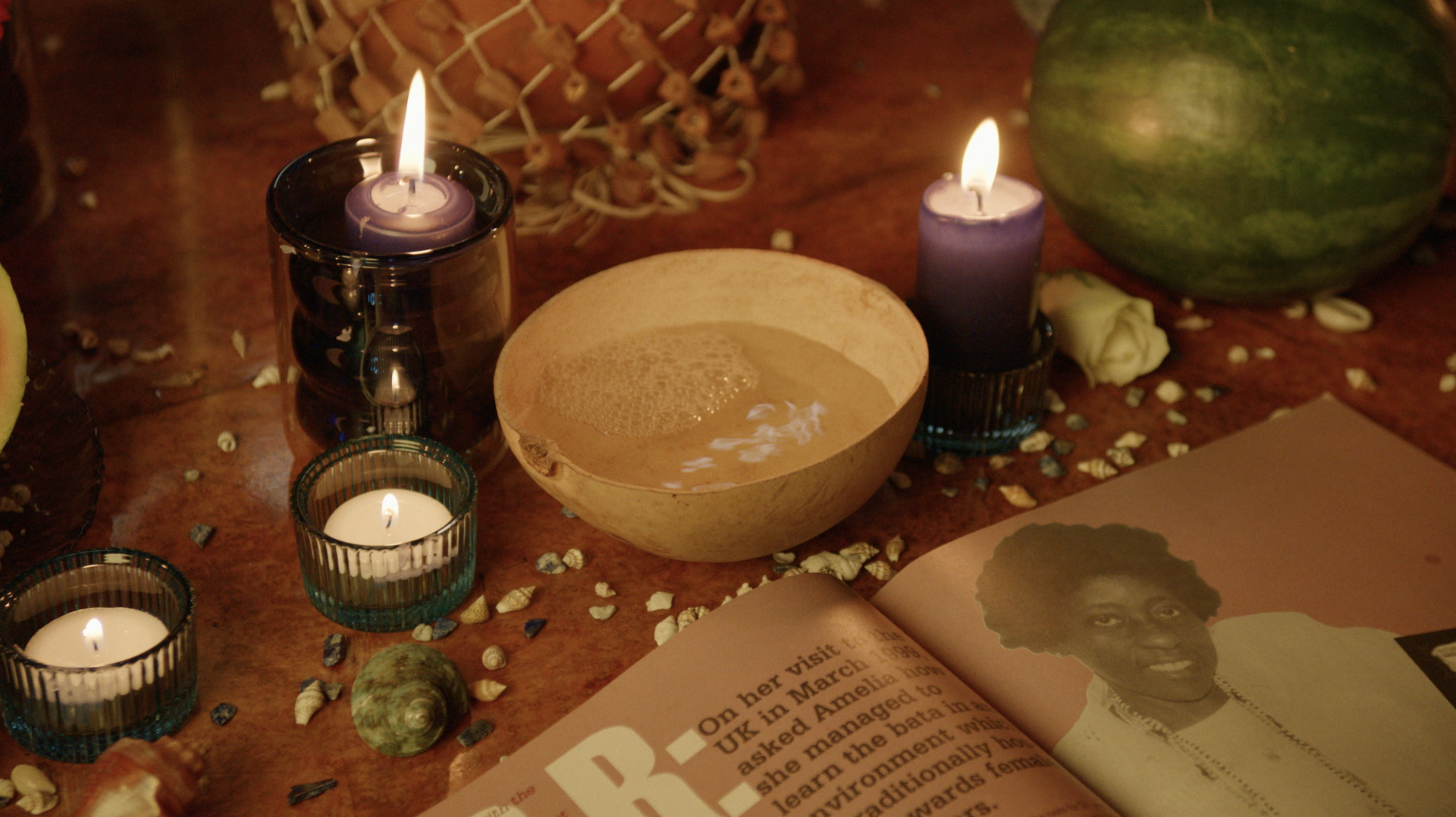
Artwork: Evan Ifekoya (10)
Georgia Metaxas, Lecturer and Tutor, investigates photography’s non-linear relationship to time, engaging memory, migration and intergenerational narratives. Working across photographic, moving image and book forms she approaches the image as a mnemonic and material site through which personal and collective histories are activated and re-formed. Recent publications include a photobook, Mnemosyne Grove with Perimeter Editions (2024), which Georgia will discuss in conversation with Marta Weiss, V&A Senior Curator of Photography at the Hellenic Centre later in 2026.
“My recent work centres the olive tree as a recurring motif, tracing connections between land, family archives and storytelling across sites in Greece and Australia. Through repetition, archival reworking and material experimentation – including carbon printing with charcoal derived from olive wood – this practice-based research considers how meaning emerges through the entanglement of image, material and place.”
Srin Surti, who works as a Tutor across three modules, explores the coexistence of pictorial and sculptural qualities in relief as an analogy for cultural hybridity. He works through analogue, digital and performance strategies within his print-making practice. Currently working on his PhD with University of the Arts London, recent research highlights include a residency at the Research Art Lab, Orford Ness (2025) and an article in AD magazine issue #44: ‘On Being an Artist, Educator and Researcher’.
“The consideration of relief – traditionally regarded as a sub-category of sculpture – as a form of imprint prompts my investigation into the nature of flatness and depth, image and object, printing matrix (plate, screen, digital file) and substrate (paper, fabric, wall). Within this, I use the intangible qualities of lightness and shimmer as affectual ways of working with image and surface to explore notions of slippage and hybridity.”


Lucy Willow, Senior Lecturer on campus and Tutor online, runs a research group called DUST from an old shop in Penzance. The shop is an artwork, inviting visiting artists and researchers to tell their stories and share experiences of grief through the lens of a collection of broken artefacts. Her newest project, though, is on the move.
“’The Wandering School of Art’ is a new, artist-led school inspired by my experience as an artist and Senior Lecturer in Fine Art at Falmouth. I have set up The Wandering School of Art as an independent space for shared learning, drawing on a long and wonderful history of free-thinking, radical art schools, where artists make up our own rules. It is a pedagogical experiment into idleness and the profound states of creativity to be found in doing nothing.”
My own research is concerned with de-centering arts pedagogy through digitality, informed by questions about opacity, presence, and how we listen online. I am a Research Affiliate in Falmouth's Centre for Pedagogy Futures, where I co-founded an online research group, and I was recently selected to be a participant in The Cornwall Workshop with Ane Hjort Guttu and Adam Chodzko, a residency for artist teachers.
My pedagogical research is informed by a studio practice that engages with the politics of the body(ies) in place and questions of visibility, legibility, disappearance and incoherence. My work is born of my training in sculpture and materially involves photographic print, moving image, sound and drawing. Increasingly, I’m making this work online to activate slippage between the image, embodiment, sound and space.
Read more about Josie’s perspective on teaching art online in contingent times here.
Read more about each academic's research and experience in profiles here.
IMAGE CREDITS:
1 Robyn Cook, A Barometer of Unease, 2025 [mixed media / digital animation]
2 Flora Bowden, Untitled [acrylic on linen], 2021
3 Maria Christoforidou, Library Obscura, Issue 01, 2026, The AfroSea Collective Publication
4 Kate Fahey, Optimal Functioning (I), 2025. Image: No Show Space and Commonage. Photo: Reinis Lismanis
5 Lucy A. Sames, Froath on the Sea, a reading with well water, Matt's Gallery, 2025. Image: K. Cooke
6 Luke Dowd, Bonsai, Inkjet print, 21cm x 29.7cm, 2026
7 Charlie Duck, While we gently roast, low and high fired stoneware, 72 x 99 x 6 cm, [ceramic] 2024-26
8 Jo Griffin, Twenty Trees, 20 x 20 cm [pencil, charcoal, chinagraph on paper], 2026
9 Mary Anne Francis, Prospecting alchemy as ludicrous critique of capitalist imaginaries: a picture-play [detail], 2026
10 Evan Ifekoya, MODUPE, [film still], 2025
11 Georgia Metaxas, Carbon Testing, Mnmosyne Grove, 2024
12 Lucy Willow, The Wandering School of Art, 2026
You might also like

Business course leader publishes book drawing on 20-years of research into local sustainability

Archives in Action: Heritage, culture and the power of memory through fashion

Game Development student to present research at conference

PhD researcher explores the body, performance and AI
