PhD researcher explores the body, performance and AI
20 April 2026
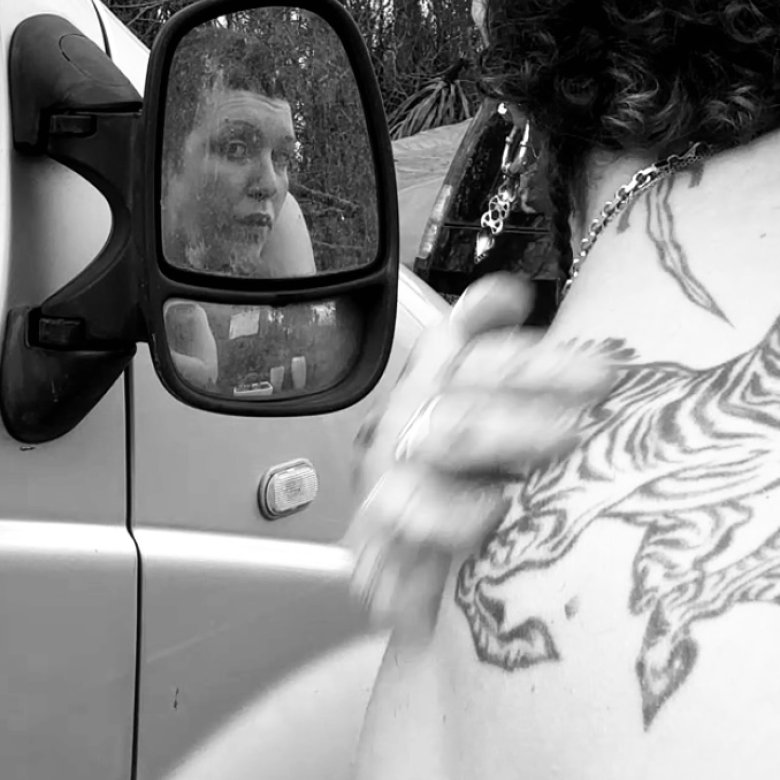
Performance artist and Falmouth University PhD student Ellie Neason is pushing the boundaries of creative practice through her research, examining the relationship between the human body and artificial intelligence (AI).
With a background rooted in fine art and performance, Ellie’s work draws on the legacy of 1970s and 1980s feminist performance while engaging directly with contemporary debates around AI, creativity and authorship. “I started working with performance iterations with AI right at the end of my master’s, and it felt like the starting point for a really strong PhD project,” she explains.
At the heart of Ellie’s research is an evolving dialogue between human performance and machine-generated response. Her process involves performing live work, feeding it into generative AI systems, and then responding to the outputs through further performance. “It becomes a feedback loop,” she explains. “I perform, the AI responds, and then I perform that response. It’s like a performative dialogue with intelligent technologies.”
Even if I have a complicated relationship with it, it’s important to confront it and have those conversations.
Through this iterative method, Ellie explores questions of embodiment, autonomy and presence in a digital age. “My research looks at where the body exists within post-human theory; especially in a time where AI and technology are part of our everyday lives,” she says. “It’s about testing the relationship between lived, physical experience and non-human systems.”
Alongside these explorations, Ellie’s work also engages critically with ideas of artistic skill and authorship. “I come from a very traditional background - drawing, painting, performance rooted in DIY practices,” she says. “So, there’s an ongoing conversation in my work about what happens to skill and creativity when AI becomes part of the process.”
This creates a dual critique: Ellie asks AI to respond to her performances, while simultaneously questioning the creative validity of AI-generated outputs. “I’m asking AI to critique physical performance, but at the same time, I’m critical of what AI produces,” she explains. “That tension is really important to the work.”
Although still in the early stages of her PhD, Ellie has ambitious plans for how her research could be developed. “I’d love the final outcome to be a technological performance that exists across multiple places: something that travels or operates in different locations at once,” she says.
Her work is also deeply informed by her own lived experience of nomadic communities, which she hopes to incorporate into future ethnographic research. “I’ve lived in caravans and travelled a lot, so I’m interested in how identity and subjectivity move through space - especially in relation to technology.”
Working with AI presents unique challenges, particularly as the technology evolves so quickly. “It’s constantly changing,” Ellie says. “You can start to define an ethical framework, and then something new comes out and shifts everything again. So, it’s about staying flexible and open.”
Despite her critical stance, she believes engaging with AI is essential. “To ignore it would be naïve,” she says. “It’s shaping how people think, create and research. Even if I have a complicated relationship with it, it’s important to confront it and have those conversations."
Falmouth’s supportive research community
Ellie chose Falmouth for her PhD because of its strong creative network and supportive research environment. Now based within the Centre for Blended Realities (CBR), Ellie describes her experience as both challenging and rewarding.
“It’s intense, but in a really good way,” she says. “You come in thinking your research is solid, and then through discussions and processes like ethics approval, it gets unpicked. But that’s where the growth happens - my project has already developed so much.”
Ellie is also a student representative, giving her a broader perspective on the postgraduate research community. “It feels like a real network - almost like a family. There’s support from people at every stage, and there’s a strong focus on student-led research, which is really empowering.”
Reflecting on her time in CBR, Ellie highlights the breadth and ambition of the work taking place across the centre. “It’s such an exciting environment,” she says. “The research happening there is incredible - really interdisciplinary and forward-thinking. It’s a place where you’re constantly inspired by what other people are doing.”
For Ellie, that sense of curiosity and experimentation is key; not just to her own practice, but to the future of creative research. “It’s about asking difficult questions,” she says. “About the body, about technology, and about what it means to create in this moment.”
You might also like

Graphic Design team launch new research initiative

Research Fellow on artists using technology to reveal its flaws and problems

The MA Fine Art Online team explore 'thoughtful, generous and alive’ research-led teaching

Business course leader publishes book drawing on 20-years of research into local sustainability
