AI and the creative process: what it means for artists and their cultural value
12 March 2026
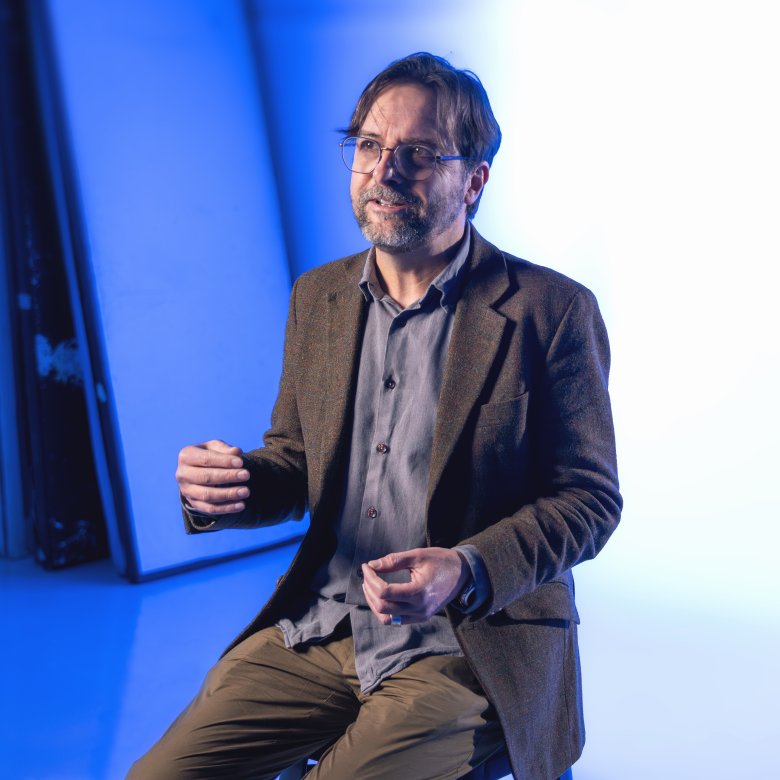
This article was written by Associate Professor William Huber, course leader for MA Artificial Intelligence for Creative Practice.
“Artificial intelligence” in the creative space has generated a number of responses, mostly centred around the replacement of large numbers of creative workers with generative tools and reality blurring ephemeral “AI slop” circulating on social media platforms.
Surprisingly though, for a community defined by experimentation, curiosity and imagination, many of us have accepted this outcome.
Many have been oddly reluctant to experiment, to think within a context of creative practice, and to explore its possibilities as well as its problems and limitations. Disengagement leaves the real promises of these technologies, as the basis of new experiences and new cultural forms, largely unexplored.
A large part of that response has been shaped by the way AI has entered creative life: framed almost entirely through an industrial model, promoted by (and sold back to us by) corporations speaking the language of optimisation, efficiency and asset pipelines, where labour costs are reduced through automation.
But AI is not reducible to the handful of digital products and services currently being marketed to creatives and the general public. The mistake is to treat it as either an endpoint or a verdict on creative value. It’s neither. We need creatives who can see AI as a layer: one added to an already dense stack of technologies, platforms, workflows and expectations that contemporary creative practitioners are expected to navigate.
Asserting creativity’s cultural value
The best way for us to move through this landscape is to recognise our cultural value and assert our capacity for thinking, knowing and understanding based on human experience and insight. The ground hasn’t settled yet, and that is precisely where the opportunity lies for artists, designers and other creative workers to demonstrate their irreplaceable value.
The twentieth century saw an explosion of technologies that transformed creative practice, from recorded and amplified music to digital production tools and the internet. In each case, artists and designers had time to adapt, misuse and reshape those tools into new cultural forms.
But with AI, we have started somewhere else entirely. During this moment in which these technologies are emerging, the cultural sector is dominated by industrial models that frame creatives as fungible — as interchangeable labour within production systems — rather than as cultural agents shaping new forms.
Instead of encountering AI as a creative or cultural material, we encountered it in products wrapped around opaque systems and generating assets designed to circulate within platforms — short-form videos, viral content, synthetic imagery. We do not yet have widely recognised cultural forms that sit outside those value-extraction frameworks which further cement a corporate hold on the public cultural and informational sphere.
The early generative systems that have become the public face of AI are very good at approximation. Left mostly to their own devices, they produce work that looks and sounds like things we already recognise. In that sense, they extend a longer platform-driven trend towards familiarity, repetition and optimisation that diminishes rather than democratises the expansion of creative vocabularies.
What’s missing so far are new cultural forms that feel native to this technological layer rather than borrowed from earlier ones. That absence is often interpreted as a failure of AI. I think it is better understood as a signal that the culture itself has not caught up yet.
AI beyond workflows and efficient outputs
One of my concerns is how quickly AI has been framed in terms of existing workflows. We’re taught tools, prompts, pipelines: this tool for that task, this output for that client. That framing is seductive because it promises speed, relevance and employability. But it also risks locking creative practice into the narrow logic of the platforms that currently dominate AI.
If creativity is forced to fit inside AI systems, rather than AI being placed within creative practice, the space of possibility shrinks, and the agency of the human creator diminishes.
Creative authority rarely emerges from doing exactly what a tool expects: not asking, “what is this supposed to do?” but instead “what can I do with it, how can I push it?”. It comes from misuse, friction, resistance and recontextualisation. It is built on a foundation of cultural literacy and humanistic education: art and media history, film and screen and literary studies, philosophy, and cultural history. In understanding our pasts and our present.
For creatives this not only matters for our practice, but also in the context of our work and labour. In the UK, creative labour markets are already highly flexible. Roles shift quickly. Skills date fast. AI hasn’t created that instability, but it has intensified it. Teaching fixed workflows in response to that instability is a short-term solution at best.
Too often, creative education has fitted people to pipelines rather than cultivating creative intelligence as a whole person. What will help us thrive are intellectual curiosity, aesthetic adventurousness and the specificity of human experience. Critical engagement, ethical reasoning and cultural literacy matter whether someone works with AI directly, indirectly or not at all.
Exploring AI for creative practice
That is why educational spaces that prioritise thinking and knowing over prescriptive practice matter so much right now. Here at Falmouth, we have launched our MA Artificial Intelligence for Creative Practice for those who want to explore AI as a subject, a material and a cultural force.
We do not assume that AI already has a settled purpose. AI is placed within a space where creatives with a variety of practices can be alongside those with backgrounds in the humanistic study of culture and thought, to consider AI as something more than a workflow tool pushing assets through a production chain.
That distinction allows for scepticism as well as curiosity. It allows refusal as well as experimentation. Most importantly, it allows uncertainty to be treated as productive rather than worrying.
If creatives disengage entirely from AI, decisions about its cultural role will still be made, just without us. If we engage only on the terms set by corporate platforms, we abdicate our agency.
The harder, more interesting option is to engage critically, slowly and collectively at a moment when cultural forms remain unsettled. To imagine new forms of engagement, new approaches to storytelling and worldbuilding, and new aesthetics.
Unshaped landscapes can be uncomfortable. They offer few assurances and no templates. But they also offer something rare: the chance to shape what comes next. Creativity prospers in that space.
Further reading
Read more on How creative universities should respond to AI by Russell Crawford, Deputy Vice-Chancellor (Interim).

You might also like

Online Creative Writing lecturer wins Royal Society Trivedi Science Book Prize

Professional Writing course leader releases new book with The History Press

Meet the creative behind Falmouth's new Content Creation & Branding course

