
Artificial Intelligence for Creative Practice MA
Exploring the intersection of technology, culture and human imagination.
Course overview
This master's programme explores how artificial intelligence can extend and reshape human creativity, in sustainable and ethical ways, through the lens of Falmouth University's 120-year creative legacy.
Designed to support a wide range of creative and technical backgrounds, this master's degree examines how artificial intelligence can be brought into work across image, sound, moving image, text and interactive media, opening up new and meaningful creative experiences.
As a student, you will investigate the relationship between emerging technology and aesthetics, considering how form and expression evolve in a digitally mediated world. Central themes include the ethical, environmental, economic and social impacts of AI; questions of intellectual property in new creative contexts; and the aesthetic and epistemological implications of practices which embrace and question these new systems, tools and platforms.
Guided by research-active staff, this course offers an individually tailored, research-led learning experience, culminating in a Major Project that realises your own aesthetic and conceptual vision. Through experimentation and critical inquiry, you'll develop the insight and confidence to question, create and lead within the evolving field of creative technologies.
Graduates emerge prepared to shape the future of digital creativity: whether as researchers, artists, designers or strategists exploring the intersection of technology, culture and human imagination.
Why study this course at Falmouth?
Delivered in a cultural and natural setting like no other, this programme has been developed in partnership with faculty, researchers and industry collaborators: from those with expertise in emerging technology, as well as those from traditional creative arts disciplines.
The course is focused on understanding and interrogating the use of technology in creative practice: the applications of technology – including AI and automation – are examined critically against central themes of environment, sustainable practice and societal benefit.
Course details
This master’s course equips you with the critical, technical and creative skills needed to engage meaningfully with artificial intelligence as a force in contemporary creative practice. You will learn to understand AI not only as a set of computational tools, but as a cultural, ethical and socio-technical system that reshapes creative labour, authorship and production.
Through a blend of conceptual frameworks, hands-on experimentation and reflective inquiry, you will design and evaluate original AI-driven creative workflows, developing the confidence to question, create and lead within an evolving field.
Across the course you will develop skills in:
- Critically analysing AI technologies within creative, cultural and professional contexts
- Applying AI tools, models and workflows to produce original creative work
- Evaluating and enacting responsible, ethical and legally compliant AI practices
- Designing and appraising effective human-AI collaborative workflows
- Demonstrating data literacy and understanding how model characteristics shape creative outcomes
- Communicating complex ideas about AI-driven creative work to specialist and non-specialist audiences
The course culminates in an independently led Major Project: a portfolio-ready artefact that realises your own aesthetic and conceptual vision, supported by a dedicated supervisor.
Module details
This module builds your practical and professional foundations through making, reflection and dialogue. You will create small artefacts, examine legal and ethical considerations and learn to design for diverse audiences. Alongside exposure to pipelines and specialist techniques, you will produce reflective case studies that evidence your development and connect your practice to professional pathways.
This module explores the relationship between technology and creative practice across media, from technologies of reproduction and automation in the creative industries to contemporary AI-enabled cultural production. You will be introduced to the core AI technologies used in creative work and supported to situate current and emerging tools within their broader historical, cultural and economic contexts.
Building on the first two modules, you will research an existing creative practice case study and define a new creative workflow for your own practice, developing fluency with the relevant technologies and sharpening your conceptual clarity. The module emphasises iterative experimentation and reflective documentation, while also considering the industrial and innovation histories of the tools you use.
This module examines AI as both a technical field and a societal force, focusing on how systems are built, deployed and governed. You will analyse issues including bias, transparency, labour impacts, creativity and ethics. Through research-led study of an AI application in context, you will evaluate its technical, aesthetic, social and moral implications and reflect on AI's wider effects on human agency and society.
The Major Project is an extended opportunity for independent research and portfolio-ready creative production, using AI tools in support of clearly defined aesthetic and conceptual goals. You will define and pitch your project at a proposal milestone, apply project and time management methods, and produce the final artefact and a supporting creative statement as your principal submission.
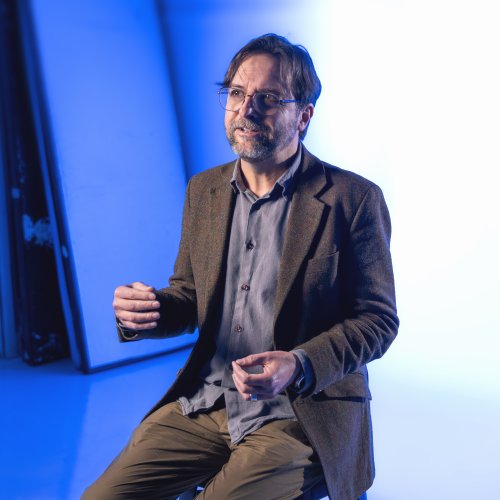
AI and the creative process: what it means for artists and their cultural value
This article was written by Associate Professor William Huber, course leader for MA Artificial Intelligence for Creative Practice.
Read articleHow you'll learn & be assessed
Learning is situated in an environment that mirrors the creative industries, helping to prepare you to take your learning and apply it in real world contexts. You'll learn through guided lectures and seminars, as well as through exposure to research projects, participating in group projects and your own research. You'll also get to explore the range and breadth of research in a creative institution, collaborating with research colleagues in technical centres such as the Centre for Blended Realities, along with those in other areas that resonate with your own professional practice.
Assessment for this course is 100% coursework. There are no exams as part of this course.
Assessments are composed of practical activities underpinned by critical analyses of technology workflows, applications and practices to further support your learning. Module leaders and supervisors will be available to guide and support you through your assessments to enhance your relevant technical and academic skillsets.
Facilities
- Large studio equipped with updated i7 machines
- Attached labs for console development, immersive experience design and robot fabrication (including 3D printers, laser cutters, soldering stations, CAD tools and CNC machines)
- Specialised computing hardware for game development, deep learning projects, motion capture and immersive experiences
- Standard packages used in software development for the creative industries, including Adobe and Autodesk suites
- Rokoko Smartsuit Pro 2 motion capture suits, including Smartgloves and Face Capture
- Access to standard packages used in software development for the games and visual effects industries, including the Adobe and Autodesk suites and Maxon ZBrush
- Attached lab committed to staying at the cutting edge, featuring AR, VR and MR (XR) equipment including HoloLens, HoloLens 2 and Meta Quest 3 & 2
- Flexible studio working hours in term time
- Technicians on-hand during opening hours to assist with the different tools

Virtual tour
Discover where you’ll spend your time as a student with our 360° tour, showcasing our facilities, accommodation, town and scenery.

Meet the team
Staff
Dr William H Huber
Associate Professor of Game Studies
Dr William Huber studies videogames, new media and digital/ludic culture. Currently Associate Profes...

Dr Michael Scott
Head of Computing and Associate Professor of Computer Science Education
Dr Michael Scott is the Head of Computing and Associate Professor of Computer Science Educ...

Sokol Murturi
Lecturer of Computer Science
Sokol Murturi is currently a Doctoral Candidate in the intelligent games and games intelligence PhD ...

Matt Watkins
Lecturer in Computing
Matt is an artist, lecturer, developer and designer. He has been responsible for the visual and tech...

Dr Yousif Al-Daffaie
Course Leader, Interior Design & Interior Architecture
Dr. Yousif Al-Daffaie is an international award-winning researcher in architecture who specialises i...
Drummond Masterton
Head of Architecture and Design
Drummond trained as a 3D designer, at Grays School of Art, Aberdeen and at postgraduate level at the...

Holding the space: How creative universities should respond to AI
This article was written by Professor Russell Crawford, Deputy Vice-Chancellor (Interim).
Read articleSome members of staff only teach on specific modules, and your course might not feature every staff member who teaches on the course.
Careers
This course prepares you for roles across the emerging creative and digital industries, as well as for independent and research-led pathways. Graduates will be well-placed for work in generative media production, AI-assisted design, digital content creation, experience design and creative research and development, along with roles in innovation labs across the arts and cultural sectors. The course also provides a strong foundation for freelance and entrepreneurial practice built around hybrid human and AI workflows.
You might currently be, or aspire to be:
- A studio or fine artist working in the art-and-technology space
- A narrative designer in games and immersive theatre
- An art director in film, games, television and the wider creative arts
- A designer or director in digital design and marketing
- A music producer
- A practitioner working in higher or further education
Because independent research runs throughout the course, it is also a natural route into doctoral study, whether in creative computing, digital humanities, practice-based PhD programmes or research in creative AI.
Today’s creative industries are thriving and diverse. Discover the Falmouth graduates whose lives have been shaped by their creativity, explore where a degree at Falmouth could take you and learn about our Employability service.

Fees, costs & funding
Tuition fees
£10,950 per year – full-time UK (£250 acceptance fee payable. This is deducted from tuition fees)
£19,950 per year – full-time EU/international (£500-£2,500 acceptance fee payable depending upon your status. This is deducted from tuition fees)
£10,950 per year – full-time UK (£250 acceptance fee payable. This is deducted from tuition fees)
£19,950 per year – full-time EU/international (£500-£2,500 acceptance fee payable depending upon your status. This is deducted from tuition fees)
Tuition fees for September 2028 will be confirmed in summer 2027.
Tuition fees are set annually. The University may therefore raise tuition fees in the second or subsequent years of a course, in line with inflation and/or the maximum permitted by law or UK Government policy. Students will be notified of any changes as soon as possible.
The figures above don't include accommodation and living costs.
Typical course costs
Recurring annual costs
AI tool subscriptions: several tools used on the course operate on subscription or pay-per-use models - £0–£600 per year
One-off costs for the duration of the course
- You can use industry-standard computers and kit on campus. Read about the latest computer specifications we recommend
- External SSD for project file storage and backup (min. 1TB, USB-C; G-Tech, Samsung T-series or similar recommended) - approx. £80–£150
- Webcam (if not already included with your laptop) - approx. £25–£100
- You will also need a reliable internet connection: we recommend fibre broadband if available, with a minimum of 5Mbps
Optional costs
Sketchbook/research journal - £15–£40
Headphones, closed-back, suitable for studio work (e.g. Sony MDR-7506, Sennheiser HD 280 Pro, Beyerdynamic DT 770 Pro) - £60–£150
Optional study trips
There are optional trips as part of your experience on this course. These will be to relevant industry and academic events, such as visits to artists' exhibitions and/or festivals such as Ars Electronica, MUTEK and ISEA. Costs will vary - approx. £0–£400.
Welcome to Artificial Intelligence for Creative Practice MA. Here you will find information about any pre-course preparation, as well as confirmation of your tuition fees together with any other costs that you might incur throughout your course that are not covered by your student loan.
Tuition fees
Tuition fees for postgraduate students starting in September 2027
Course equipment and costs
Recurring annual costs
AI tool subscriptions: several tools used on the course operate on subscription or pay-per-use models - £0 to £600 per year
Essential
At Falmouth, you can use industry-standard computers and kit on campus, with some IT suites open 24 hours during teaching weeks.
The latest advice about which computers we recommend you buy for your course is available here: https://github.com/Falmouth-Games-Academy/ga-computer-advice#readme
If you have any questions or want us to check your setup, just get in touch with us on games.support@falmouth.ac.uk
It is important that you have a reliable internet connection, as some materials are made available to you through our virtual learning environment. We recommend a fibre broadband connection if available, but a minimum of at least 5Mbps will be suitable for livestreaming content.
External SSD for project file storage and backup (min. 1TB, USB-C; G-Tech, Samsung T-series, or similar recommended) - approx. £80 to £150
Webcam (if not already included with your laptop) - approx. £25 to £100
Optional costs
Sketchbook/research journal - £15 to £40
Headphones, closed-back, suitable for studio work (e.g. Sony MDR-7506, Sennheiser HD 280 Pro, Beyerdynamic DT 770 Pro) - £60 to £150
Optional study trips
There are optional trips as part of your experience on this course. These will be to relevant industry and academic events, such as visits to artists' exhibitions and/or festivals such as Ars Electronica, MUTEK and ISEA. Costs will vary - approx. £0 to £400.


Similar courses

Indie Game Development MA (Online)
Become a confident and daring indie game developer, producing vibrant and engaging experiences for g...

Game Programming MSc
Get the edge in the highly competitive games industry by learning technical, creative and profession...

Game Design MA
Are you passionate about games and keen to make them better? Do you feel curious about what makes a ...

Game Art MA
Are you an artist with a passion for games? Do you want to develop your skills to meet the challenge...

Artificial Intelligence for Games MSc
Break new ground in the application of AI for games. Do you want to explore the applications of...