
Game Programming MSc
Get the edge in the highly competitive games industry.
Course overview
Whether you’re currently studying for a computing degree, are in the early stages of your career or want to re-train in this exciting field, this Gaming Programming course will help you to become a confident game developer who can deliver compelling play experiences.
Working with artists and designers in a studio environment that mirrors the industry, you’ll experiment with cutting-edge technologies and game programming techniques. You’ll learn technical, creative and professional skills from experienced game developers and researchers. You’ll also benefit from our industry connections and insights – several of our graduates have founded successful indie game studios.
Study at Falmouth:
- Develop an imaginative approach to problem-solving, complementing your technical expertise and other highly sought-after transferable skills
- Learn from game developers with experience spanning experimental gameplay, human-computer interaction, graphics and simulation, distributed systems, analytics, artificial intelligence, procedural content generation, physical computing and digital creativity
- Be encouraged to explore your unique creative voice and experiment freely with new technologies
- Undertake cutting-edge research under the supervision of subject matter specialists
The Games Academy is an educational affiliate of the BCS

Course details
On this Game Programming MSc, you’ll develop your knowledge of the mathematics and technology that underpins digital games. You'll learn industry-standard game programming approaches and methodologies; and discover how to rapidly take a game from initial concept to a pitch-ready demonstration. For your Final Major Project, you’ll also have the option to make a complete and potentially marketable game.
By working with – and optimising – state-of-the-art, real-time interactive simulation technologies, you’ll gain the knowledge to contribute to the development of new algorithms and extensions. You’ll also have opportunities to contribute to ground-breaking research efforts, equipping you with the transferrable skills for the games industry as well as software engineering in many other domains.
Development Practice
You’ll deepen your knowledge of game development practices. Working in interdisciplinary teams and employing specialist skills such as C++ programming and git versioning practices, you’ll devise small-scale artefacts. You’ll also carry out a personal reflective case study that will help to enrich and expand your practice.
(30 credits)
Digital Games Technology
Develop your knowledge of mathematics and the technology underpinning digital games by experimenting with low-level graphics APIs, such as OpenGL, to recreate the classics or demake modern titles.
(30 credits)
Advanced Game Programming
Make use of industry-standard engines, such as Unreal 5, to implement original and compelling gameplay experiences using advanced game programming techniques.
(30 credits)
Game Development Project
Work in a simulated studio environment in multidisciplinary teams – formed of artists, designers and programmers – to rapidly take a game idea from initial concept to a working demonstration that you can pitch for further funding.
(30 credits)
Major Project
Pursue your own practice-based or empirical research and development efforts under the supervision of a subject-matter specialist. Many choose to situate this work in the game development project they commenced in the previous study block, in an effort to commercially publish their game.
(60 credits)
We regularly review course and module content to ensure our students receive a high-quality and rewarding academic experience. As such, there may be changes made to the curriculum which are not immediately reflected in the content displayed on our website. Optional modules may be updated to maintain the best experience. Any students or applicants affected will be informed of approved changes directly.
From module information to course aims and assessment criteria, discover the full course details.

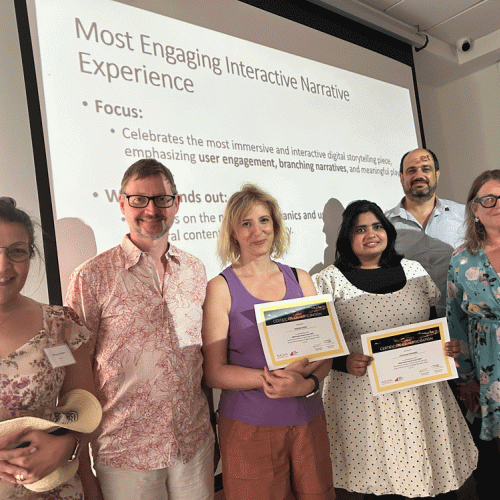
Meet the Game Programming lecturer at the cutting edge of interactive design
Anjuman Shaheen, Lecturer in Game Programming MSc, has completed an intensive summer school in Malta that explores the advancement of narrative video games, interactive video, artistic installations, XR and other emerging forms. Now, Anjuman is bringing the knowledge she learned in this insightful workshop to her practice as a lecturer at Falmouth.
Read more
How you'll learn & be assessed
With regularly timetabled support sessions from our course team and access to our studio throughout, you’ll be able to produce games to a high standard, learning to collaborate effectively as a member of a game development team as well as to conduct cutting-edge research and development. You'll learn through:
- Demonstrations
- Studio practice
- Project supervision
- Lectures
- Seminars
- Practical workshops
- Crit sessions
- Tutorials
- Guest speakers
- Mentoring
Assessment is 100% coursework, with the learning situated in an environment that mirrors industry, helping to prepare you for what it’s like in a real game studio.
Assessments are composed of practical activities underpinned by critical analyses of the workflows and practices applied in the module to further support your learning.
Module leaders, supervisors and technicians will guide and support you through your assessments to enhance your relevant technical and academic skillsets.
Facilities
Our facilities range from:
- Modern i7 machines
- Specialised computing hardware for deep learning projects
- Standard software used in the games industry, including Adobe and Autodesk suites
- Access to free software
- Access to AR/VR technologies

Virtual tour
Discover where you’ll spend your time as a student with our 360° tour, showcasing our facilities, accommodation, town and scenery.

Meet the team
The Game Programming course is part of Falmouth’s Games Academy, one of the largest dedicated game development studio spaces of any UK university. You'll learn from industry experts with years of experience across game development disciplines.

Dr Michael Scott
Head of Computing and Associate Professor of Computer Science Education
Dr Michael Scott is the Head of Computing and Associate Professor of Computer Science Educ...
Dr Joseph Walton-Rivers
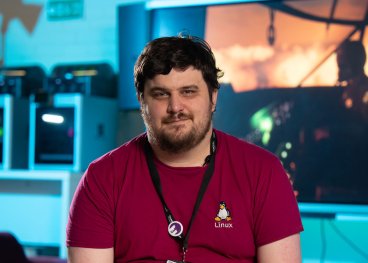
Course Leader: Computing
Joseph Walton-Rivers is the Course Leader for Computing within the Games Academy. He joined the univ...

Brian McDonald
Head of Games & Head of Games Incubation
Brian McDonald is Head of Games and the Games Incubator Programme at Falmouth University. Brian h...

Dr John Speakman
Lecturer
Dr John Speakman is a Lecturer with the Games Academy. He joined Falmouth University in May 2016, to...

Matt Watkins
Lecturer in Computing
Matt is an artist, lecturer, developer and designer. He has been responsible for the visual and tech...

Tim Phillips
Lecturer
Tim joined Falmouth University in 2018 as a game designer in the computational creativity research g...

Andy Smith
Technical Manager/Technical Tutor
Andy joined Falmouth University in 2013 after completing his undergraduate studies in Communication ...
Warwick New
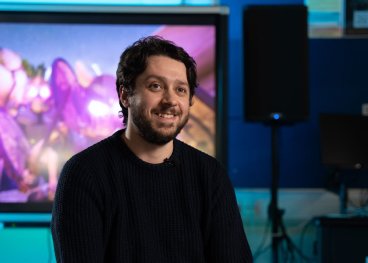
Lecturer: Software Engineering
I'm a Software Engineering Lecturer and PhD Student with a background in DevOps and Web Development ...

Dr Anjuman Shaheen
Lecturer, Game Programming MSc
Dr Anjuman Shaheen (she/her) is a Lecturer in Game Programming at Falmouth University, specialising ...
Some members of staff only teach on specific modules, and your course might not feature every staff member who teaches on the course.
Careers
As a graduate of this Game Programming master’s course, your career could progress into roles such as:
- Game / Gameplay Programmer
- Tools Programmer
- Game Designer
- Systems Designer
- AI Programmer
- Software Developer
- Technical Director
- Entrepreneur
- Researcher / Further study
This Game Programming master’s will also give you the opportunity to tap into our industry connections and insights; several of our graduates have seen great success with the UK Games Fund and founding their own indie game studios, through career support from our Employability Service.
Today’s creative industries are thriving and diverse. Discover the Falmouth graduates whose lives have been shaped by their creativity, explore where a degree at Falmouth could take you and learn about our Employability service.

Fees, costs & funding
Tuition fees
£10,950 per year – full-time UK (£250 acceptance fee payable. This is deducted from tuition fees)
£19,950 per year – full-time EU/international (£500-£2,500 acceptance fee payable depending upon your status. This is deducted from tuition fees)
£10,950 per year – full-time UK (£250 acceptance fee payable. This is deducted from tuition fees)
£19,950 per year – full-time EU/international (£500-£2,500 acceptance fee payable depending upon your status. This is deducted from tuition fees)
Tuition fees for September 2028 will be confirmed in summer 2027.
Tuition fees are set annually. The University may therefore raise tuition fees in the second or subsequent years of a course, in line with inflation and/or the maximum permitted by law or UK Government policy. Students will be notified of any changes as soon as possible.
The figures above don't include accommodation and living costs.
Typical course costs
- The latest advice about which computers we recommend you buy for your course is available here: https://github.com/Falmouth-Games-Academy/ga-computer-advice#readme
- £30–£150 for a headset with a microphone
- £25–£100 for a webcam
- Internet access with at least 5Mbps speed to enable livestreaming of content
If you need to bring other equipment or materials with you, these will be outlined in your Welcome Letter.
Welcome to Game Programming MSc. Here you will find information about any pre-course preparation, as well as confirmation of your tuition fees together with any other costs that you might incur throughout your course that are not covered by your student loan.
Tuition fees
Tuition fees for postgraduate students starting in September 2027
Course equipment and costs
Essential
At Falmouth, you can use industry-standard computers and kit on campus, with some IT suites open 24 hours during teaching weeks.
The latest advice about which computers we recommend you buy for your course is available here: https://github.com/Falmouth-Games-Academy/ga-computer-advice#readme
If you have any questions or want us to check your setup, just get in touch with us on games.support@falmouth.ac.uk
Headset with Microphone
You will need a headset with a microphone for some classes. We recommend purchasing a high-quality headset for your comfort. Manufacturers such as Sennheiser, Razer, HyperX and Corsair are rated highly by our current students. These can cost between £30 - £150.
Webcam
You may need a webcam in some teaching. Manufacturers such as Logitech, Microsoft, and Razer are rated highly by our current students. These can cost between £25 - £100.
Internet Access
It is important that you secure sufficient access to the Internet as some materials are made available to you through our virtual learning environment. We recommend a fibre broadband connection if available, but a minimum of at least 5Mbps will be suitable for livestreaming content.
If you have further questions, need more detailed advice or would like us to check the suitability of a particular model, then please email: games.support@falmouth.ac.uk
Pre-course preparation
The course will primarily focus on developing your practical problem-solving and programming skills, alongside fundamental knowledge of agile project management, computer science, mathematics, and game engine architecture.
There will be considerable emphasis on the challenges and opportunities presented by game programming in the context of multidisciplinary studio-based development of digital games. It is anticipated that you are a confident programmer, or willing to rapidly upskill, and so the course will immediately focus on practical development skills and the implementation of relevant programming techniques.
However, you may not have used the programming languages and tools that are typically used in the games industry. As such, you are encouraged to familiarise yourself with C++ alongside several frameworks and engines prior to your arrival.
Some free online resources are:
C++: https://www.learncpp.com
SDL: https://lazyfoo.net/tutorials/SDL3/index.php
OpenGL: https://learnopengl.com/
Unreal Engine: docs.unrealengine.com/en-us/Resources
You are also encouraged to watch:
Computing: www.youtube.com/user/computerphile
Mathematics: www.youtube.com/user/numberphile
Game Maths: www.youtube.com/user/BSVino
The best way to learn a programming language or tool is to use it to make something. Therefore, you are strongly encouraged to devise and work on a project to hone your skills prior to your arrival. A suggested first project is to re-imagine a classic 1980s arcade game and implement it in C++. While you are doing this project, you can engage with our online community. Please join our Discord channel, introduce yourself, and show us your work-in-progress: https://link.falmouth.games/discord


Similar courses

Artificial Intelligence for Creative Practice MA
This master’s programme explores how emerging technologies can enhance and transform human creativ...

Indie Game Development MA (Online)
Become a confident and daring indie game developer, producing vibrant and engaging experiences for g...

Game Design MA
Are you passionate about games and keen to make them better? Do you feel curious about what makes a ...

Game Art MA
Are you an artist with a passion for games? Do you want to develop your skills to meet the challenge...

Artificial Intelligence for Games MSc
Break new ground in the application of AI for games. Do you want to explore the applications of...