Research Fellow shares how his practice critiques AI in new in-person and online exhibit
19 March 2026
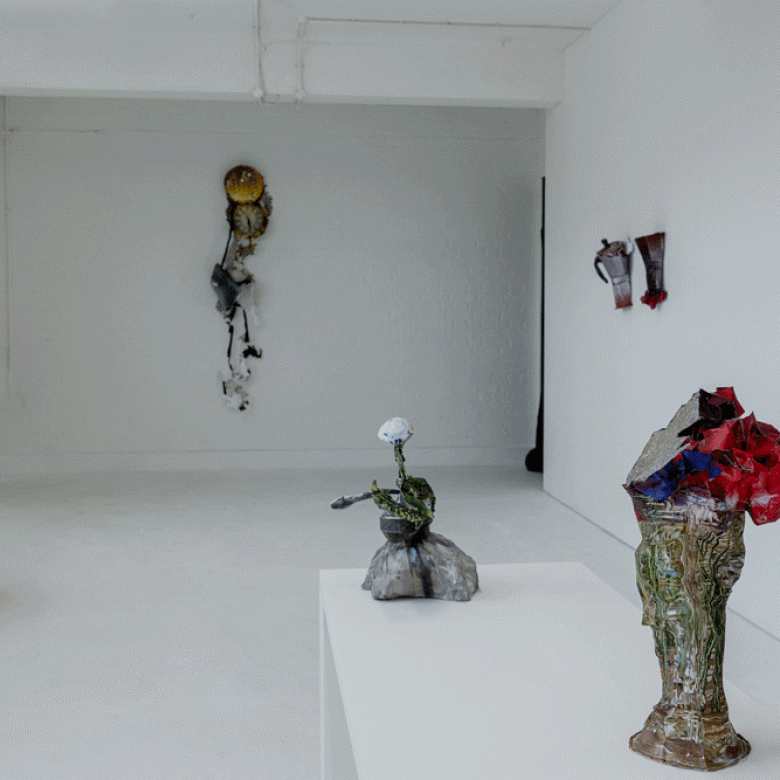
Dr Tom Milnes, a Research Fellow at Falmouth’s Centre for Blended Realities (CBR), focuses his practice on exploring the materiality of imagery and technology; engaging with the cultural impact of media through glitches, errors or hidden subcultures. Now, Tom brings his research and practice to Plymouth to curate an exhibition that critiques AI through practice in engaging ways.
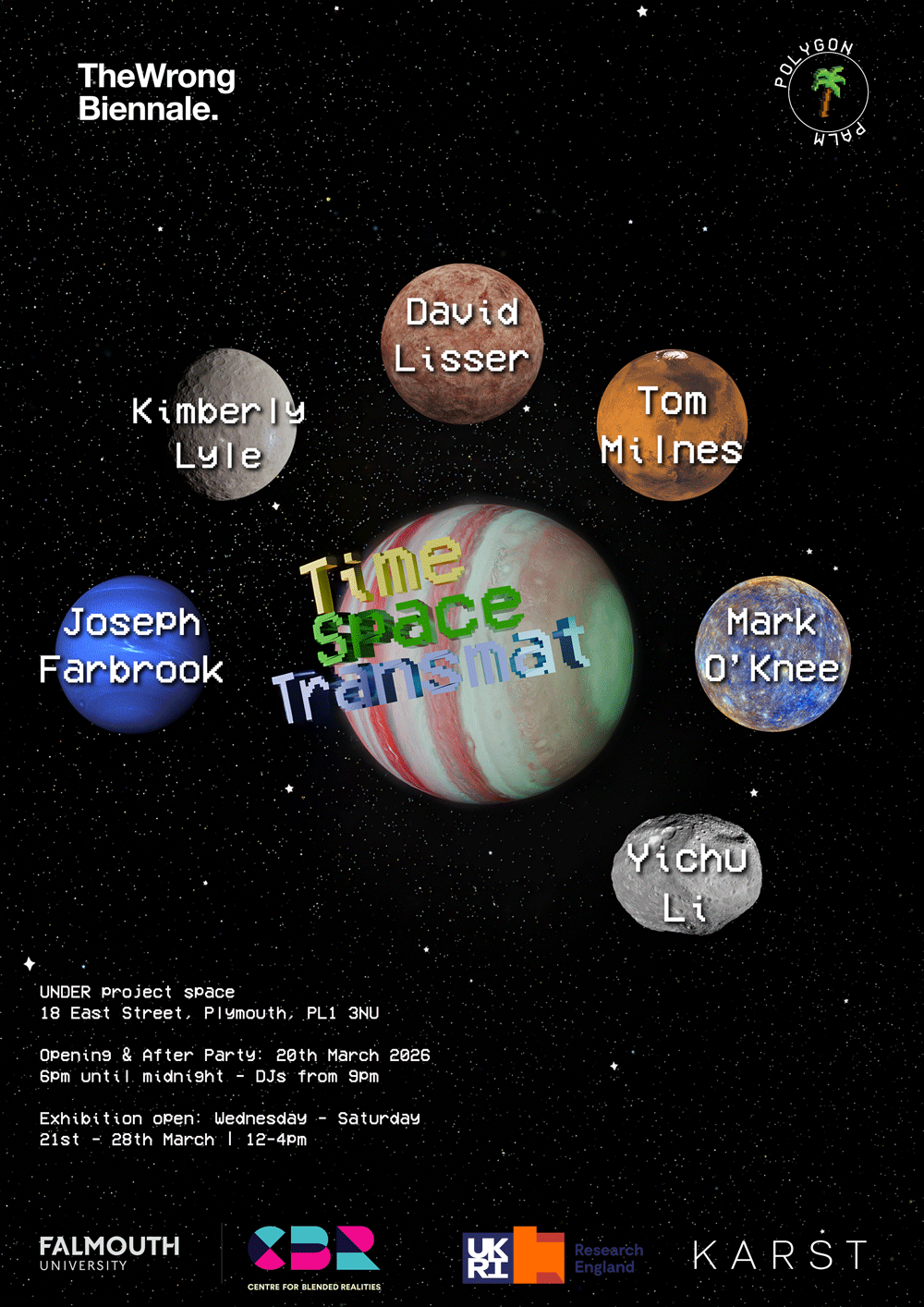
Named ‘Time. Space. Transmat’, the exhibition is set to open on Friday 20 March and will be running for just over a week. The exhibition takes place both online and in person, with its physical exhibit taking place at Plymouth’s UNDER Project Space and its online exhibit finding its home on the online platform, Polygon Palm.
We chatted with Tom to learn more about what to expect at the exhibition, his personal highlights and how he has engaged with AI in interesting ways within his curational practice.
Can you give us an overview of the exhibition you’ve curated?
The exhibition is called ‘Time. Space. Transmat’ and it's an experimental hybrid (online and in real life) exhibit that explores the unstable territories of translation, transportation and transmogrification in the networked age. The title is borrowed from Juan Atkins’ 1980s techno project, ‘Model 500’, and references teleportation and transmission through time and space.
Taking place on the world’s largest online biennale, TheWrongBiennale, the online exhibit shares digital artwork while speculating on the ways AI, digital systems and machine mediation fracture and reshape communication. The participating artists - Yichu Li, Kimberly Lyle, David Lisser, Joseph Farbrook, Mark O'Knee and myself - all respond to these themes through online works which have been generated and assembled with artificial intelligence. Each piece has been presented as a unique web environment within the Polygon Palm site.
The physical exhibition at UNDER Project Space in Plymouth questions what it means to transmit ideas, objects and selves across uncertain thresholds: from code to image, screen to object and immaterial networks to physical artefacts. Works within the exhibition emerge in states of mistranslation and remote manipulation, exploring the poetics of systems that are never fully under human control.
‘Time. Space. Transmat.’ examines contemporary concepts of movement and transformation, it explores how we relocate ideas, identities and matter across different realities and media. The artists exhibiting respond to the fluid boundaries between virtual and physical spaces, exploring how teleportation (instantaneous movement), transportation (physical and metaphorical journeys), and translation (interpreting and transposing meaning) are reshaped through technology and our understanding of presence and experience, particularly through computation and artificial intelligence systems.
Can you talk us through some of the highlights of the exhibition?
There are six artists exhibiting. I’ve been thinking recently about how to make our voice heard in an increasingly imposing digital environment, reflecting on Yuk Hui’s recent article about how AI generated knowledge will outweigh human knowledge. It made Kimberly Lyle’s work in the exhibition all the more poignant. In her work, Lyle asks what we might learn by asking human-centred technologies to speak in the language of other species or to see through their lens. Her project explores translation as a generative act, inputting birdsong into AI voice generators to produce hybrid voices that fall between species. These sounds expose the anthropocentric limits of AI while generating unfamiliar forms of expression.
Based on these ‘voices’, Lyle uses prompt image generators to imagine how animals might see their environments, drawing on differences in vision shaped by biology, such as limited colour ranges or an altered depth of field. Together, these sound and image pairings use mistranslation as an opening to perspectives beyond our own. For the exhibition at UNDER, Lyle will be inviting visitors to engage through a uniquely tactile way of listening.
In what ways have you engaged with AI in your work?
AI is generally a catch-all term for advanced algorithmic systems that may incorporate things like machine learning, computer vision or Large Language Models. In my own artwork and research practice I have examined how machine learning and computer vision has been developing in capture technologies, for example 3D scanning and photogrammetry. These systems are far from perfect, often struggling to capture plain, reflective, transparent or overly complex three-dimensional physical structures. My practice deliberately seeks to glitch these systems; in doing so revealing the materiality of the technologies inner processes and providing insight into its thinking.
I have created Augmented Reality, net art and sculptural projects that explore these methods. At a recent exhibition at StudioKIND, I created paper sculptures using techniques known as Pepakura, a hobbyist form of paper craft which takes 3D models and creates printable, flat nets of an object that can be cut, folded and stuck together to form 3D paper sculptures. I see these are a form of investigation into the increasing advance of computation into all of our images (not only AI generated) and finding ways to explore digital processes away from screen-based media is intriguing to me.
Who do you think would be interested in visiting the exhibition?
I think anyone who is interested in knowing more about how artists internationally are using the internet, technology and post-digital processes to make work that critiques our networked world. It’s not all digital work (which may be surprising) as there will be sound pieces, etching, sculpture and installations too. There will be live performances on the private view night, Friday 20 March, as the exhibit is partly inspired by a techno track of the same name.
Can you tell us more about the ways you’ve been working with the Centre for Blended Realities (CBR) at Falmouth?
My research explores the intersections of post-digital art, media archaeology and emerging technologies, with a focus on how digital tools reshape aesthetic experience, authorship and materiality. I’m particularly interested in post-internet practices, photogrammetry, glitch aesthetics and the evolving role of automation and machine vision within artistic production.
At CBR, I’ve been leading a series of workshops that explore glitch with 3D scanning. This expands my practice-based research, which investigates the creative and critical potential of errors, malfunctions and algorithmic processes. This is a methodology I developed during my PhD at Falmouth, where I investigated what I term ‘Spatially-Immersive Networked Composites’, an umbrella term for new, networked digital imagery such as 3D-scans, XR filters, Google Earth and memes. Through sculpture, 3D imaging and immersive installations, I explore how computational imaging and networked systems influence the way we perceive and construct visual culture.
With CBR, aside from developing experimental exhibition projects, I’ve been writing journal articles for Media-N and Visual Resources. I’m hoping at least a couple of these will be published this summer.
External links
You might also like

Research Fellow on artists using technology to reveal its flaws and problems

The MA Fine Art Online team explore 'thoughtful, generous and alive’ research-led teaching

Business course leader publishes book drawing on 20-years of research into local sustainability

Archives in Action: Heritage, culture and the power of memory through fashion
