Visual Effects graduate celebrated with Academy Award
15 May 2026
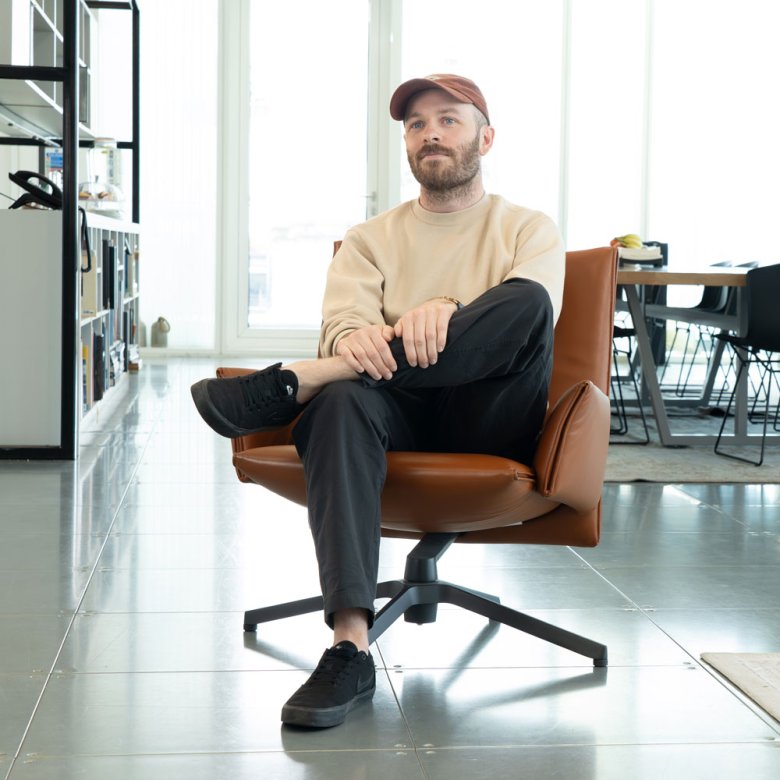
BA(Hons) Animation & Visual Effects graduate Josh Bainbridge has received a Scientific and Technical Academy Award for his work at Framestore, helping develop a layered shading system used across more than 100 film and television productions. The technology allows artists to create believable digital characters, environments and visual effects, and has contributed to films including Guardians of the Galaxy, Blade Runner 2049, Barbie, Wicked and Paddington in Peru.
We spoke to Josh about what went into the award, the challenge of creating invisible visual effects (VFX) and how his time at Falmouth helped shape the way he works.
Josh studied BA(Hons) Animation & Visual Effects at Falmouth, which has since separated into the BA(Hons) Animation and BA(Hons) Post Production & Visual Effects course.
Congratulations on your Academy Award! Can you tell us a bit about what the technology does and what it meant to you to receive that recognition?
Perhaps a good place to start is that this award recognises the technology and methodology used at Framestore to author the visual look of characters and environments for over 100 films and episodic shows. That's the broad picture.
Specifically, it is the toolbox that artists creating computer-generated imagery (CGI) employ to compose materials of digital assets, describing the visual identity of a surface. That could be the different features of a character, their skin, eyes and fur. For environments, think of something that looks weathered or affected by its environment, like the rusty hull of a ship in a storm.
Making these assets feel believable and tell a story means an artist thinking about what the material composition is, how that material is layered out of individual components. They need to express intent, like sweat on skin or frost over glass. Our shading technology provides the system for an artist to describe that intent and get a physically correct look as an outcome.
I should also add this award represents the work from so many people for over 15 years. It is as much for them as it is for us, and the collaboration between artists and technologists that makes this possible. Nathan Walster and I, colleagues and co-awardees, are just a small part of that. It feels surreal, to tell you the truth. And it means a lot to see the recognition for what everyone here has achieved.
Is there a particular project where you felt the technology really proved itself or surprised you with what it could achieve?
Seeing the work artists have on their screens as I'm walking by, I am often surprised. They really push what is possible with the technology.
Sometimes you'll see the look of a single character being made from hundreds of individual nodes. It can be genuinely mind-boggling to piece apart. But knowing what my team builds makes that possible, it is really special.
I was not at Framestore during the formative years when Guardians of the Galaxy first came out. It was just Nathan at that time. I joined the effort a year or two later. Since then, a classic example of layered shading that comes to mind is Blade Runner 2049. An interesting sequence in that film featured a planet of dust coating an old, abandoned city. You'll see a car land in a derelict building where the simulation of the dust, the effect on the car and even the beams from the headlights all need to come together in a realistic way.
Another example would be a shot from Paddington in Peru where the young bear is caught in the rapids of a river. It was great to see the layering of the water on top of the fur look so believable. In those shots, even though the viewer knows it is CG, you really want it to feel natural, and not take them out of the moment.
A recent film we worked on was F1. This required a lot of challenging invisible effects. From replacing and adding cars to changing weather systems, all of which makes the production possible. Starting with real reference footage of F1 races, we needed to match the footage exactly. Having CG elements match reality requires the complex layering of materials to be really accurate. In the end, with invisible effects, if we have done our job right you shouldn't see any trace of VFX in the final film.
You studied BA(Hons) Digital Animation & Visual Effects at Falmouth. What drew you to Falmouth in the first place, and what was it about the course that appealed to you?
Falmouth felt like a good place to grow and explore. It struck me as somewhere with a strong creative culture and a genuine connection with nature, which I really valued.
Being away from a big city, I think that did provide me space to think and focus.
The course itself taught a blend of creative and technical skills, a combination I was interested in. It also showed that artists worked very collaboratively, which was another way in which I wanted to work. It felt like a great fit.
Are there any parts of the course that you still use today?
The most important skill I've learned is communication. We build great things together, and communicating is at the core of that collaboration. Falmouth was a great place to take your first steps working this way. A safe space to try, sometimes fail and grow.
In my final year at Falmouth we worked towards a short animation. Having so many come together from across the course allowed us to really think about the process. We wanted a stylistic look, and so it was my first opportunity to write the underlying shaders we would use to get that look. This was a bit unorthodox for a student film. But it really paid off. From then on it was clear this was an area I enjoyed, a sort of cross-section of science and art.
How important has collaboration been to the way you work, and how did Falmouth prepare you for that?
Being a superstar, whether that be an amazing artist or a brilliant scientist, will only take you so far. It needs people to work together. And crucially, those people need different talents and strengths. Today, a lot of my work is around supporting that collaboration, that cross-section of art and science.
Falmouth is a place of diversity. I found even within a single course, there was a brilliant array of skills. From those that knew production and how to keep things on track, to the techies making the tools, all the way to dedicated and passionate animators bringing it all to life.
Being at Falmouth has definitely shaped the way I work, and was the stepping stone needed to get me onto the next chapter.

You might also like

Meet the Drawing graduate nominated for the New Blood Emerging Art Prize

Acting alumna on forging a creative practice that's entirely your own

Product Design graduate on being shortlisted for award and having her work discussed with Queen Camilla

Music alumna on why she chose Falmouth, the creative cycle and releasing her new EP
