
Architectural Design & Technology BA(Hons)
Harness technology to shape remarkable built environments.
Course overview
Architecture mirrors the world around us: it’s a built record of human ingenuity. In today’s era of rapid global change, technology can empower architects to be a creative, positive influence on our built heritage.
On this hands-on, technology-focused course, you will learn to do just that. You will fuse creative design-led thinking and construction technology with a strong focus on digital workflows and environmental performance to positively impact the future of architecture.
You’ll develop the skills required to simulate, model, design and test architectural technologies through real-life design challenges – both in your studies and on site at a collaborative building project. You’ll also investigate how architectural design can create harmony between humans and their environments, while sharpening your research and technical analysis skills.
Working in a professional studio setting, you’ll collaborate with BA (Hons) Architecture students and peers across the University, gaining first-hand insight into the different roles and perspectives within the design process. Together, you’ll develop a creative and critical perspective on built environments and discover how technology is essential to shaping them.
Choosing between a three-year course and a four-year course with a professional placement, you will engage with industry through project-based learning, preparing you for an exciting career supporting architectural and design-led practices through technical and digital expertise.
Why study this course at Falmouth?
- Benefit from state-of-the-art technical facilities, including a new design and manufacturing studio, to support your design development and digital and physical modelling.
- Have the opportunity to work with specialists and tackle real-life, industry-informed briefs, and gain hands-on experience before you graduate.
- Work in collaborative design studios with access to making, printing and digital technical workshops.
- Draw inspiration from Cornwall’s unique coastal landscape, geology, regeneration, and changing built environments.
Designed in line with professional and national education standards, this programme is built to support your future career in architectural technology. We expect to make a formal submission for CIAT Accreditation (Chartered Institute of Architectural Technologists) in academic year 2027/28.
Course details
This Architectural Design & Technology course focuses on project-based learning, with a collaborative live project in the first year connecting you with real-world challenges, client engagement and making from the outset.
You will develop a comprehensive understanding of building information modelling (BIM) alongside integrated environmental solutions (IES) enabling you to approach design with both precision and sustainability in mind.
Access to industry-standard and essential digital tools, including CAD and immersive technologies, supports the development of practical and highly relevant skills used to design, model and develop buildings. Combining design thinking with technical problem-solving, you will learn to translate concepts into effective, buildable solutions.
Where you will learn
You will spend the majority of your time studying on our Penryn campus, in industry-centered facilities, or out on site during Practice modules visiting live building projects. During the programme there will also be exciting practical build projects in collaboration with BA(Hons) Architecture students that will take place on our Falmouth campus. Find out more about travelling between campuses.
Modules
In your first year, you will develop essential skills in spatial design, drawing, model making, CAD and introductory BIM. You will explore construction, materials, climate literacy, human comfort and the historical and global contexts that shape architectural design. A collaborative live project gives you the opportunity to apply learning in a real-world context while developing teamwork, making and professional awareness.
Design 1: Foundations of Spatial Design
Explore spatial design through drawing, model making and visual communication while developing a small-scale architectural project focused on structure, shelter and context.
Digital Skills 1: Communication
Develop foundational digital and visual communication skills for spatial design through drawing, CAD drafting, model making and digital presentation techniques.
Environment 1: Climate Literacy and Design Principles
Investigate sustainability, climate literacy and human comfort for architectural design while developing research skills through technical analysis.
Design Technology 1: Construction and Introductory Detailing
Examine building construction methods, structures, materials, regulatory frameworks and inclusive design considerations that inform architectural decision-making.
Digital Skills 2: Introductory Model Development
Develop applied CAD and BIM skills to support the creation, coordination and communication of digital building models within built-environment workflows.
Practice 1: Collaboration and Live Project
Take part in a collaborative live project involving client interaction, teamwork and hands-on making while developing an understanding of materials, construction processes, professional behaviours and roles within the design team.
In your second year, you will develop digital and technical skills through larger and more complex projects. You will explore adaptive reuse, construction systems and sustainable design strategies alongside BIM coordination, digital survey and modelling methods, visualisation and environmental analysis. Professional practice, collaboration and technical integration become increasingly important within project work.
Design 2: Adaptive Reuse
Develop integrated design proposals for housing or mixed-use projects while exploring surveying techniques, adaptive reuse, conservation contexts and technical communication.
Digital Skills 3: Model Development and Visualisation
Develop digital modelling and visualisation skills using survey information and site data while exploring immersive technologies and advanced rendering workflows.
Environment 2: Building Envelope and Performance
Explore climate impacts, mitigation and adaptation within a global context alongside sustainable construction systems, building services and environmental strategies through technical investigation, site visits and detailed digital representation.
Design Technology 2: Building Systems and Technical Detailing
Investigate more complex building systems, façade design, structures and technical detailing while applying environmental and regulatory analysis to building performance.
Digital Skills 4: Building Performance Analysis
Apply BIM workflows to integrate technical data into digital models, using environmental and analytical tools to evaluate building performance and inform design decision-making.
Practice 2: Professional Contexts and Employability
Apply knowledge of architectural practice systems by analysing ethics, law, procurement and project management to support technical and design decision-making and employment preparation.
You can choose to take an optional professional placement after your second year on a three-year programme.
You’ll be responsible for finding your own placement, with support from the Employability team.
Choosing this option will enhance your industry experience and skills while studying.
How you’ll study during your professional placement
You’ll spend time working in a professional context, as part of a business or organisation. This can be in one role, or up to three, and must be for a minimum of 24 weeks.
You’ll develop in-demand workplace skills, deepen your insight into industry and grow your network of contacts, all of which could help you get ahead in your career after graduation.
Throughout this year, you’ll develop a portfolio of work that includes critical self-reflection on what has been learned from the experience. You’ll be required to evidence your experiences, the skills you’ve learned and your professional growth.
In your final year, you will bring together design, digital, technical, environmental and professional learning through an integrated project. You will establish a project brief, progress the design through spatial coordination and project planning, investigate sustainable construction through independent research, and develop the project through detailed technical resolution and professional practice.
Design 3: Project Brief, Spatial Coordination and Project Planning
Develop a project brief through analysis of site, context and user needs and evolve the design through spatial coordination stages with associated project-planning strategies.
Environment 3: Sustainable Construction Research Report
Develop academic skills and inform your design processes through research into innovative materials, sustainable construction strategies and environmental design solutions within a global context.
Practice 3: Project Delivery and Professional Development
Develop professional knowledge relating to business practice, ethics, health and safety, procurement, contract administration and information management, while preparing for employment.
Design Technology 3: Integrated Technical Resolution
Complete a major integrated design project from design intent through technical design and BIM-based project documentation, demonstrating a well-resolved and professionally communicated design.
We regularly review course and module content to ensure our students receive a high-quality and rewarding academic experience. As such, there may be changes made to the curriculum which are not immediately reflected in the content displayed on our website. Optional modules may be updated to maintain the best experience. Any students or applicants affected will be informed of approved changes directly.
Stories from our community
Explore student projects, graduate successes, staff news and industry insights.

Product Design graduate on being shortlisted for award and having her work discussed with Queen Camilla
28 September 2026
“It’s a reminder that thoughtful, inclusive design has a place in the wider furniture world,” ...

Sustainable Product Design graduate on being shortlisted for the Engage2Innovate awards
21 September 2026
BA(Hons) Sustainable Product Design graduate Olly Brown has been shortlisted for the Engage2Innovate...

Turning a cinema into a communal living space on the Interior Architecture course | Degree Show Stories
04 September 2026
BA(Hons) Interior Architecture graduate Hannah Schmidt reimagined an old art deco cinema in Plymouth...

Designing micro-living apartments to help tackle homelessness | Degree Show Stories
04 September 2026
BA(Hons) Interior Architecture graduate Sholto Ross has spent the past year working on his final pro...

Architecture Senior Lecturer on co-creating public exhibition in France
14 August 2026
The Solastalgia Pavilions: Four Vanishing Plants is a recent exhibition that took place at Jardi...

Architecture students get hands-on in community live project
29 July 2026
First-year BA(Hons) Architecture students recently took on a live build community project with Brick...

Interior Design student scoops national award for ambitious second-year project
21 July 2026
For BA(Hons) Interior Design student Marea Tippetts, developing digital skills and having the space ...

Sustainable Product Design students create circular solutions to waste in live brief
07 May 2026
Second year BA(Hons) Sustainable Product Design students have recently been working with Lovat...

Architecture students present ideas on how to reimagine ruins
23 April 2026
Final year BA(Hons) Architecture students have been creating and presenting a collection of inspirin...

Sustainable Product Design students win funds to make locally sourced, eco-friendly chalk
17 April 2026
Two second year BA(Hons) Sustainable Product Design students have recently been awarded £3,000 as p...

Product design graduate on designing award-winning modular footwear
30 January 2026
BA(Hons) Sustainable Product Design graduate Ben Mancini has been recognised internationally after w...

Online Interior Design graduate wins final year project competition
30 January 2026
BA(Hons) Interior Design (Online) graduate Bri Riley-Moore drew on her professional background in we...

Meet the Falmouth graduate behind new pottery studio Out West
29 January 2026
Falmouth graduate Louis Domville-Musters is the multi-talented creative behind Out West Studio, a ne...

Falmouth University awarded £1.4m to power the future of creative design and manufacturing
18 November 2025
New state of the art design and advanced manufacturing facilities for students at Falmouth Universit...

Sustainable Product Design alumnus on material innovation and returning to campus to teach
13 November 2025
Charlie Ruck is a Sustainable Product Design BA(Hons) alumnus who is forging a multi-faceted career....
How you'll learn & be assessed
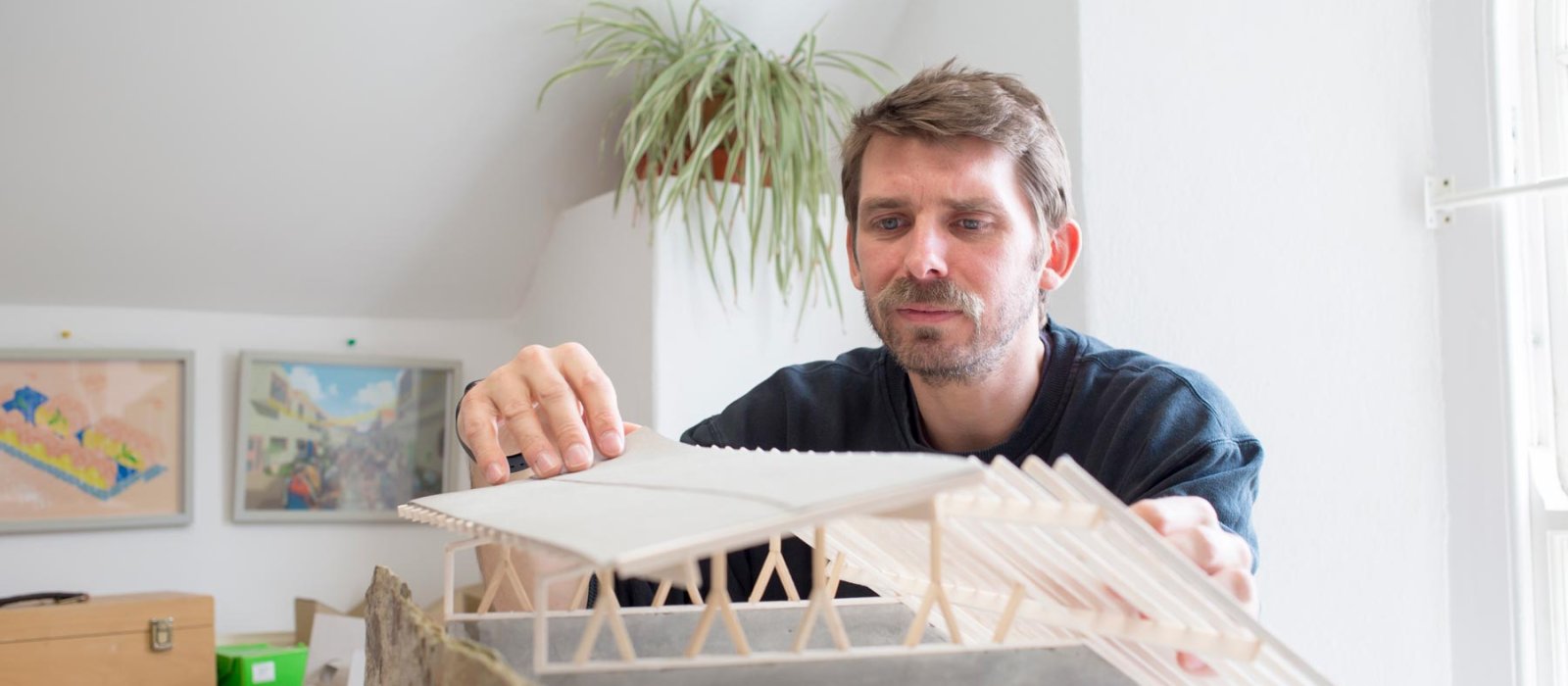
The course is delivered through a blend of lectures, seminars, tutorials, workshops and studio-based digital project work.
You will spend the majority of your time studying on our Penryn campus, in industry-centred facilities, or out on site during Practice modules visiting live building projects. During the programme there will also be exciting practical build projects in collaboration with BA(Hons) Architecture students that will take place on our Falmouth campus. Find out more about travelling between campuses.
Learning is structured around project-based learning, where students develop design and technical proposals in response to real-world and practice-informed briefs. A live project in the first year introduces industry engagement early in the course.
Teaching combines creative and technical approaches, supporting you to develop skills in research, drawing, digital modelling, environmental analysis, and critical evaluation.
The course emphasises digital workflows and methods, reflecting current and emerging practices within architectural design and construction technology.
Regular feedback, discussion, and review are embedded throughout, enabling you to refine your ideas, build confidence and develop a strong portfolio of digital work.
100% of your assessment will be coursework. Formative tutorials, workshops, interim reviews and peer discussion support the development of work before summative submission.
Assessment methods:
Portfolios, studio practice, learning journals, presentations, technical and professional reports, research reports and digital/computer-based project outputs.
Facilities
You will spend the majority of your time studying on our Penryn campus, in our new state-of-the-art Design & Advanced Manufacturing facilities or out on-site during Practice modules visiting live building projects. During the programme there will also be exciting practical build projects in collaboration with BA(Hons) Architecture students that will take place on our Falmouth campus. Find out more about travelling between campuses.
- Shared Studio space
- High spec CAD workstation suite
- 3D Lidar scanning equipment
- VR headset and design suite
- Point Cloud capture and analysis software
- Autodesk Revit software
- Library and journals

Art & Design Facilities
Primarily located at the Falmouth Campus in a subtropical garden, our studios and workshop facilitie...

Library Facilities
Offering extensive collections, our two libraries provide a wealth of digital resources, magazines, ...

Sports Centre
Our Sports Centre, on Penryn Campus, includes a spacious gym with up to 90 of the latest, new statio...

Virtual tour
Discover where you’ll spend your time as a student with our 360° tour, showcasing our facilities, accommodation, town and scenery.

Meet the team

Tanya Griffiths
Course Leader, Architecture BA(Hons)
Tanya Griffiths is a Chartered Architect with over 25 years practice experience working in senior an...

Laura Battersby
Lecturer, Architecture BA(Hons)
Laura is the Year 1 Lead on the BA Architecture course. She is responsible for organising the Year 1...

Janie Hinton
Lecturer in Architecture
I am a qualified architect, a member of the ARB and RIBA, and I have worked in practice for twenty y...
Some members of staff only teach on specific modules, and your course might not feature every staff member who teaches on the course.
Careers
After graduating from this course, you could become:
- Architectural Technologist
- BIM Coordinator or BIM Technician
- Architectural Assistant
- Technical Designer
- CAD Technician
- Design Coordinator
- Digital Modelling or Visualisation Specialist
- Construction Design Technician
Today’s creative industries are thriving and diverse. Discover the Falmouth graduates whose lives have been shaped by their creativity, explore where a degree at Falmouth could take you and learn about our Employability service.

Similar courses

Integrated Master’s Combined Arts MA (Online)
This Combined Arts online degree gives you the opportunity to explore a wide range of creative disci...

Interior Architecture BA(Hons)
Uncover the impact and potential of the spaces in which we work, rest and play, on this future-focus...

Interior Design BA(Hons) (Online)
Test the bounds of what's possible to achieve in interior spaces and develop the entrepreneurial kno...

Architecture BA(Hons)
Generate imaginative, impactful designs and start your future career on this highly creative, social...

Graphic Design BA(Hons)
Graphic Design is one of the most versatile visual disciplines, embracing words and pictures, form a...

Interior Design BA(Hons)
Delve into the world of built spaces, interior environments and the people who inhabit them. Through...

Textile Design BA(Hons)
On our textile design degree, you’ll be part of a vibrant, supportive community of multidisciplina...

Product Design BA(Hons)
Become a conscientious and innovative product designer with the professional practice skills to make...
