Centre for Blended Realities: exploring how human realities interact with a fast evolving world
29 April 2026
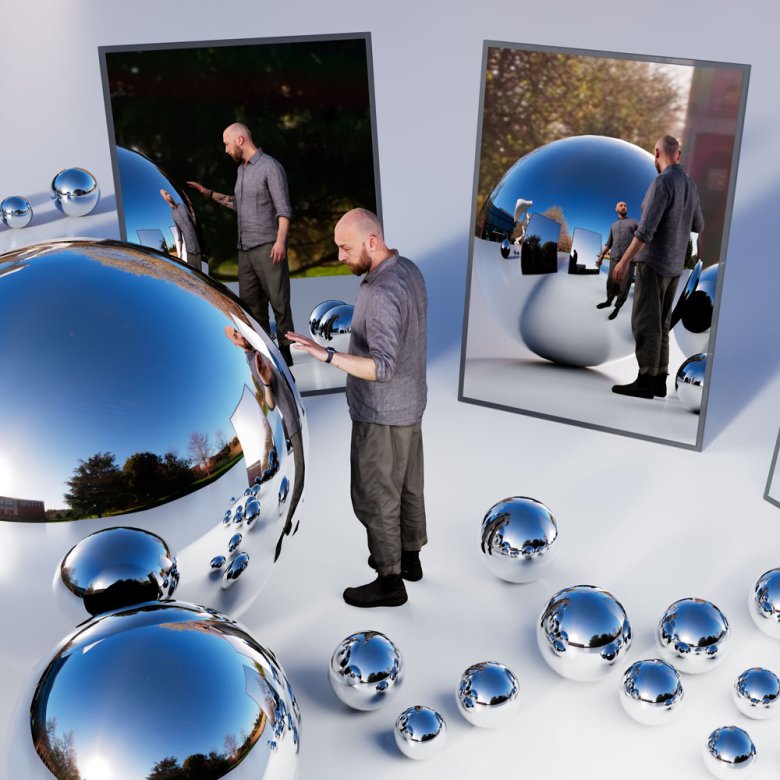
Much of the public conversation around technology and artificial intelligence begins with capability: what systems can do, how quickly they are improving, and where they might be applied.
It was within this context that Falmouth University received £7 million funding from the Expanding Excellence in England (E3) Research England programme for the Centre for Blended Realities (CBR) in January 2024. The Centre was established to support interdisciplinary, practice-led research that engages with emerging and convergent technologies, and to examine how they shape new forms of knowledge production and exchange.
At the time, technologies were accelerating faster than public understanding. Digital and physical lives were becoming increasingly entangled, while questions about who technology serves, and who it leaves behind, were raised briefly and then displaced by the next development.
Since then, those tensions have intensified. Artificial intelligence has entered everyday life at speed, immersive technologies have moved closer to the body, and the boundaries between online, embodied, ecological and social experience have become harder to disentangle.
New team, new realities
Late last year, CBR welcomed five new academics – Professor Hetty Blades, Dr Tom Milnes, Dr Teoma Naccarato, Professor Nick Peres and Professor Dylan Yamada-Rice, bringing backgrounds spanning fine art, healthcare, dance and education. They joined colleagues seconded to the Centre to undertake research that will inform teaching, knowledge exchange and wider engagement with external partners. The research and collating its impact is supported by Dr Lance Peng.
Although the Centre focuses on technology, its work does not begin with application or optimisation. Instead, it starts with people: bodies, lived experience, creativity and the question of who gets to shape how technologies are used, rather than simply adapting to them.
Rather than treating “realities” as abstract or purely technical constructs, researchers at CBR use the term in its plural sense to describe overlapping physical, digital, biological, environmental and social worlds.
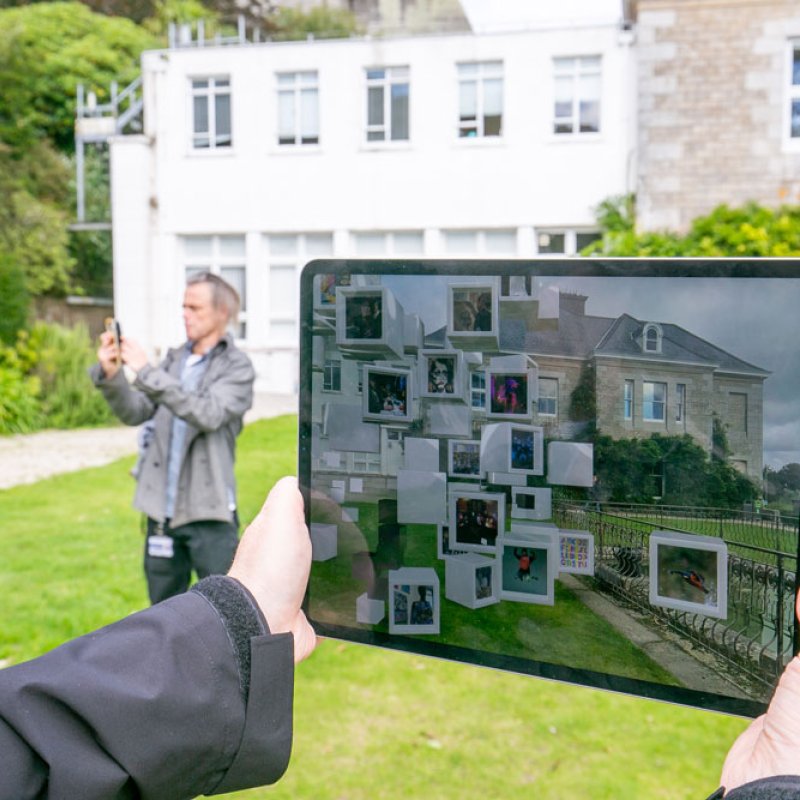
As Professor Lee Miller, Head of the Centre, explains: “When we talk about blend, it’s not just digital and physical technology. It’s an intersection of material, biological, environmental and more with them.”
In his work across the various projects within CBR and in his own research concerning exploring local drag practices and cyber-queer initiatives, Lance observes that the “blended aspect allows these realities to collide and interact in order to better understand each other. Applications in medicine, performance and digital archiving are reshaping our relationship to documentation and embodiment, which is a small window into how CBR’s ideas come to life.”
Giving voice to experience not just innovation
For Tom Milnes, technology increasingly exerts pressure on individuals, society and politics in ways that are poorly understood and is often “an imposition on individuals, society, politics that shapes how we live, that we do not understand and is not led by our needs or experiences.”
Research, in this framing, is not about celebrating innovation for its own sake, but about examining what kinds of futures are being designed, and for whom. “It’s about understanding something about technology,” he says, “or making people’s lives better through it.”
This expanded understanding of reality opens up space for research that is cultural and ethical as much as it is technical. Hetty Blades describes her work as a form of “critical reflection on technology,” particularly in response to the interactions between dance and technology. For her, ethical questions need to be addressed early, before tools become invisible infrastructures that shape behaviour without scrutiny.
For Teoma Naccarato, whose background is in dance and performance, this scrutiny is inseparable from the body. Her research focuses on “technologies that are in, on and around bodies and movement,” drawing attention to how sensing technologies, interfaces and systems intersect with physical presence and agency. In blended realities, the body is not a neutral user but a site where power, access and representation are negotiated.
A consistent theme across the Centre’s work is a commitment to amplifying voices that are often marginalised in technological decision-making. Rather than assuming expertise flows in one direction, CBR researchers emphasise listening, co-creation and participation. Milnes describes this as “allowing those voices to be heard,” particularly in communities more likely to be shaped by technology than to shape it.
This approach is evident in Dylan Yamada-Rice’s research with children, which challenges the assumption that young people are naïve or uncritical users of technology. “When you go into schools and talk to kids,” she says, “they’re very critical of stuff. They understand smart technologies are tracking them. They understand that their data is being collected.”
Rather than shielding children from technology, Yamada-Rice’s work often involves inviting them to dismantle and interrogate it. “I started to work with children to take apart technologies and hack them,” she explains, creating space for curiosity, experimentation and resistance. In this context, technology becomes something that can be questioned and reimagined, rather than simply consumed.
Technology beyond the commercial packaging
CBR’s outlook could be described as optimistic, but that optimism is not rooted in faith in technology itself. It rests instead on confidence in people’s capacity to question, repurpose and redirect it. Miller acknowledges how easily tools become captured by commercial or extractive uses, but argues that this capture is neither inevitable nor definitive. “Just because they’ve been packaged and branded in a certain way,” he says, “doesn’t mean that’s the end of the story.”
This is particularly the case with Nick Peres, who combines his role at Falmouth with working as Director of Digital Innovation and Transformation at Torbay and South Devon NHS Foundation Trust, where he co-leads the Digital Futures programme, and as XR technologies adviser for NHS England.
“Across health and care, whether that's a clinical setting, a community organisation, a care home or a creative programme, the tools being adopted are rarely shaped by the people who will live with them,” explains Nick. “The communities most likely to benefit are often the ones least likely to have had any influence over the design. What interests me is what happens at the edges, where creative practice meets care, where participatory approaches sit alongside clinical or community need, where something built in a studio ends up mattering in someone's everyday life.
The role of place
This perspective is closely tied to place. Cornwall, often framed as peripheral to technological innovation, has long been a site of creative experimentation. As Miller notes, “Cornwall has long since been a really vibrant place of creativity and the development of new technologies.” At Falmouth, that history is reflected in a legacy of making, critical art practice and technological curiosity.
“Boundary spaces are uncomfortable for institutions, but they're where the most useful things tend to happen,” Nick continues. “Cornwall gives us a particular opportunity to test that, and for a university rooted here, there is a real responsibility to make sure the work is genuinely in service of the communities around it.”
What emerges from CBR’s work is not a research agenda centred on speed, scale or solutions, but a set of questions that a creative university is particularly well placed to address: who technologies are for; how bodies, creativity and care are accounted for; how communities can work with technology rather than being acted upon by it; and how realities remain plural, contested and open to change.
In a rapidly evolving technological landscape, that commitment to holding space for human-first inquiry is less a position than a responsibility, and one that creative universities are uniquely equipped to sustain.
Image credits: 'considering digital narcissism' by Georg Finch (header image); 'digital for real' by Georg Finch
Further reading
Read more on How creative universities should respond to AI by Russell Crawford, Deputy Vice-Chancellor (Interim).
Read more from William Huber, who designed the Artificial Intelligence for Creative Practice MA.
You might also like

Quality of teaching keeps Falmouth’s Events and Tourism courses among the best in the country

Future Creatives Collective and Creative Competition return for 2027

Falmouth University announces appointment of next Vice-Chancellor and Chief Executive

Falmouth University honours four champions of Cornish and cultural identity with 2026 Honorary Awards
