How to create a professional illustration portfolio
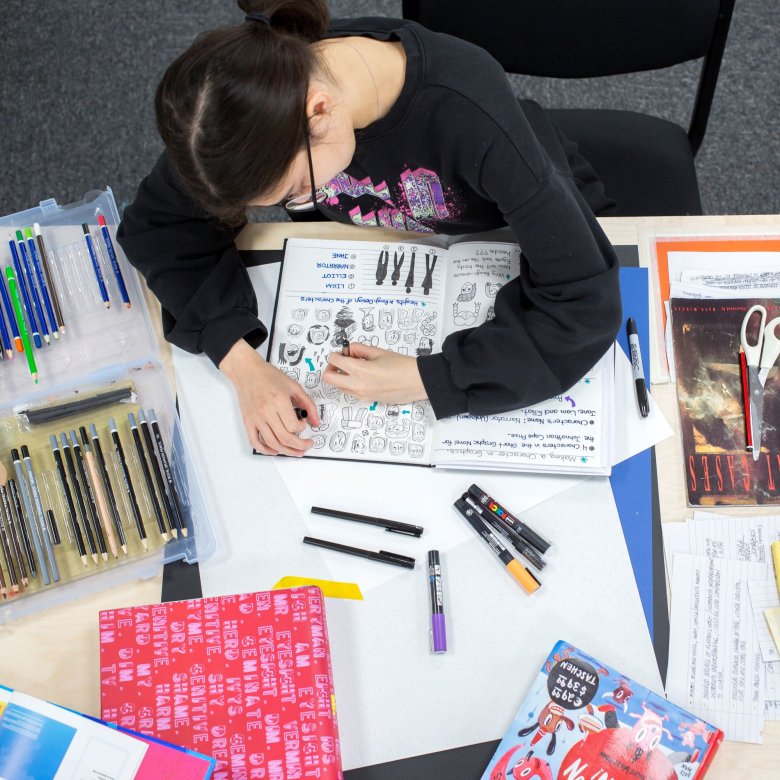
In this guide, Illustration BA(Hons) course leader Nigel Owen explains how to build an illustration portfolio that shows off your skills and creative process to potential employers.
A portfolio is more than a collection of your best drawings. It's the culmination of years of study and experimentation, and for many illustrators, it's the first real interface between their work and the industry. Whether you're pitching to art directors, applying for freelance briefs or putting together an application for further study, your portfolio does the talking before you get the chance to.
Why does your portfolio matter?
Your portfolio is an expression of everything you are as an illustrator.
It should give anyone looking at it – a client, an art director or an admissions tutor – a genuine sense of who you are as an artist and where you are in your development, not just proof that you can draw well.
Because of this, your portfolio should always be treated as a living project rather than a finished product. The version you show at 20 will look nothing like the one you show at 25, and that's exactly as it should be.
What should your portfolio say about your style?
Many illustrators come to their portfolio with a strong sense of who they think they are as an artist. In our experience, that rarely survives a genuine period of exploration – the style you arrive with is very often not the style you leave with, and that's a good thing.
Being open to different media and different approaches is a real asset. If you have a particular technical strength, show it off, but it's just as valuable to demonstrate range, and to include work where you visibly took a risk.
What work should you put in your portfolio?
You don't need to fill your portfolio with only your best work. Pick pieces you're genuinely confident talking about. You can even include the odd piece that didn't fully succeed, provided you've thought through why it didn't work and can explain that clearly.
You are the expert in the work you're showing, so don't include anything you can't speak to with confidence. Alongside finished pieces, include the process work that shows how you think: sketchbooks, mind maps, roughs and early experiments. Art directors are often just as interested in your process as your finished artwork.
Being able to talk about your own work, warts and all, says more about you as an illustrator than a portfolio of flawless pieces ever could.
How much work should you include?
How much you include depends on the context, but the aim is always the same: enough to tell a complete story about you as an illustrator, without overwhelming the person looking through it.
For a professional portfolio, a physical version is best kept to around 12 spreads – you could go as low as 8 to 10. Ideally, it should be possible to look through in around 20 minutes.
If you're building a portfolio specifically for a university application, the requirements are often a little different. You can read more in our guide to building a portfolio for illustration applications.
How should you organise your portfolio?
There should be a clear thread of you running through your portfolio – a story of who you are as an illustrator, not just an unordered set of images.
Open with your strongest piece, and close with your second strongest, so it's the thing that stays with someone after they've put your portfolio down. Anything weaker should sit around two-thirds of the way through, not at either end, and should be there for a reason – always have your explanation ready before anyone asks.
Should you have a physical or digital portfolio?
Ideally, both. Most illustrators now lead with a digital portfolio, but a physical version still has real value, particularly for in-person meetings, interviews and portfolio reviews with art directors or publishers.
No matter the format, think of your portfolio as a curated space that represents your identity as an illustrator, which you return to and refine, rather than a one-off document. Use platforms like Instagram and other social media as satellites that direct people back to this central portfolio, rather than replacing it altogether.
How do you promote your portfolio?
A great portfolio only helps your career if people actually see it. Share new work as you make it, rather than only when a project is finished, so people get a sense of you as a working illustrator, not just a finished-product machine.
Illustration fairs and open calls are worth taking seriously too – they're some of the more direct ways of putting your portfolio in front of art directors and publishers who are actively looking for new talent. And don't underestimate direct outreach: a short, personalised pitch with a link to your portfolio remains one of the most effective ways to get your work seen by the right person.
For more on breaking into the industry, our illustration career guide covers this in more depth.

How often should you update your portfolio?
Review your portfolio regularly – monthly is a good habit to build – swapping out weaker pieces as your stronger, more recent work comes through. Your portfolio should always reflect where you are now, not where you were a year ago.
It's also worth tailoring your portfolio to the specific opportunity in front of you. If you're pitching for editorial work, lead with editorial pieces; if you're applying to a course or an agency with a particular reputation, make sure the work you lead with reflects that.
What are the common portfolio mistakes to avoid?
Skip the pencil portraits of your pets. Leaning too heavily on secondary photographic reference is one of the most common mistakes – what we want to see is creative, imaginative drawing alongside observational drawing, and that observational work should stretch into a more organic approach rather than simply copying a photograph.
I don't mind a slick, tightly curated portfolio, but given the choice, I'll always favour a thoughtful, considered body of work over one that's simply neat.

About Nigel Owen
Nigel Owen is an illustrator and Falmouth University lecturer, whose editorial work has been published internationally across titles including The Guardian, the New Scientist and National Geographic. His practice spans digital and traditional media, and his research explores visual problem-solving in illustration. Find out more about Nigel's career by visiting his staff profile:
Read Nigel's profileOur Illustration courses

Illustration BA(Hons)
Become adept at problem solving and creating your visual language on this Illustration degree, renow...

Illustration: Authorial Practice MA
Develop your unique visual language on this studio-based Illustration MA. You’ll learn to see your...

Illustration BA(Hons) (Online)
Gain the professional practice and entrepreneurial skills needed to turn your talent into a successf...

Credit: Jonathan Scane
Illustration MA (Online)
Immerse yourself in the diverse and evolving world of contemporary illustration on this stimulating ...
You might also like

Creatives on Creatives: Denzil Forrester MBE and Duncan Cameron


How to build a career as an illustrator

Architecture students get hands-on in community live project
