Games Academy graduates help deliver BAFTA-winning Atomfall
08 May 2026
Three graduates from Falmouth University’s Games Academy have helped create the action survival game Atomfall, which went on to win best British game at the BAFTA Games Awards. Faith Hamill, Ross Everson and Chris Copeland now work across VFX, Animation and technical art at Rebellion, one of Europe's biggest independent multimedia studios.
We caught up with them to talk about building and refining the world of Atomfall – a project shaped by British landscape, culture and craft – and stepping into studio roles on a major release.
Faith Hamill, VFX Artist
Graduate of BA(Hons) Game Art
Atomfall was your first project at Rebellion and it won a BAFTA. How does it feel to have that as the starting point for your career?
It certainly feels like a high bar to beat! It's really wonderful to see the project receive so much success and recognition. For many of my colleagues it's a culmination of close to seven years of hard work, and it's become an IP that the entire company loves. I feel very lucky that I got to be in the right company at the right time. The game would be nothing without the talented people behind it, and I am so lucky that I get to continue working alongside my colleagues each day.
What were you responsible for on Atomfall and what were you most proud of?
When I first joined Rebellion as an intern, I was responsible for a lot of polish and set-dressing as I got used to the engine. It was a really great starting point for me, as I got to learn quickly what a finalised standard of work is at Rebellion.
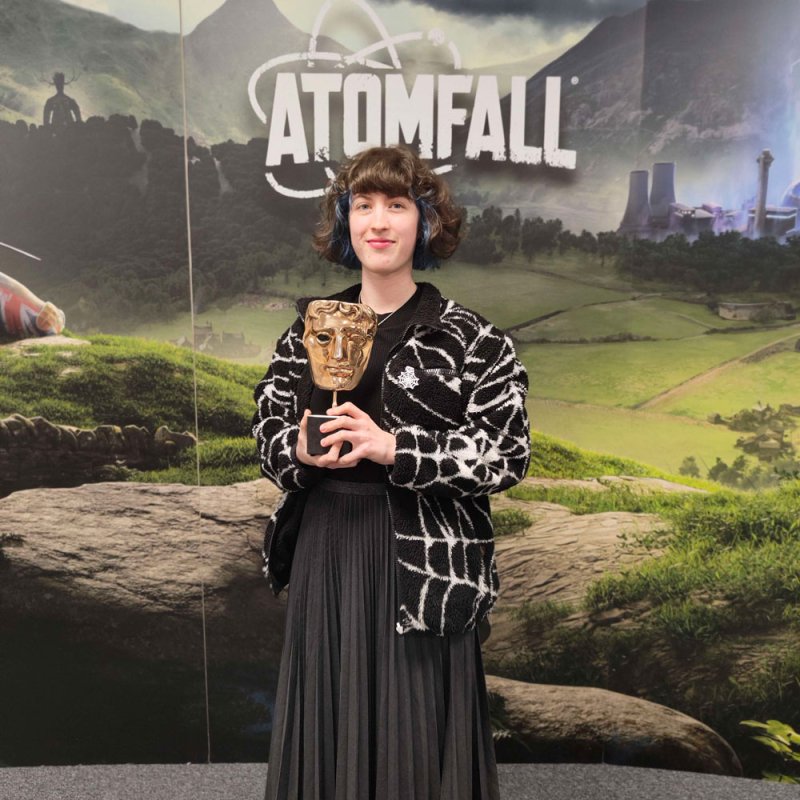
A slightly reduced team size moved on to work on Atomfall's first downloadable content (DLC), which is also when I became a junior and was trusted with implementing new VFX and optimising the game. The second DLC saw the team size shrink down again, which meant that the number of VFX artists on the project also decreased to two people splitting their time between projects, and myself as the only VFX artist fully on Atomfall! I was often trusted with entirely new features, as well as initiating communication between departments in meetings, and I'm immensely proud of what the team and I were able to accomplish in that time. Being trusted by the rest of my team to work so independently really helped grow my confidence, and that second DLC definitely shows off the work that I'm most proud of.
Looking back at your time on BA(Hons) Game Art at Falmouth, what parts of the course felt most relevant once you were working in a real studio?
So many of the skills I learnt on the course were transferable. Whether it's using Photoshop to mock up textures and concepts to other departments or using my modelling skills to create supplementary elements for VFX, I still use my studies, including the areas I didn't specialise in. The most valuable parts of the course, however, had to be the modules that focused on developing soft skills.
Falmouth's joint game projects are absolutely brilliant at letting students develop their teamwork and communication skills, and my learned knowledge of Agile principles and project management through version control software has been indispensable, and is actually really similar to how game projects are planned in industry.
Some of Faith's work on the game can be found in the video below. More can be found on their Artstation.
Ross Everson, Senior Animator
Graduate of BA(Hons) Game Animation and MSc Entrepreneurship
You were recently promoted to Senior Animator at Rebellion. What does stepping into that more senior role mean to you and how has your day-to-day work changed?
Stepping into the senior role means a lot to me for sure. I started in this industry five years ago, so it feels rewarding to have gone from a junior to a senior in that amount of time. I was always inspired by my seniors when I was starting out in the industry, so I just try to work hard and be as helpful as I can to the younger animators on the team to hopefully inspire them.
My role hasn't changed a huge amount really. You end up doing the senior work before you get the title. However, recently I have begun conducting interviews for my company. This is a fantastic bit of responsibility that I am very grateful to have the opportunity to do.
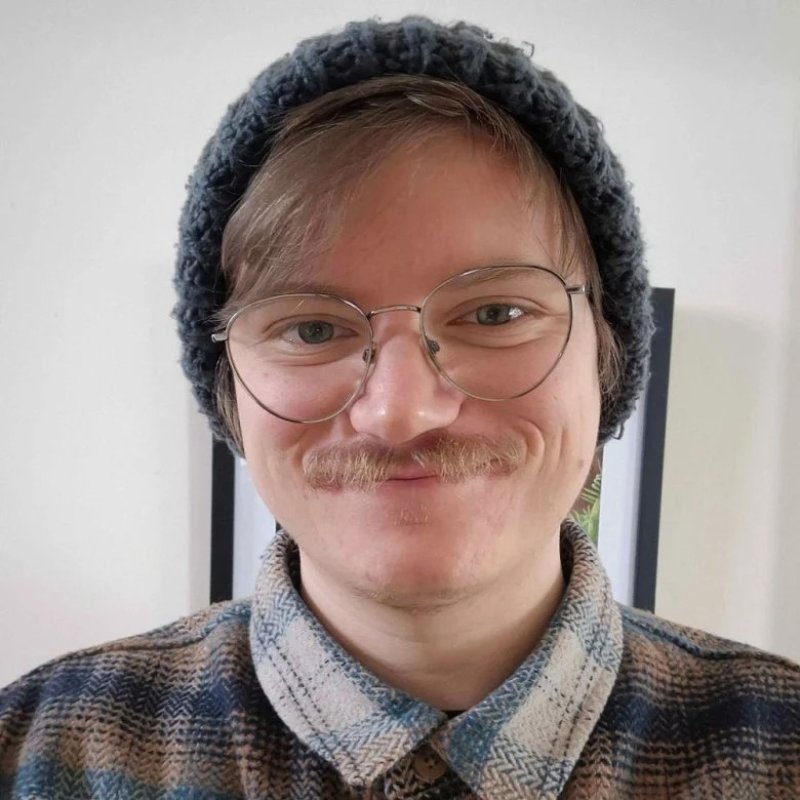
What does your work on Atomfall involve, and what were some of the challenges of bringing that world to life?
When I was brought onto Atomfall, I was told I would be working on the Ferals. These are the infected individuals you can find in various locations in the game. Due to my past experience on Warhammer, I had some practice in animating weird ghoul-like characters.
The biggest challenge with these Ferals was their proportions. The Character Art team did an amazing job with them but finding the right movements for them was definitely hard, especially the running animations. We did have motion capture on them to start with, but I decided a hand-keyed approach was much better for them. It took a lot of work to make them feel giant, scary and lethal without making them look goofy like a Scooby-Doo character. I am really proud of what we accomplished in the end.
After the main game launched, I was then moved onto Wicked Isle, the first expansion, to work on the Aquatic Ferals. I felt like I had a much better understanding of the character at that point, so I went all in on giving them some really fun leaping attacks. After that I briefly worked on Red Strain, the second expansion, where I gave the Red Ferals some new idles, runs and attacks.
What skills or approaches from your time at Falmouth do you still draw on now you're working in a professional studio environment?
Communication between disciplines. Honestly, it's something that the Falmouth University environment does well and it really helps in the workplace. Even though I have worked remotely for my whole career, I have worked hard on keeping lines of communication up with my colleagues via Slack, Teams or whatever software they use.
Falmouth's encouragement for us to communicate with the other disciplines on our team and across our course has helped me with collaboration throughout my whole career.
Some of Ross' work on the game can be found in the video below. More can be found on his Artstation.

Chris Copeland, Technical Artist
Graduate of BA(Hons) Game Development: Art
Atomfall is rooted in a very specific piece of British history and geography. What was the process like of translating real Cumbrian landscapes and culture into a game world?
Bringing Atomfall to life required a huge group effort from the team at Rebellion. I joined the company towards the end of the game's development, but I was still able to get hands-on with it. I know that to translate the stunning environments of the Lake District into the game world, Rebellion sent some of the team out on location to gather references and inspiration which was pretty cool. We have a fantastic Art Department and also have a great photogrammetry team, which means that we can literally scan real-world assets and bring them into the game which makes it even more authentic. Our Technical Art Department was then able to take these assets and create procedural tools to scatter them across levels, allowing artists to set dress large areas whilst still keeping them authentic to the Cumbrian landscape.
My main focus on Atomfall as a part of the Technical Art Department was assisting with the optimisation of the game. Amongst other things, we do sweeps of levels and identify assets, materials or even complex lighting that could be simplified, edited or removed to make the game run smoother on our target consoles. A lot of the time, this kind of work only gets noticed if it's done poorly, as players can be frustrated to play a game that is lagging or stuttering due to heavy GPU usage, and rightly so. The great thing about Atomfall was that there were quite a few mentions from reviewers about how well the game ran across multiple platforms, so I think the Tech Art team was proud of that.
What did your BA(Hons) Game Development: Art course at Falmouth give you that helped you land and hold your own in a professional studio role?
I think the main things that the BA(Hons) Game Development: Art course gave me were teamwork opportunities and freedom. The course was structured in a way that really suited me. A lot of the modules and briefs that I did during my time at Falmouth were very open-ended. This was great as it allowed me the freedom to experiment with different techniques and workflows which helped me decide what sort of role I wanted in the industry. I never felt like I was funnelled down a single path, and instead I had the opportunity to build a range of different skills that I think really help me in my current role as a Technical Artist.
Technical Art is known as a 'T-Shaped role'. I'm often having to communicate with colleagues from many different departments, work with them to develop tools, solve problems and be able to translate complex technical issues into a more easily digestible format.
I think working on the team-based modules at Falmouth definitely laid the foundation for this and really sharpened my ability to communicate effectively.
The opportunity I had at university to work with people from different specialisms to create a student game was incredibly valuable, and I think it directly contributed to getting me to where I am today.
Unfortunately, much of my work on the game was 'invisible', but the trailer for Alien Deathstorm (below) contains work that all three of us were involved in. Please note that this video contains some blood and gore.
You might also like

Games Programming graduates sign BELTFED publishing deal

Meet the Film alumnus producing a Cornish-language short film


Film graduate shortlisted at Young Arrows for shoestring skate campaign
