Research Fellow on artists using technology to reveal its flaws and problems
24 September 2026
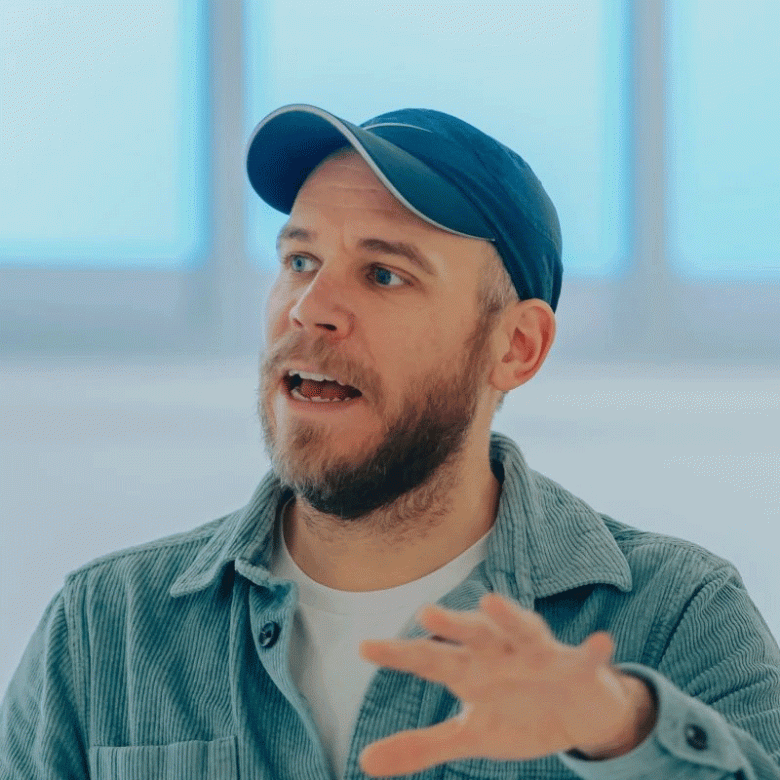
Dr Tom Milnes, a Research Fellow at Falmouth's Centre for Blended Realities, has built a practice out of glitches, errors and hidden subcultures, using the cracks in computational systems to reveal how they actually work.
Following his ‘Time. Space. Transmat’ exhibition last year, Tom was in Austria this summer talking about his latest research, which looks at Gaussian splatting, where he received an honourable mention during the conference awards.
But what exactly is Gaussian splatting? Splatting is a fast-growing form of 3D scanning behind the smooth, ‘reality capture’ imagery now spreading through games, architecture and extended reality.
Rather than the sparse dots and empty space produced by older scanning methods such as LiDAR, a Gaussian splat gives each captured point a coloured, faded orb, with its position and density calculated through probability rather than fixed by a single photograph. The result can look startlingly convincing.
But as Tom puts it, “it's no more real. It may look more real, but it's actually that there's a lot more processing to get that sort of very real look.”
That extra processing is where his research starts. Splats rely on the same infrastructure as AI: power, water, cooling and the minerals needed to build and run the hardware.
Tom describes this as extractive in two senses. It draws on the environment through its energy and resource demands, and it draws on people, such as their skills to construct something or the culture that feed into it. This is because the scans, and the data generated, feed back into training the systems further.
Rather than argue against the technology from a distance, Tom is drawn to artists who critique it through use. “Art and creative practice are incredibly powerful and proven ways of communicating complex issues. This process takes on another level when we can use the things we are critiquing to show someone the problems with technology like splatting or AI,” he says.
This summer, Tom took this perspective to the Expanded Conference 2026 (part of the Ars Electronica festival) held in Linz, Austria where he presented his paper, The Extractive Image-World. Within it, Tom highlights five artists and collectives who take the creative engagement approach, each finding a different way to turn scanning and volumetric imaging against its own claims of neutrality.
“None of the artists abandon the technology they're examining,” Tom told us. “Rather, they each use it to expose something it would rather keep hidden. I think it’s important for us as researchers and educators, and for those undertaking a creative education, that using a tool to unpick its own faults is a valid and increasingly necessary form of critique.”
The Artists
John Gerrard: plastic, oil and the ocean
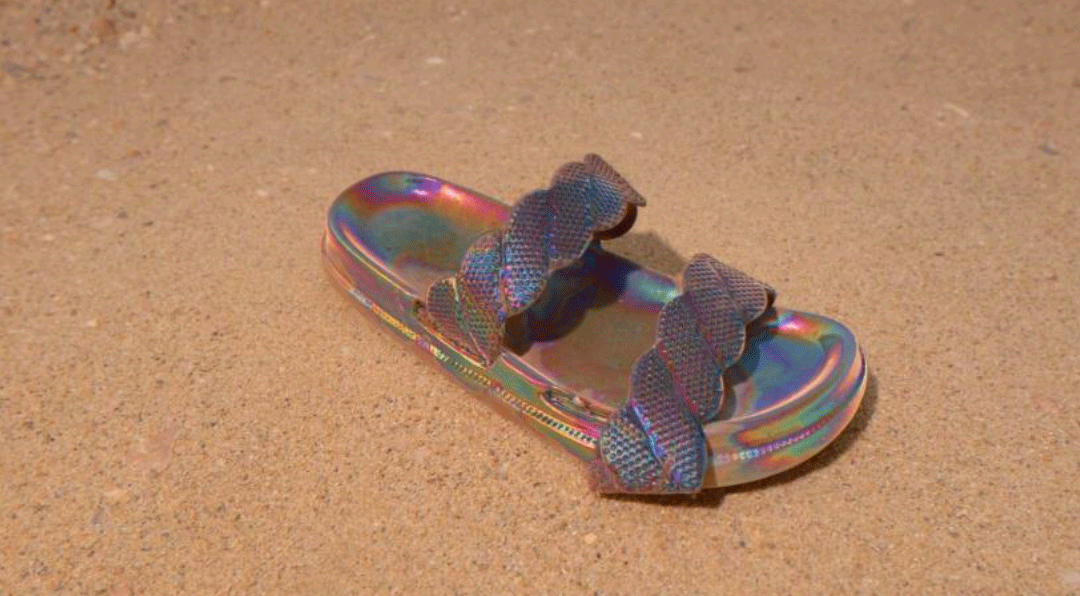
Presented by LACMA in Los Angeles, Gerrard's browser-based work, SPIRITS, scans discarded plastic sandals and shoes collected from beaches around the world, overlaid with oil slicks and ocean currents.
The piece ties the splat and therefore the art directly to a petrochemical history: plastic made from oil, worn as footwear, drifting through the ocean, then recaptured as a computational image running on servers and screens. It doesn't look to resolve the contradiction of using an energy-intensive medium to depict environmental damage, instead it situates itself within an uneasy critique and acts as a red flag of global trade.
Ars Electronica Futurelab: when the scanner shapes reality
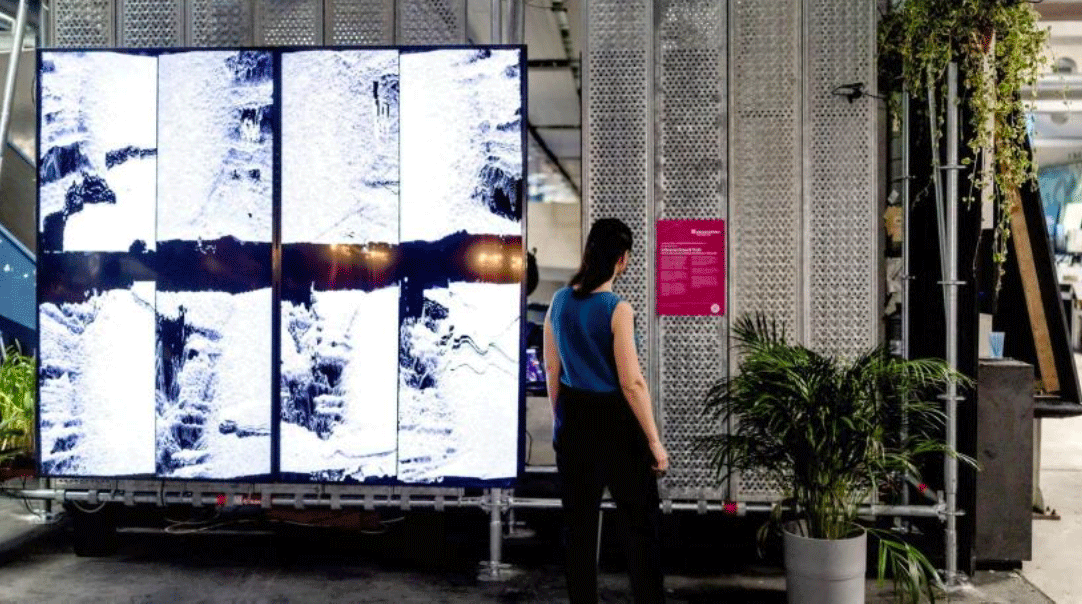
Inference Ground Truth, an installation from Ars Electronica Futurelab, uses Gaussian splatting to record traces of movement while questioning whether a scanner ever simply passively records reality, or actively influences the version of it we see.
In machine vision, ‘ground truth’ usually means the verified data a model is trained or tested against. The work instead treats ground truth as something negotiated through how the scanner is positioned, calibrated and rendered into a scene, not captured as a neutral fact.
ScanLAB Projects: the desert as witness
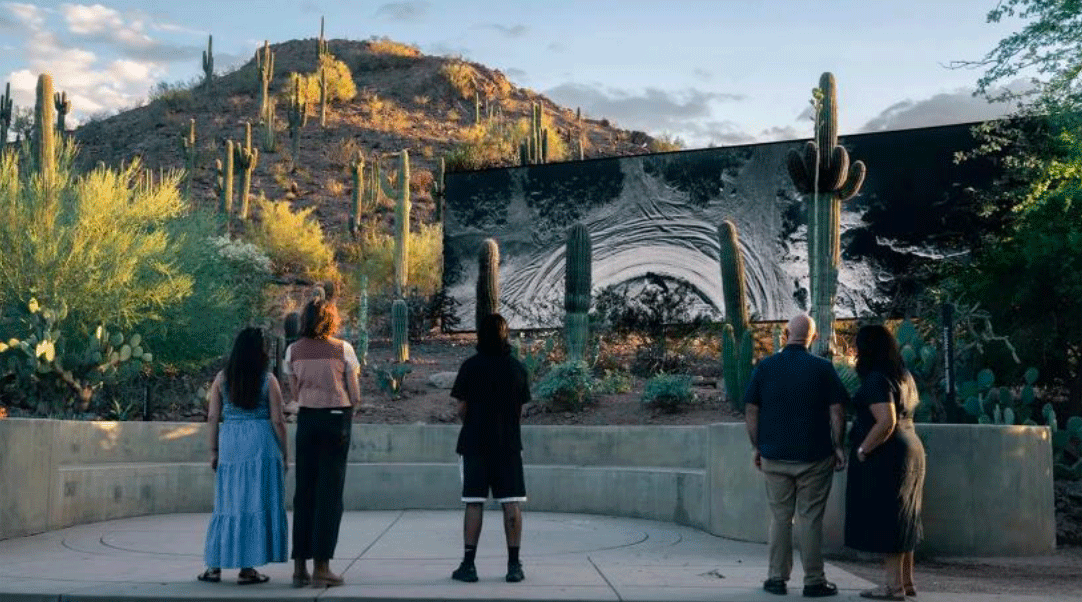
For FRAMERATE: Desert Pulse, made for Phoenix's Desert Botanical Garden, ScanLAB used LiDAR and time-lapse photogrammetry to track the Sonoran Desert as a living, changing environment.
Growth, bloom, decay, fire damage and sediment movement all become visible through the project's point clouds. The resulting work is a granular, sampled texture rather than a smooth environment flattened into an asset.
Forensic Architecture: evidence, not illusion
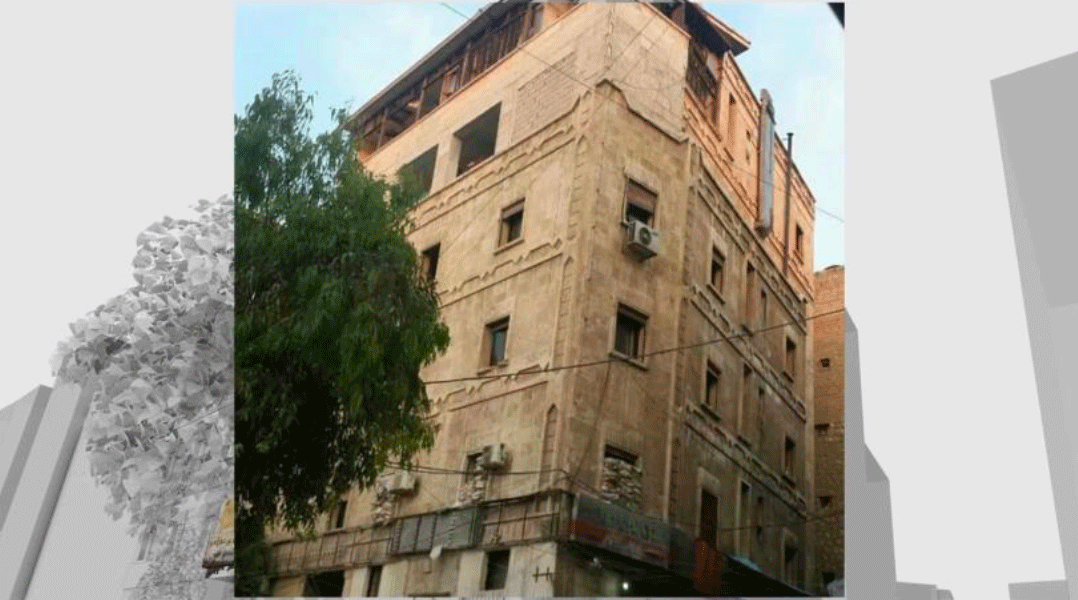
Forensic Architecture builds spatial reconstructions from photogrammetry and open-source video evidence to investigate state, corporate, military and environmental violence.
Their practice treats 3D reconstruction as a contested, evidentiary process, forcing it to disclose its sources, its gaps, its assumptions and its limits rather than presenting a smooth, total picture.
Morehshin Allahyari: who gets to scan
Allahyari's Material Speculation: ISIS, along with her wider work on digital colonialism, uses 3D scanning, modelling and printing to question the politics of preservation and ownership.
A scan can look like it rescues an object from destruction, but it can just as easily shift ownership away from the community or history it came from, into a platform, museum, archive or corporate database. Her work extends the argument beyond carbon and hardware.
Extraction becomes a question of who has the right to capture, store, own and circulate the data of cultural objects, and what gets hidden behind the language of preservation.
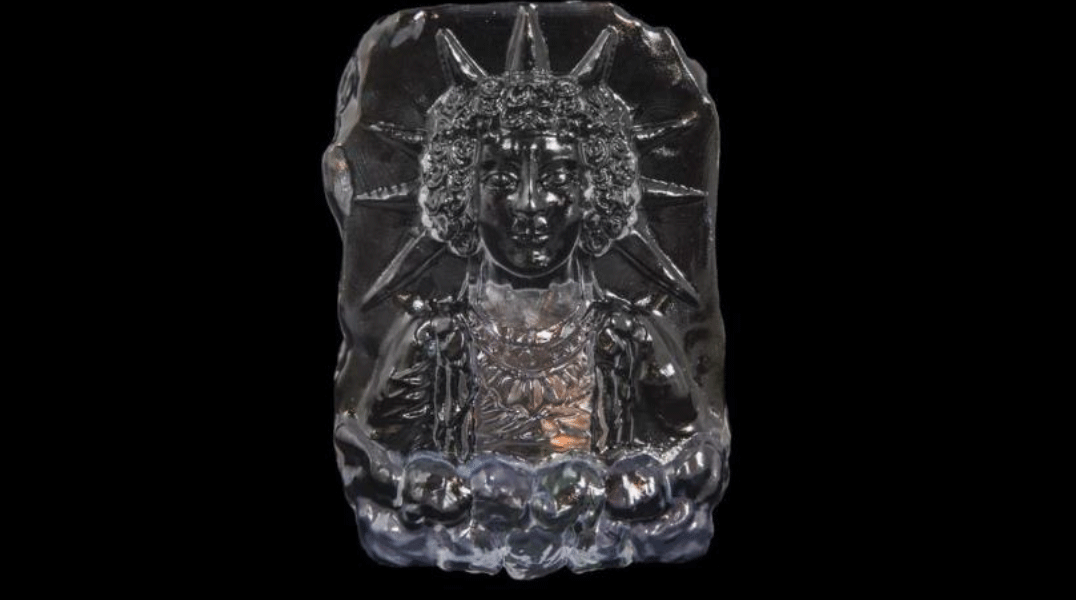
Image credit (top to bottom):
John Gerrard, SPIRITS, 2025. Browser-based artwork using high-resolution Gaussian splats of found plastic footwear. John Gerrard. Source: LACMA Unframed.
Ars Electronica Futurelab, Inference Ground Truth, 2025. Gaussian Splatting installation. Photo credit: Bettina Gangl / Ars Electronica Futurelab.
Rick White-Pickett. Source: ScanLAB Projects.
Forensic Architecture, Airstrikes on M2 Hospital, 2017. Source: project page.
Morehshin Allahyari, Maren, from Material Speculation: ISIS, 2015. Image courtesy of the artist. Source: Archinect.
You might also like

The MA Fine Art Online team explore 'thoughtful, generous and alive’ research-led teaching

Business course leader publishes book drawing on 20-years of research into local sustainability

Archives in Action: Heritage, culture and the power of memory through fashion

Game Development student to present research at conference
