Vice City and the world: how Grand Theft Auto holds a mirror to America
23 November 2026
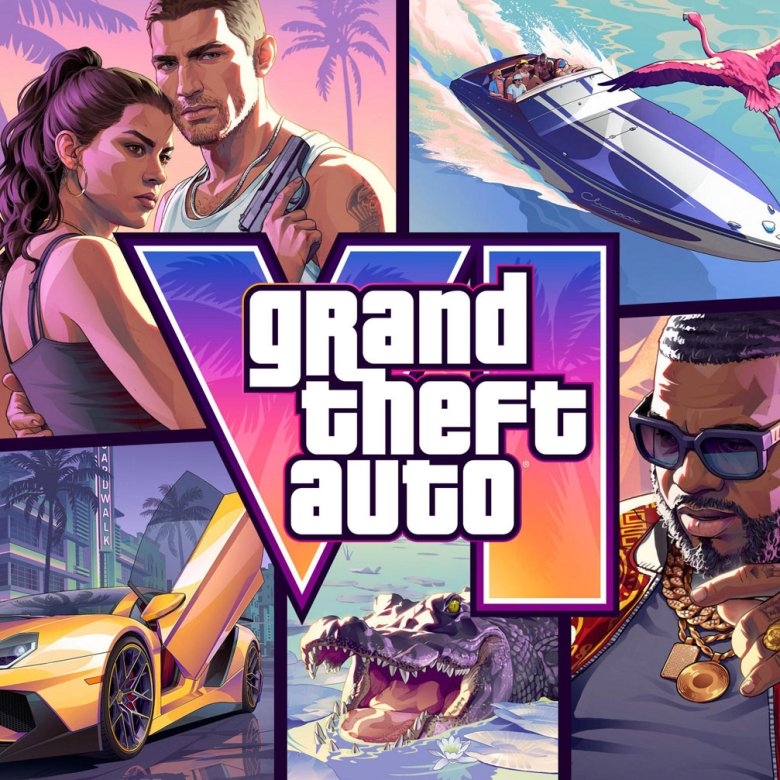
Vice City is back, and Associate Professor William Huber reflects on how the Grand Theft Auto (GTA) series raises questions about the global image of America, the role of the humanities in creative education, and what happens to satire when the target catches up with the caricature.
Dr Huber is a game studies researcher and the course leader for Falmouth University’s postgraduate programmes in game design, game art, computation, and artificial intelligence. He’s also a native Californian living in the UK.
America's image of itself
As players around the world return to GTA’s supercharged vision of American cities and regions - this time, back to Vice City and Leonida, its hyperbolic interpretation of Miami and Florida - I think of the game as being less the picture that the world has of America than a reflection of America's own image of itself.
Liberty City, San Andreas and Vice City are built from American cinema, television, music and talk radio. It's an exaggerated vision that America has been exporting to the rest of the world for well over a century. So although GTA’s production roots and some of its sensibilities are British, Americans still find it recognisable because they're seeing their own media, with the volume turned to eleven, reflected back at them.
There's a lot of precedent for this kind of reflection of America back to itself. It was French critics who named 'film noir'. Jules Dassin, blacklisted in Hollywood, went to Paris and made Rififi, an American heist film in French. Europe, and increasingly everyone else, has been reading America's image of itself back to it for nearly a century.
GTA is the latest and biggest turn of that loop. That turn is powered by a deep cultural literacy, from creators well versed in the histories of film and music.
A British sensibility
The series began at DMA Design in Dundee, and the original team was riffing on a rough-edged picture of Dundee as much as on anywhere American. GTA became 'about' America over time, and Sam and Dan Houser were central to that, eventually relocating to New York. Yet the tone retained much that was recognisably British. The fake adverts and radio phone-ins owe more to Spitting Image and Chris Morris than to Hollywood, and the distance affords the satiric licence to be sharper and less merciful in their aim.
The Housers grew up in London, the sons of Walter Houser, a solicitor, saxophonist and co-founder of Ronnie Scott's jazz club, and Geraldine Moffat, an actor best known as Glenda opposite Michael Caine in Get Carter. I am tempted to read GTA through that: boys raised on gritty, sardonic British gangster cinema, and around a club that was itself a London translation of American jazz, who went on to filter American forms through a British sensibility and sell them back across the Atlantic.
Tellingly, when they did take the series out of America in London 1969, still my own favourite GTA, they went home to exactly that era of British crime film.
Fun fact: the voice of antagonist Albert Crisp (the game’s stand-in for Ronnie Kray) was performed by John Berger, the late art critic, writer and producer of Ways of Seeing.
Why aesthetic and cultural literacy matters
Their background afforded them broad cultural literacy: fluency in film, music, genre and the aesthetics of place. GTA is successful largely because of this highly attuned sensibility about what to satirise and how to do it.
Most people don't grow up with that kind of literacy and cultivation, and the humanities should be where we teach it. I say this as the humanities are being cut across British universities, especially in creative education, which has pivoted largely to technical skills. If we want this kind of cutting insight to come from more than a handful of well-connected households, restoring the humanities to creative education is going to be important.
Who builds this America?
I'm not sure that 'American vs non-American' quite works as a way of thinking about the terroir of GTA. Rockstar is headquartered in New York and makes the games across studios in Scotland, England, Canada, India and the US. Like Hollywood, largely built by émigrés, it's a transnational production of a national myth.
That raises the pressing question of who gets to build this America, and on what terms. It's hard to ignore the irony of a series about chasing the American dream outside the rules being made partly by workers in Scotland who are now in an employment tribunal over whether they were fired for organising a union.
Two imagined Americas
I'd distinguish the real America from the America of the global imagination, and the imagined one has two halves. There's political America: the ally, the guarantor, the superpower in the news. And there's cultural America: the music, the cities, the cinema, the gunplay, the idea of 'freedom' as excess and disintegration. GTA doesn't have a foreign policy. Its America is entirely the second kind.
Those two imagined Americas now seem to be coming apart. Pew's survey this spring found China viewed more favourably than the US in most of the countries it polled, a first in two decades of tracking. Yet the year's biggest cultural event will be millions of people around the world choosing to spend weeks inside an American city. The world can lose faith in Washington and still want to live in Vice City. Dassin's story is an old version of this: political America expelled him, and cultural America went with him to Paris anyway.
I wonder what happens to satire when audiences no longer feel there's a stable 'normal' America for it to exaggerate. GTA's comedy relies on a gap between the image and the parody. If players abroad experience GTA VI's Leonida as less exaggerated than their news feeds, the game shifts caricature toward documentary, or at least confirmation.
For a huge share of its players outside the US, in cities like Lima, Lagos, Seoul and São Paulo, Liberty City, San Andreas and Vice City are the first North American cities they ever 'lived' in.
GTA doesn't merely reflect how the world imagines America. It produces that imagination, especially for newer generations.
Dr William Huber
Dr William Huber is the course leader for the BA(Hons) Game Development: Design, BA(Hons) Game Development: Writing, BA(Hons) Game Animation and BA(Hons) Esports and Livestreaming programmes.
An Associate Professor of Game Studies at Falmouth's Games Academy, Dr Huber’s teaching explores the creative and cultural dimensions of games. His research examines game aesthetics, authorship and the histories of play and digital media, shaping a critical understanding of games as cultural artefacts.
He has been a leading figure in the field for nearly two decades, serving as President of the Digital Games Research Association from 2017 to 2023 and contributing to international scholarship through numerous publications and keynote lectures. At Falmouth, he champions a studio-based approach to learning that connects theory, practice and experimentation, helping students develop as thoughtful, industry-ready creators.
You might also like

Falmouth academic leads new programme to unlock the safe and responsible use of AI for UK independent filmmakers

Falmouth Comedy Writers earn nominations at the Audio Production Awards 2026

Creatives on Creatives: Edward Rowe and Dr Kingsley Marshall

Mark Jenkin earns three nominations at the British Independent Film Awards
