Rewriting the Story of Metal
25 August 2026
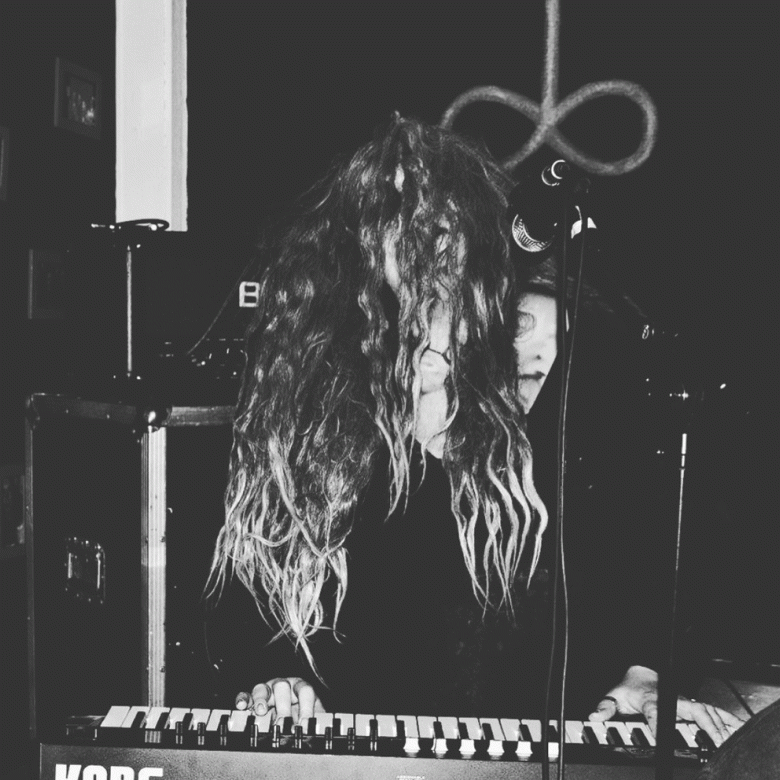
Metal music generates an image in the minds of people. Loud, outside the mainstream, lots of black and framed by how men create the music and experience the community.
It's an image that's persisted since its beginnings, but for BA(Hons) Popular Music lecturer Frankie Stevens and PhD Research (Online) student Rose Johnson, it’s not just the view of those outside the community, but from within as well. Rose and Frankie approach metal from different perspectives, but at the heart of their work is the idea of broadening the perspective of metal to include more than just men.
Rose's research for her PhD centres on queer and trans fans of the band Ghost, built from interviews with 113 people about why the band matters to them. Working from a feminist musicology perspective, Frankie argues for the “rescription” of women into metal's history, writing them back into the story they were always part of.
Rewriting who metal is for
Frankie, who lectures across Falmouth's undergraduate music degrees, is editor of Routledge’s new book Women and Femmes Voices in Metal Music, Culture, and Scholarship: Feminist Strategies of Resistance. Her argument is straightforward: women have shaped metal from the start, even when those writing metal's history has overlooked them.
“It's time we rewrote history, because that's what we’re doing in academia. We're entrusted with that huge responsibility,” Frankie says.
From her research on Ghost, Rose makes a related argument about how metal’s unhelpful obsession with subgenre boundaries effectively polices what is considered ‘real metal’. These boundaries, by design or accident, end up excluding the perspective and legitimacy of Ghost’s fans from the metal experience.
“If we expanded what metal could be, then look at all these cool things we could do, and the new audiences we could support,” Rose says.
Ghost as a gateway
A significant part of Rose's research looks at why Ghost specifically resonates so strongly with queer and trans fans. It found many of them grew up in evangelical households. For these fans, she's found, the band's theatrical Satanism reads less as shock value and more as a safer outlet, a way of pushing back against a heavily religious upbringing without the confrontational extremity found elsewhere in the genre.
“Ghost exists in this really interesting place where it has that heaviness to it, and that spirit of transgression and rebellion, Rose explains. “If you grew up on Top 40, or grew up listening to only praise music, it's like: ‘holy crap, music can be this?’”
That accessibility, she suggests, is part of what makes Ghost — who Frankie affectionally, and with Rose’s endorsement, describes as ‘black metal ABBA’ — a genuine gateway into heavier music for people who might otherwise never have found their way into metal at all.
Safety, and care in the community
In their conversation, Frankie and Rose return to the physical and social spaces metal frequently creates, exploring who gets to feel safe within them. Rose describes fans meeting each other through small signals, like spike heels worn in a mosh pit, or a pride pin spotted across a crowded venue that tells someone they're safe to approach if they need help finding the bathroom.
Frankie's earlier work traces something similar from a different angle. She's written about the informal subcultural spaces women find at metal shows, whether that's dancing rather than moshing, or gathering outside the main venue or in the loos to talk about metal and build friendships away from the crowd.
For fans navigating disability, agoraphobia or unfamiliar venues, Rose has found that these small, self-organised acts of care do a lot of the work that formal venue policy often doesn't.
The body, resilience and healing
Frankie's current research moves in a new direction, looking at how vocal techniques borrowed from metal and punk — screaming, shouting, distortion — might support what she calls “alternative femininities.”
“How do we unlearn this kind of quiet, submissive demeanour that essentialist femininity expects women to embody?” she asks.
Drawing on the concept of building up inner resilience over time, Frankie is interested in how metal's intensity might help people withstand the everyday erosion of microaggressions and hostility, without needing every setback to take a visible chunk out of who they are.
Rose sees a version of the same thing in her Ghost fans, many of whom describe finding a kind of strength reflected back at them in the music itself, a reminder that the version of themselves they're not always allowed to be elsewhere is welcome in this space.
A place for research that doesn't fit neatly
Metal studies isn't a department at Falmouth. It exists here like the practices of many students and academics: when creative interests and perspectives combine across disciplines. Drawing on Rose's ethnographic work with fan communities, on Frankie's musicology perspective on metal and feminism, and in the connections, both are building with wider fields like disability studies and horror studies.
Whatever the perspective, they personally draw on or draw into the conversation. Central to their work is a story about who gets to belong, and who gets to make that decision. And if those boundaries can be removed, that will empower those within the wider metal community to add a depth and richness to metal that the current male dominated framing doesn’t capture.
Rose and Frankie, in their different ways, are both trying to make that circle wider in metal’s fan and academic communities.
External links
Women and Femmes Voices in Metal Music, Culture, and Scholarship: Feminist Strategies of Resistance
Photo credit: SIVE Photography.
You might also like

Falmouth’s Film lecturers feature at Cornwall’s first Folk Horror Film Festival


Creatives on Creatives: Denzil Forrester MBE and Duncan Cameron

Quality of teaching keeps Falmouth’s Events and Tourism courses among the best in the country
