Why Ad Creatives Need to Learn to Play
16 October 2026
This article was written by Joel Ferguson, Course Leader for BA(Hons) Creative Advertising. Read Joel's thoughts on teaching the next generation to work in games, where players expect fun, not interruption.
Become a Game Creative
Games are no longer a niche pastime. Around half the country plays them, and game culture is now part of everyday life. This is a creative industry which is developing environments where people gather, play, compete, perform identity and participate in culture.
That cultural impact means the games industry is influencing what people expect from the brands around them. I’ve watched brands try to enter these spaces, some successfully and some not.
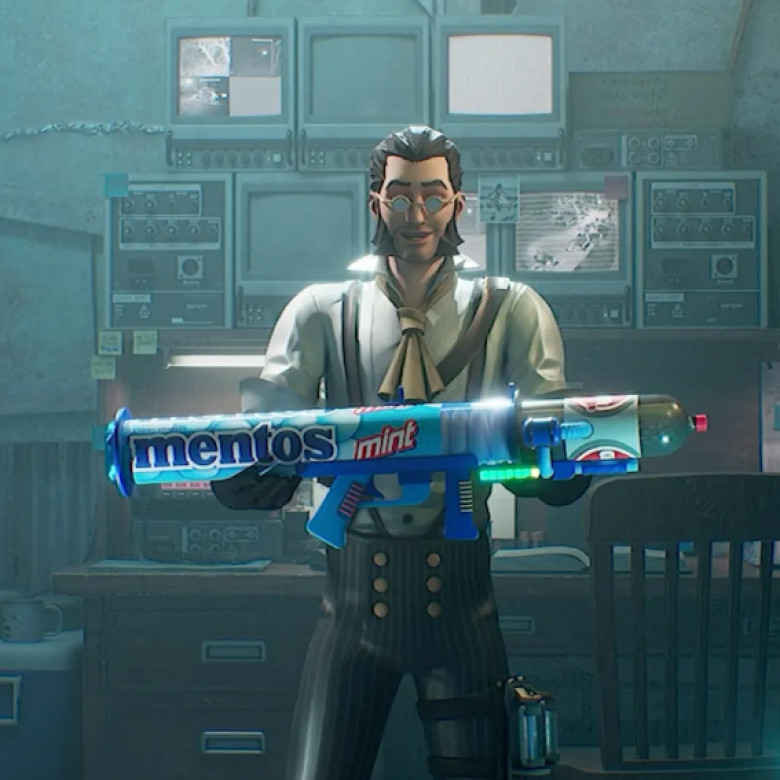
The Mentos Fizzooka and Wendy’s in Fortnite show what’s possible when a brand gives players something that belongs in the game. For our advertising students, that is a real opportunity, and one this piece sets out to explain.
Right now, most ad creatives don't have that grounding. That gap is an opportunity I want our students to fill, and it's why we've started teaching them to think like game creatives as well as ad creatives.
As a games designer and educator at Falmouth, I've become semi-obsessed with what happens when non-game brands intersect with game environments.
The Fizzooka had a meaningful impact on the way that Fortnite was played, built on real creative thought about how people generally tend to play the game, and how that gameplay loop can be disrupted. That's exactly the kind of thinking I want our students to leave Falmouth able to do.
The rise of agencies offering game integration can't be ignored. A recent addition to the roster is Parasol.gg, led by Ryan Norrington. Put that next to the scale of spaces like Roblox, Fortnite and Animal Crossing, and it becomes obvious that advertising, marketing and communications people need to change the way they think about games.
Is gaming just another media channel? Can it be treated the way we treat radio or TV? I don't think so.
As part of writing this, I had the opportunity to chat with Ryan about Parasol and about ads as games. "It's a completely different world now from when GTA 5 launched 10 years ago, because now you've got platforms like Fortnite and Roblox, which can create a lot more content than something like GTA Online ever could."
Unreal Engine 6
Ryan pointed to the upcoming launch of Unreal Engine 6 – the technology infrastructure that games are built on.
"Soon you'll be able to publish a game from Unreal Engine, put it onto Steam, put it onto PlayStation, but also you'd be able to put a version of it onto Fortnite as well."
For a brand, that means playable experiences that carry across multiple game titles, and players' hard-earned rewards and microtransactions coming with them to new games. Nike going from FIFA to GTA VI.
"I don't think there is really a development team out there that can create content at the same rate as just handing over the keys to their players," Ryan says, and that opening up of a game to its players is where brand partnerships and integration really flourish.
This is how the Fizzooka came to life, and where the ad creative fits into the mix.
Bringing Games into Advertising Education
We've made a concerted effort to add games into the curriculum of our advertising and marketing courses, and higher education needs to equip future professionals with the skills to excel in their fields. For three years Ryan has provided our students with amazing briefs, asking them to ideate, mock up and pitch integration ideas, or even entire brand-owned games.
We've had students with no prior game knowledge go from playing Dress to Impress on day one, to pitching a seasonal, roguelite Love Island game with live event tie-ins and a Boots integration, in under four weeks.
As Ryan says, it's about learning enough to get you about 60% of the way there. There'll always be a developer that will get you to 100%, but our students learn enough to be in the room and contributing.
Good Game Strategy
Games are a cultural space as much as a channel. These are places where people gather, play, compete, perform identity and participate in culture, and I'd hate to see in-game advertising fall under the umbrella of digital out-of-home. If you want to enter credibly, you must give players something that makes sense within the logic of that specific game.
Look at what the Helldivers 2 dev team did, honouring players' choice to save the children: an epic trolley problem that shows how much players want meaningful content that results in feel-good moments. Players largely hate advertising, and EA's ad pathway announcement didn't go down well, because gamers expect the worst from us.
"I'm not here to read stuff. I'm not here to look at stuff. I'm here to play something," Ryan says, and that's the shift ad creatives need to make.
I propose that we creatives own this space, as game strategists and game creatives, and it's what we're training our students to understand and become.
If the thing you make isn't fun, players will clock it immediately and leave. If it ignores the context of that specific game, it will feel like an intrusion rather than a contribution.
So the challenge to the industry and opportunity for the future advertising and marketing creatives is to also be game creatives and game strategists.
Oh, and if you get the chance to meet Ryan, ask him where the name 'Parasol' comes from. It's a great story.
External links
You might also like

Film & TV student on BAFTA scholarship and living with bipolar

Creatives on Creatives: Denzil Forrester MBE and Duncan Cameron

Quality of teaching keeps Falmouth’s Events and Tourism courses among the best in the country

Online Creative Writing lecturer wins Royal Society Trivedi Science Book Prize
