Game Design master's graduate on embracing AI in industry
19 August 2026
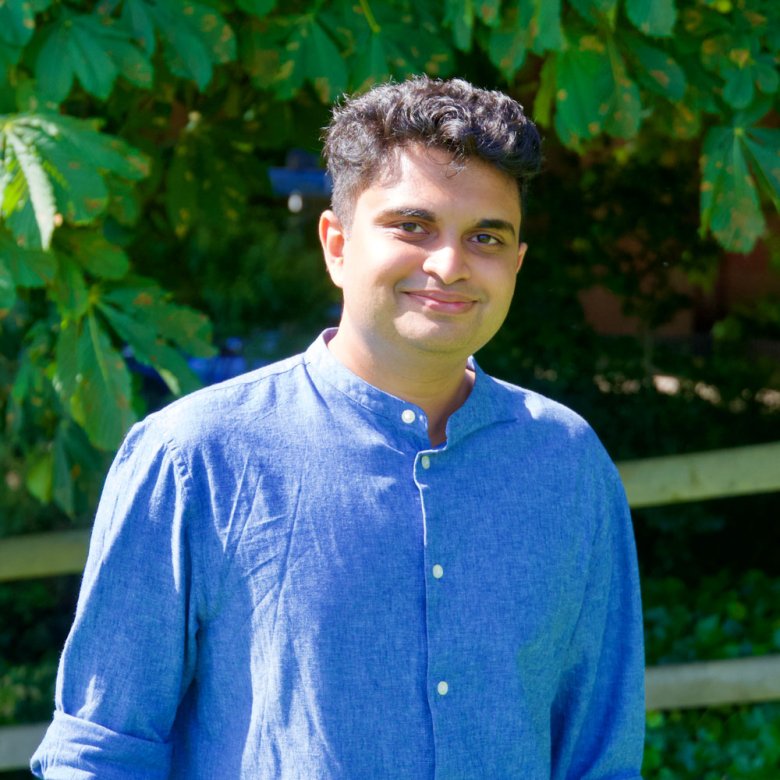
MA Game Design graduate Avi Parmar has landed an internship at software company Discovery Education. Based in Bath, Avi spends his days designing Claude skills, creating animations and sitting in on the kind of meetings that shape how creative teams actually work.
We caught up with Avi to talk about landing a role between production, technology and creative decision making, why AI still needs a human eye and what it was like being interviewed by a fellow Falmouth graduate.
Congratulations on starting your role as Creative Technology and Production Intern at Discovery Education. What does your day to day involve?
I'd say 50% of my job is designing and writing Claude skills to improve efficiency on workflows, 30% is a mix between creating animations, assets and making interactives, 20% is sitting through some really cool (and sometimes boring!) meetings. Discovery Education has a really pretty office based in Bath, so as a bonus I get to visit all these beautiful touristy spots and old Roman buildings while I'm on lunch, which is super helpful in keeping me inspired.
Your interviewer at Discovery Education was also a Falmouth graduate. Did that change how the interview felt, and what do you think makes a Falmouth graduate more employable than most others?
It did change how the interview felt since we had something to talk about before the interview actually began, which is really helpful for me since I tend to be extremely anxious in interviews. My interviewer, Lizzy Lambley, was also super sweet and made me feel comfortable, and after that sense of familiarity was established, it was a really fun experience to run through all of my work and talk about why I would be the best fit for the role.
It may sound odd, but I think what makes a Falmouth graduate more employable than most others is the constant exposure to beautiful Cornwall. I am so incredibly lucky to have had Falmouth as my first home in the UK. I think that something about talking to all the friendly people in Cornwall, sitting by the beach and creating such a uniquely personal memory of Cornwall in some way plays into inspiring young artists into creating beautiful pieces of work. I know that, for me at least, the only reason I could work so hard during my MA course was because every week I could walk over to the beach with my camera and just capture the waves, the seagulls, the sunsets and all the different things I found fascinating about Falmouth, and that really helped in keeping me inspired.
That combined with the enormous library at Penryn Campus, the resources and all of the incredibly knowledgeable faculty, means that essentially you're in a good space mentally and you have all the resources in the world to stay curious and pursue your dreams.
Part of the internship is about modernising and automating production workflows using AI. Could you talk us through what that looks like in practice?
I am a strong believer that AI has a future, and I think that it's really healthy to openly get involved in any and all conversations regarding AI, and to learn as much as possible as fast as possible. AI, however, is built on datasets, and datasets are inherently backward-looking. So essentially, a model is trained on past data, but to be a creative means to be forward-looking and create something new.
I think that as time goes on, AI is going to prove to be extremely useful in creating, or supporting the creation of assets, code and media, but at the end of the day it's the creative's job to understand people, society and culture, and to design work that is impactful.
The key to success in the creative space today seems to be to make cool stuff fast, and my job mostly involves designing tools to help us create more quickly, think more creatively and reduce the friction or resistance of tooling and asset creation. Most of my job involves creating Claude skills, which involves understanding markdown, Python and API functionality along with an overarching knowledge on how assets traditionally get produced.
How did the MA Game Design course prepare you for a role that sits between production, technology and creative decision making rather than game design in the traditional sense?
I studied film and 3D animation for four years before I did my one-year course in Game Design. So when I started game design, I honestly had no idea what I was doing. I remember when I made my first game it was so bad that I was physically embarrassed to show it around. If there's one thing my year at Falmouth University taught me, it's to never lose faith in curiosity.
The master’s course taught me how to learn a lot of skills extremely quickly, and how to keep an open mind while doing so. I learnt key skills, like game design, coding for multiple engines and mixed media asset creation, all of which played a role in me graduating from the course with a distinction. Mixing those skills with the things I learnt in filmmaking and animation made me understand a huge range of production workflows for all kinds of different media practices.
I know that, for me at least, the only reason I could work so hard during my MA course was because every week I could walk over to the beach with my camera and just capture the waves, the seagulls, the sunsets and all the different things I found fascinating about Falmouth, and that really helped in keeping me inspired.
When I graduated from Falmouth the entire games industry hit a serious downturn, and suddenly, employment was a struggle, and the only thing that ended up helping me was my relentless curiosity for the craft, and taking up projects without any promise of gain. All my dots somehow connected in the end, and I got the perfect role where I have to dabble with everything from films to games, while learning something new (AI).
Looking ahead, what are you most hoping to learn or achieve during your time at Discovery Education?
I think for me it would be to integrate all of these skills that I have within film, animation and games production and design, with AI.
I know how painful it can be to search through the internet for hours on the best way to compress a 15GB GIF, or to not have a smooth pipeline built to transfer files between Maya, Substance, Unity and Unreal, or have your axes, normals or units changed the moment you export any FBX from Blender. These problems are never-ending, and the more tools that we as creatives have to play around with, the more complicated this is going to get.
It's already the case that it's normal for creatives to be overworked, underpaid and even exploited in the industry, and I think that, while things just simply haven't been that great these past few years, the wave of AI is here to heal those problems in the long term. We don't have to spend an entire day trying to fix a corrupted After Effects file, or to spend half a day arranging VOs for a rough cut, if Claude can do that in under half an hour and in bulk!
I'm hoping that my time here is going to allow me to play with all of these cutting-edge tools to the fullest, so I can help teams in the future to speed up workflows to the point where we focus 100% on delivering the most cutting-edge, innovative, creative and fun pieces of content. I am in a unique position in time and opportunity now that I've got a job that truly uses all my skills and pushes it much further, and I'm hoping that by the end of my internship I'll have a clearer idea on how impactful these skills are, and how that changes my employability.
External links
Website - https://aviparmar.com/
Linkedin - https://www.linkedin.com/in/avi-parmar/
You might also like

Games Programming graduates sign BELTFED publishing deal

Meet the Film alumnus producing a Cornish-language short film


Film graduate shortlisted at Young Arrows for shoestring skate campaign
