Creative Music Technology graduate on mixing her own album
02 November 2026
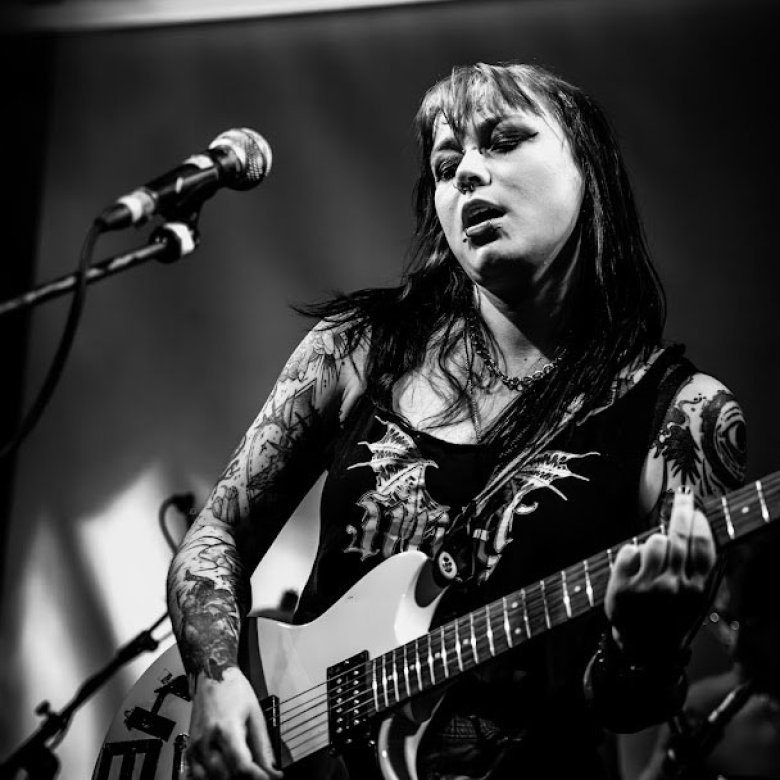
BA(Hons) Creative Music Technology graduate Harri Bettsworth writes her own songs, fronts her own band and is now mixing her own album. Since graduating in 2020, she has turned her third-year project at Falmouth, Hex Poseur, into a run of EPs and a packed set on the LOUD WOMEN stage at this year’s Rebellion Festival.
We caught up with Harri to talk about Hex Poseur, the tutor who encouraged her to start a band and her advice for students ready to form their own.
Hex Poseur began as an alter ego while you were living in Cornwall. Where did the character come from, and how has she evolved since?
I think Hex has always been a version of myself, but with some aspects exaggerated. She is the nonpart of me that is more confident, outspoken and a little mysterious. I envision her as more witch-like and ethereal than totally human, so there is some distance between myself and her.
For the visual aesthetic, I wanted her to look like a horror movie character. She’s the tough final girl who’s been through a lot of s**t but is somehow still just as strong. I’ve always loved horror films, so this was an obvious choice for me.
A huge inspiration for me at the beginning was PJ Harvey and I wanted to be a similar kind of performer. I found I never fit in well in band environments, especially with songwriting, so I just wanted to write alone. PJ is very raw, authentic and independent and there is something so powerful about her identity as a solo artist with a backing band. It shows a lot of strength and ownership over her songs and it’s also not very common in rock music.
The character is still somewhat the same today, but she has developed with me as I’ve grown as a performer. The presentation is more confident and self-assured than when I started out.
You’ve put out five EPs since 2020 and are now working on an album. How has your songwriting and sound developed across those releases?
When I first started writing, I had very specific ideas in mind for how I wanted to sound. As lots of people do when they start, you begin by replicating other artists. I wrote a lot of PJ Harvey rip-offs for a while and then moved on to writing more typical old school punk songs. When first starting Hex, I was much more focused on making punk music specifically, with some grunge influences in there. I still take a lot of influence from punk, but I found it can be a little limited in terms of songwriting.
I’ve found myself gravitating towards garage rock, stoner rock and grunge a lot more heavily. I grew up listening to a lot of garage rock, so it feels like part of my DNA. I think these genres speak to me strongly: they have darker tones, steadier tempos and sludgier instruments, which I feel more connected to. Punk is energetic and upbeat, and I guess I’m a little more subdued and moody. I was quite nervous to see how people would respond to this style, but the response has been really positive, which gave me confidence to lean into it even more.
I think that performing with a band also really changes your writing style. I used to write without thinking about drums or bass parts at all because I didn’t know much about those instruments. Now when I write, I am leaving space for other instruments and thinking about the overall arrangement. I think this has made my songs more interesting and there is closer interaction between the instruments.
You’re mixing your new album yourself. How do the technical skills from your degree feed into the way you make records now?
I am! This is the first time I have ever mixed my own music, and it is quite challenging for me.
When I started my degree, I generally felt horribly out of my depth: I knew very little about the production side of music, which is why I wanted to learn. I think university is a great place to just experiment and learn without the pressure of the real world at the start.
I was always very creative and musical, but not particularly technical. The degree allowed me to understand the whole production process and everything that goes into it. Being in recording spaces was essential, and when you make your own music independently, it is so useful to understand how to record it properly. In terms of mixing, it took me a long time to get the hang of this, but university was great at laying the foundations and allowing me to try out skills I never had before. You pick up little tips from different people that stick with you.
This summer you played the LOUD WOMEN stage at Rebellion Festival to a packed Pavilion. What was that like, and what has LOUD WOMEN’s support meant for the band?
It was an incredible experience. I’ve wanted to play Rebellion for ages, and it was amazing to finally get on the bill. To have such a big crowd felt super validating for all the hard work the band and I have put in over the years. The crowd response was overwhelming; I even got a little emotional at the end of the last song. I was at the merch table for over an hour afterwards, talking to people and everyone was so kind and supportive. Definitely something I’ll remember for a long time.
LOUD WOMEN is a non-profit music promoter, online zine, festival and record label, and they have been amazing. They reviewed my very first EP back in 2020 and have been huge supporters ever since. They have really helped to showcase my music to more people and made me feel part of a larger community of female artists. I am very grateful for this support.
You’re a big part of the East Midlands punk scene. What makes that community special, and what does DIY mean to you in practice?
I think in general the East Midlands underground scene is very welcoming and inclusive. There’s not much snobbery or ego and everyone feels equal. The scene is also loyal and supportive of each other. It never feels like people are competing to be top dog; we are all just here together making great music. There is a real sense of community, and no one is really bothered about how many followers you have as long as you put on a great show.
Being DIY essentially means doing everything yourself. You don’t have a big team of people working for you or managers or anything. You don’t make a lot of money, so passion is what drives you. The imperfections of being DIY are what make it so special. Maybe it’s not recorded or produced in a top studio, and you’ve made the CDs and merch yourself, but everything has an artist’s heart and soul put into it. It’s a kind of human connection that is so authentic.
You’ve said a tutor at uni encouraged you to write the songs yourself and then find a band to play them. Can you tell us about that moment and what it changed for you?
It was during my second year of university, and I remember the moment with Simon Waite very well. We were having a one-to-one tutorial for a project where you could basically make whatever you wanted. I had no idea what to do for it so he asked me if I could show him any music I’d been working on. I had a demo I’d put together of my song Quiet (which I later released) and played it to him as an example of the kind of music I wanted to make. I hadn’t played it to anyone before and had no idea what the reaction would be, and I remember him being so excited by it. He seemed to genuinely love the song; I was so surprised that anyone could be impressed by something I had written. He even suggested adding a key change, which I ended up putting in.
He told me to find a bassist and drummer to perform the song for my project. I don’t think it had occurred to me before that moment that that was something I could do; I always thought you had to write songs as part of a band. So, I followed his advice and developed it into my third-year project, which eventually became Hex Poseur. It gave me a lot of courage that somebody believed in my music, especially someone who was in the music industry and had heard lots of people’s music before. When I was leaving university, he stressed to me that I really needed to continue performing my music. It struck me how earnest he was; I could tell that he thought I had a lot of potential and it instilled confidence in me to pursue it. I am always so grateful for that moment.
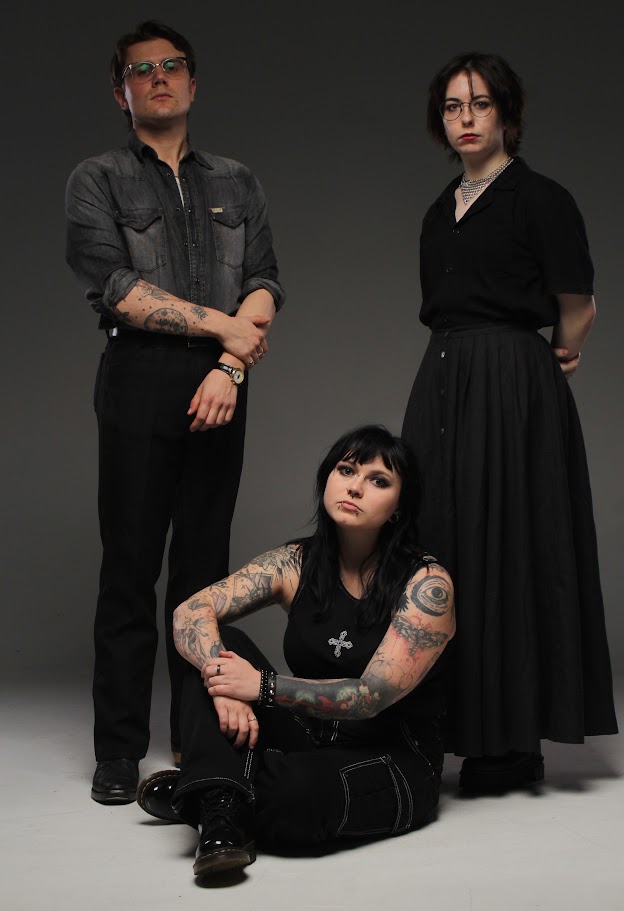
The band includes fellow Falmouth graduate Holly Osborne. How did the current line-up come together, and what does each member bring?
I met Holly at university, and she was briefly part of the band in third year, before the COVID lockdown. I moved back home to Leicester, so I had to find new band members. After a couple of years, I was looking for a new bassist and put an ad on Instagram. Holly sent me a message saying she was close enough to get involved, which was awesome because I already knew she was a great bassist and didn’t have to audition her. She is influenced by punk and emo music, so her playing style suits the songs well. On stage she has this huge, sludgy bass tone, which has so much presence to it and gives the music a real intensity. Her performance style complements mine perfectly. She is sort of dark and mysterious and gets lost in the music, and there’s no sense of her trying to pull focus or compete.
I found my drummer online when I moved back to Leicester after university and put an ad on one of those ‘find a band member’ websites. At the time Jacob Wakeling had a broken arm, and it was still COVID lockdown, so he sent me a video of him playing one of my songs in a cast, and I thought ‘perfect!’ He stressed to me that he wasn’t really a punk drummer, but I didn’t see this as an issue; I just said that he needed to smack the drums as hard as he could and it would be fine. He’s been in the band ever since and his drumming style has become a part of my sound. We have a lot of similar influences in music but also some different ones, which allows him to come in with a unique perspective. It’s a very easy working relationship as he seems to pretty much always understand what the song needs in terms of drum parts. On stage he performs with a lot of energy and precision, and we are very in sync with each other.
What skills and experience do you draw on most when reflecting on your time at Falmouth?
The hands-on practical side of being in the studio was really beneficial. I also got involved with some live sound societies and helped set up gigs, which helped me to learn how to engineer live sound. This is such a useful skill to have, especially when looking for jobs post-uni.
It was a great space to collaborate and learn how to work with lots of different types of musicians. The main thing was that it gave me space to sort of ‘trial’ being an artist before going into the real world with it. You have access to recording spaces, equipment, venues, other musicians and even photographers. You get to try all these things out and figure out the whole process before having to spend loads of money on recording studios. It prepares you to then take your music further when you leave university.
What’s next for Hex Poseur, and what would you say to current students who want to start their own band?
At the moment I am working on a full-length album, aiming to release it next spring, but we will see. Plus, just keeping on with my regular gigging and hopefully we can play more festivals next year because that was a blast!
For current students, I would say: go for it, but also find what is right for you. Don’t stick with a band that isn’t working just because you are desperate to be in a band. Take the time to find who and what you work well with. I know it feels like you need to rush into things, but you don’t; there is no time limit on being an artist.
External links
https://www.hexposeur.co.uk/
https://www.instagram.com/hex_poseur
https://www.youtube.com/@hexposeur
https://www.facebook.com/hexposeur
https://open.spotify.com/artist/0dsilbcDadopjPPW33zH17
https://www.tiktok.com/@hexposeur
https://hexposeur.bandcamp.com/music

You might also like

Creative Advertising alumnus on working across more than 100 brands in New York

Drawing alumna on working as assistant curator for renowned UK exhibition

Games Programming graduates sign BELTFED publishing deal

