Radical Localism

This Research & Knowledge Exchange Doctoral Project brief summarises our priority areas of research interest under the heading of: Radical Localism: An allotment, a microphone, (de)growth and the polycrisis read at a human scale
We welcome all research degree applications aligned with and in response to this brief.
Project brief details
The current state of digital and ecological being is one of polycrisis, and this project sets out to examine what forms of culture we can now propagate. Forms of culture that grow in a particular place, pick up currency and attention, before propagating elsewhere through digital means. In The Radicant by Nicolas Bourriaud, a radicant transmutes from being a plant to an artwork that sets down roots as it progresses through an environment.
The Ecologically Sound Working Group have established a node on the Locus Sonus network of globally dispersed microphones, creating a place whereby this localism becomes radicalised, a human-scale place for growing, forms of being that get translated into binary and dispersed globally in real time. The microphone and the allotment come together as a laboratory, for acting locally and thinking globally, with a global audience and a local material, grown in the ground, at ones feet: food, pigment, fabric, each activity dispersed through audible transactions, speech, real time audio streams, and language.
The Anthropocene can be thought of as a crisis of the human-scale caused by the rapid expansion of digital technologies, that are particularly local here: for example, Flag-Atlantic-1 parses 24TB of information a second under the sands of Sennen (see Arnold 2026). Radical Localism then is an inquiry into method and making, looking to utilise the scope of an allotment and a live feed, as prisms for looking at our current existence in a time of polycrisis.
Arnold, Bram Thomas. Antenna: Journal of Nature & Culture. Six Portraits, fibreoptics, standing stones and the ghosts of empire. Issue 70, Summer 2026.
Strategic alignment
Projects deriving from this brief are expected to sit within the Research & Knowledge Exchange strategy and the following Department.
| Centre | Centre for Blended Realities and Centre for Pedagogy Futures |
|---|---|
| Department | Falmouth School of Art |
All successful research degree project proposals must emphasise a clear alignment between the project idea and our Research & Knowledge Exchange strategy.
Project brief leads
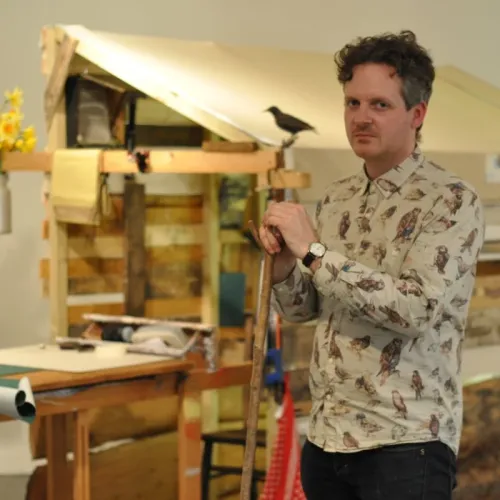
Project supervisor: Dr Bram Arnold
Dr Bram Thomas Arnold is an artist who started with walking and kept going into performance, drawing, installation, writing, academia and broadcasting. He studied the world’s first MA in Arts & Ecology at Dartington College of Arts, and in 2017 finished his PhD with University of the Arts London. A practice-based study into walking, writing and performance, developing an ecological form of subjectivity: a way of being in the world whereby an individual exists within and amongst places: ones social, geographic and political contexts. This philosophy expresses itself through a practice, Romantic in its outcomes and Conceptual in its methods, that does not restrict itself to traditional boundaries, mediums or modes of practice, a responsive way of being and making that is composed of and by its present context.
Read moreHow to apply

Enquiries
Project brief & project proposal enquiries
To discuss this project brief, ideas or project proposal responding to this brief, please contact: Dr Bram Arnold
Application enquiries
For all other application related enquires please contact the Research & Development team.
T: 01326 255831
Additional resources

Fund your Research Degree
See the options available to help you fund your research degree.

Research & Knowledge Exchange
By stepping beyond disciplinary lines, harnessing creativity and working with communities, we delive...

Doctoral Project Briefs
We invite MPhil and PhD project proposals that respond to a doctoral project brief.