Returning to study at 55 to develop award-winning train documentary
10 September 2026
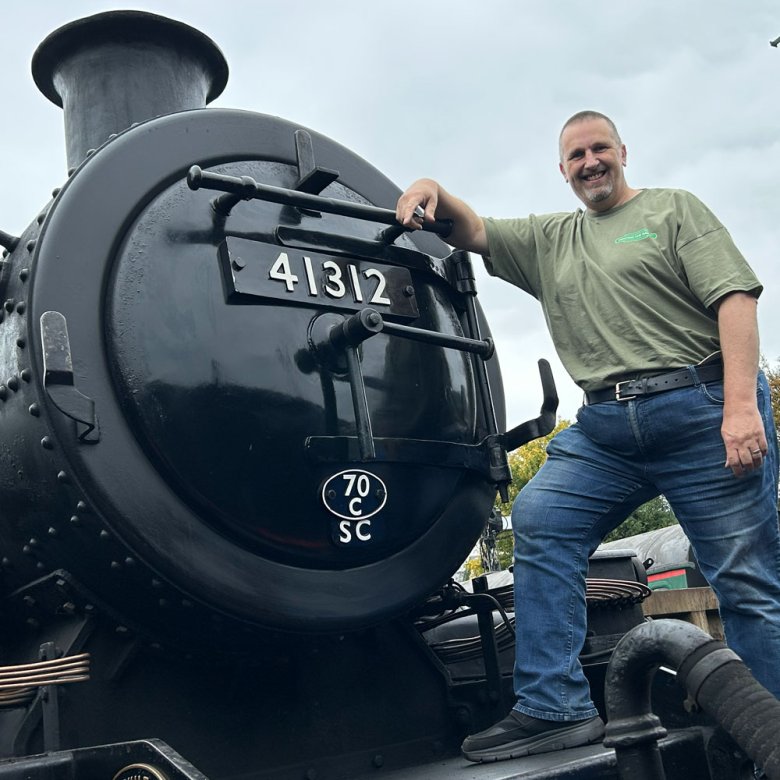
For filmmaker Chris Kirk, making films has been a lifelong pursuit. But it was the growing recognition of his documentary series Tracing the Rails, a community-made series uncovering the history of Sussex's lost Steyning Line, that prompted him to formalise that experience with an online master's degree in Film and Television at Falmouth. Now, as the series picks up awards in the USA and earns a nomination for Best Documentary Feature in Oslo, his studies are helping him develop the creative and practical skills to take the project further.
Balancing a full-time job with postgraduate study and an expanding documentary series is no small undertaking. But for Chris, returning to education at 55 has brought fresh energy to a practice he has spent decades developing. We caught up with him to talk about his experience of returning to study, how the course has shaped his approach to filmmaking and his plans for the next chapter of Tracing the Rails.
What made this the right moment to formalise a lifetime of filmmaking with a master’s degree?
I have been making films in one form or another for most of my life, but Tracing the Rails was the first project that genuinely found an audience and began to gain wider recognition. As it grew, I felt that I needed to grow with it. Part of me wanted to legitimise my position as a filmmaker with a proper qualification, but I also knew there were gaps in my knowledge that enthusiasm alone could not fill.
From my first conversations with Jem, the course leader, Falmouth felt like the right fit. He was incredibly welcoming and patient with all my questions, and that warmth has continued throughout the course. What surprised me most was how much I absolutely loved being a student again. The work is demanding, especially alongside a full-time job, but it has made me feel creatively energised, and perhaps even a little young again, which at 55 is quite an achievement!
Tracing the Rails has just picked up several awards in the USA. How did it feel seeing the series recognised?
It has been one of the most extraordinary experiences of my later life, and I am still somewhere between glowing with pride and wondering whether somebody has made an administrative error!
I must credit the university team here as well. One of the modules encouraged us to think seriously about publicity, audiences and the life of a film after it has been completed. Entering competitions was part of that, so I submitted Tracing the Rails to several without honestly expecting very much. At first, the rejections came exactly as expected, but then awards began arriving.
Around five competitions have now recognised the series at different levels, and in November we are travelling to Oslo for the Ardélion Awards, where we are nominated for Best Documentary Feature. The individual directing awards mean an enormous amount to me, but I see them as recognition of a collective effort. Tracing the Rails exists because of our presenters, contributors, volunteers, communities and, above all, Louise (my wife and also an emerging producer), who encouraged me to stop merely talking about making something and actually go out and film it. These awards belong to all of us.
You've described the project as being about absence: the stations no longer standing and the voices that may soon be lost. Where did that sense of urgency first take hold for you?
There is something very evocative about standing where a railway station once stood and finding almost nothing left. You may see an odd change in the brickwork, the curve of an embankment or a line of trees that does not quite belong, but the noise, movement and people have disappeared. The landscape remembers, although you have to learn how to read it.
While researching the Steyning Line, I realised that the same thing was happening to its human history. The people who travelled on the line, worked on it or watched the final trains depart are now elderly, and sadly some of those voices have already been lost. That gave the project a genuine urgency. Industrial archaeology can sometimes survive in photographs, maps and physical remains, but a person's memory, the sound of a particular porter's voice, the excitement of a childhood journey or the sadness of the closure, all exist only for as long as somebody can tell it. So, we are not simply documenting an abandoned railway; we are trying to preserve the emotional and social landscape around it before that disappears as well.
Are there modules, crits or conversations with peers on the course that have directly changed how you're approaching the series?
Almost every module has changed some aspect of how I work. I cannot stress enough how supportive the tutors have been or how personally invested they are in their students' success. I had worried that, as a remote student, I might somehow be at arm's length from the university, but the contact has been real, regular and genuinely caring. The course is challenging in places, but it is a master's, so it is not meant to be easy! The feedback has made me think much more critically about both the creative and practical sides of filmmaking, the tutors challenge often, but it is healthy and really stretches you.
I have always loved filming and editing, but the course has taught me that making the programme is only one part of building a sustainable production. Budgeting, ethics, risk assessment, publicity, distribution and audience development all matter enormously.
Conversations around my final project have been especially influential. Tutor feedback helped reshape the proposed promotional film into a more purposeful fundraising appeal and encouraged me to think beyond simply asking for money: I needed a credible budget, schedule, Electronic Press Kit and a realistic plan for what could be produced at different funding levels. It has made me a far more rounded and thoughtful filmmaker.
Juggling a full-time job, a master's and producing a growing documentary series sounds relentless. How do you keep all three moving without losing the joy in it?
Honestly, that has been the hardest part of the whole experience. There have been occasions when I have mixed up dates, missed something or worried that I have let the tutors down because work and the production have suddenly demanded more of me than expected. It can be relentless, and I would be lying if I pretended I had discovered a perfect system for balancing everything. What keeps me going is that I genuinely love the subject and remain serious about learning. If something matters that much, you find another hour somewhere, even if it is not always a particularly sociable hour!
I am also very fortunate that Tracing the Rails is not a solitary project. Louise is the reason it began in the first place and remains a huge source of encouragement, while Stephen, Mike and the wider team bring energy and humour when mine is running low. The tutors too, have also been remarkably understanding without ever allowing me to lower my ambitions. The joy survives because the work still feels meaningful: every interview preserves something, every episode brings a community together, and every difficult week moves us a little closer to creating something worthwhile.
You've spoken about wanting to fundraise for a second series covering a different line. What would you love Tracing the Rails to become once the MA is finished?
I would love Tracing the Rails to become sustainable without losing the warmth, independence and community spirit that made people care about it in the first place. The second series would follow the lost railway from Horsham towards Guildford, exploring the stations, structures, landscapes and personal histories along the route.
We already know there are wonderful stories waiting for us, but producing the first series largely from our own pockets is not something we can continue indefinitely. That is why fundraising forms such an important part of my final major project (shameless plug to the campaign: look us up here). With the backing of my tutors and the benefit of their different skills and perspectives, I am developing a proper campaign, an Electronic Press Kit, a realistic production budget and plans that can scale depending on whether we raise enough for one episode, three episodes or the complete series.
Naturally, I hope the campaign succeeds and eventually helps us attract a broadcaster or production partner. However, even if it does not reach its full target, the experience will still be invaluable. I will have learned how to present, finance and advocate for a project professionally. Ultimately, I would like Tracing the Rails to grow into an ongoing archive of lost railways and living memories, made with communities, rather than simply about them, but shown on television regularly. I cannot stress enough how good the tutors are on this course. Each and every one of them invests heavily in the course, the students and the university. They all seem to work inhuman hours to keep it all going and I am very very grateful for them.
External links
https://www.tracingtherails.com/

You might also like

Film & TV student on BAFTA scholarship and living with bipolar

Creative Advertising student sees her healthy eating campaign displayed at local academy

Army veteran on returning to education in his 40s to study software engineering

