Fine Art Online alumna makes this year's John Ruskin Prize shortlist after career pivot
15 January 2026
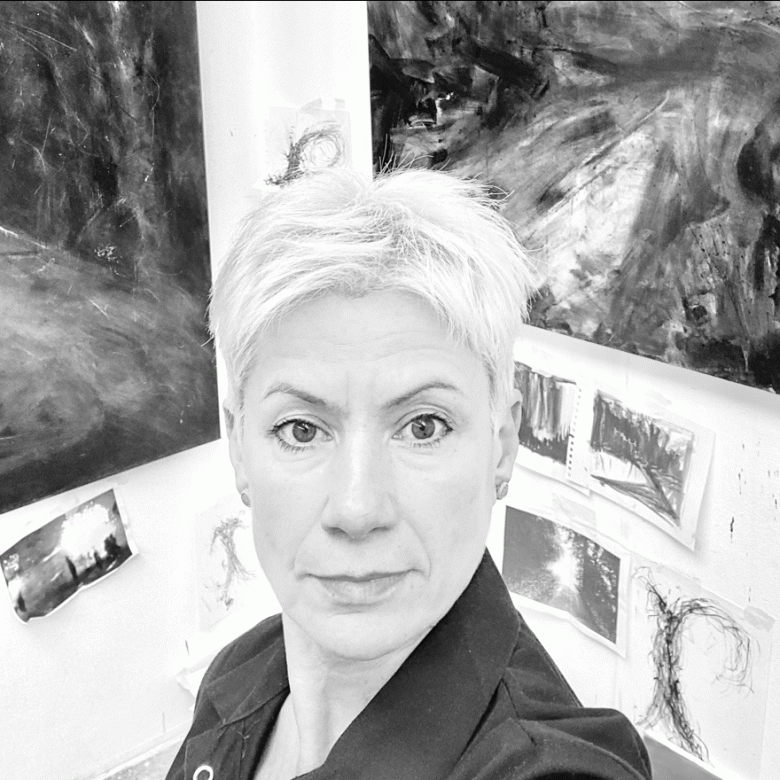
After 15 successful years of working as a marketing director, Tracy McBride decided to switch careers and pursue art professionally, a change helped through studying on Falmouth’s Fine Art MA (Online) course.
Following a “lightbulb moment” while she stood at an exhibition at the Royal Academy of Arts, Tracy recalled experiencing a sudden need to return to her artistic practice, feeling as though there was more that she wished to do, say and share. Needing structure, it was from here that she applied for Falmouth’s online Fine Art MA to make that shift happen.
Since graduating last year, Tracy has continued her artistic practice and has now been shortlisted for this year’s John Ruskin Prize, an achievement that sees her work featured in the John Ruskin exhibition at Trinity Buoy Wharf in London from January 29 to February 21.
We chatted with Tracy to learn more about how she found studying online, why making a career pivot was the best thing for her and the story behind the art that is set to be on display in London as part of this year’s John Ruskin Prize.
You recently graduated from Falmouth’s Fine Art MA (Online) after building a successful career in marketing. Can you tell us more about what made you decide to explore a new profession?
I switched careers after re-evaluating my life and thinking about what I wanted to be my professional legacy. Even though my career was successful and I had used my artistic skills within it, it was not truly fulfilling. Instead, I felt a real sense of urgency about going back to my artistic practice.
After enrolling on various local art courses, I decided to go back to postgraduate education to add academic gravitas to my work and pursue it as my professional vocation. I was both fortunate and slightly scared to be accepted on Falmouth’s Fine Art MA course. I then went on to study at Royal College of Art (RCA) where I was awarded an MA in Painting. The skills I gained from studying online with Falmouth gave me a fantastic platform to then progress my practice and ideas in a more studio-based environment.
As I was self-employed as a director at my own consultancy at the time, I could balance my time with the course. The skills I had developed from my career proved vital in helping me get through the course in terms of project and time management.
What did you find most helpful or enjoy the most while studying Fine Art MA (Online) at Falmouth?
It was both a challenging and rewarding course – it was excellent academically and I was introduced to artists, philosophers and writers who are continuing to influence my practice: Tim Morton, Donna Harraway and Anna Tsing for example. I enjoyed having the time (and pressure!) to create work that was deeply grounded by academic research. The flexibility of the course was the best part for me – I could work at my own pace and return to certain lectures, themes or references as I wished. It was also great to connect with my online cohort who have remained in contact post-graduation.
How did you find studying online?
For me it was perfect; it was complemented by additional courses, as I also went on to study at RCA and so I benefitted from a studio-based academic environment alongside the academic rigour of Falmouth. To succeed in an online course, I believe you need to be very disciplined, have project managements skills, be proficient with technology and absolutely ensure that you can maintain your studio practice alongside the academic requirements of the course.
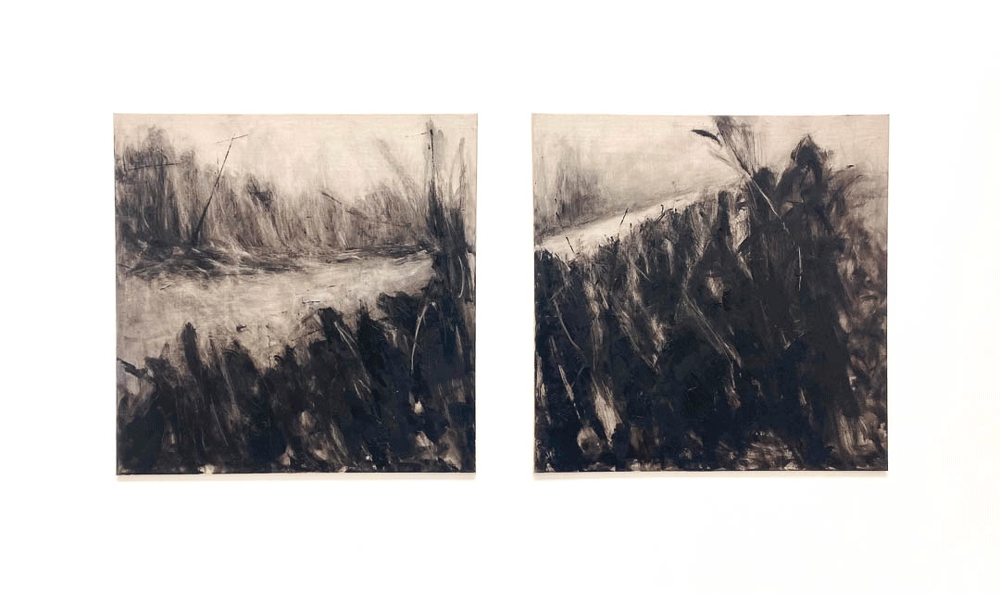
You have since been shortlisted for the John Ruskin Prize, congratulations! Can you tell us about the story behind your work?
My practice is anchored by my profound connection to the natural world, it examines the intersection of place, memory and emotion, exploring how landscapes hold histories and how materials embody energies. I experimented with painting techniques in relation to my subject and considered the landscapes of East Anglia and the vast Norfolk coastlines that have been transformed by human intervention.
My practice can be described as a dialogue between control and surrender, the landscapes I explore have been altered by human hands – reclaimed land, drained fens, manipulated coastlines – and how despite this, nature reasserts itself. As I reflect on patriarchal structures and power dynamics in local and global contexts, I see parallels between the desire to control nature and the ways in which human relationships, especially those shaped by power, function.
My work questions this urge for dominance, and how these same forces have shaped some of my own experiences. I imagine ancient knowledge embedded in the soil, the ghosts of what once was, waiting to surface in these landscapes.
How did you approach the theme of this year’s prize?
This year’s theme, ‘Patience in Looking, Truth in Making’, resonates greatly with the ethos and values that are imbued in my practice, so these paintings seemed highly relevant.
The Passage of Time explores a semi-abstract landscape rendered in a restrained, monochromatic palette. The work draws on the language of gesture—scratches, brushstrokes and scored marks—made through layers of oil paint and cold wax on linen. These surfaces record both presence and absence, the visible and the obscured, much like the land itself.
The composition evokes a terrain shaped by time and touch, altered by the persistent hand of human intervention. What once may have been open, fluid and organic is now demarcated, controlled or erased. The paintings resist moral judgement and instead invite the viewer into a slowed, attentive mode of looking—one that mirrors the patience required in both landscape observation and the painterly process.
External links
You might also like

Creative Advertising alumnus on working across more than 100 brands in New York

Drawing alumna on working as assistant curator for renowned UK exhibition

Games Programming graduates sign BELTFED publishing deal

