Why I chose to study MA Film & Television
26 November 2026
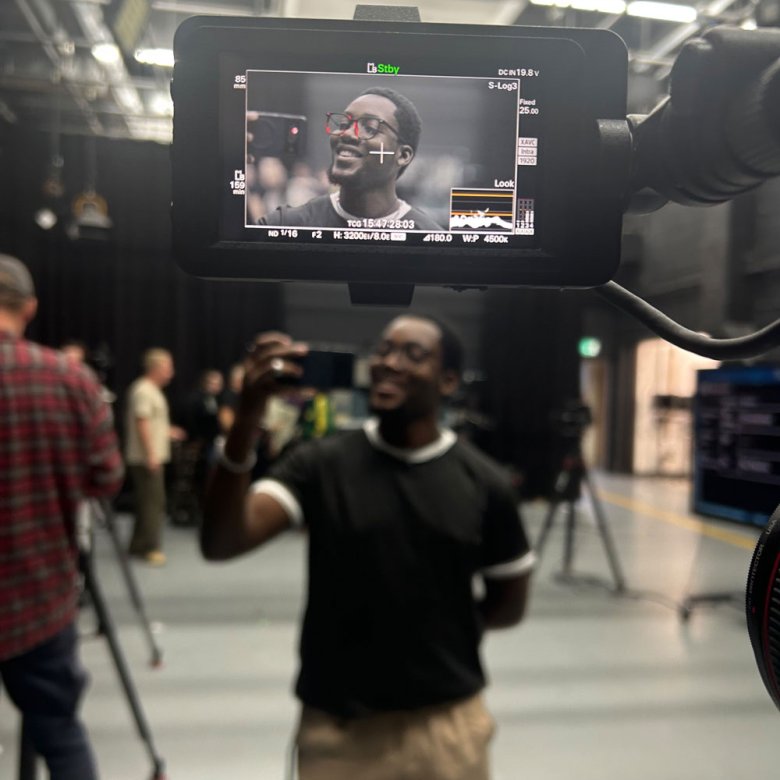
This article was written by MA Film &Television student, Victory.
Within the landscape of expressing and conveying stories, I’ve come to find that filmmaking is one of the most expressive visual mediums of storytelling. With the ability to effectively shift culture, properly define and redefine narratives, and preserve people and ideologies, there is nothing quite like filmmaking.
Within my formative years as an artist, I ventured into every form of creative expression known to me at the time, starting from two-dimensional drawings and paintings to documentary photography and graphic design. Of all these mediums, nothing sat with me as expositorily as filmmaking. I fell in love with the mere idea of being able to bring ideas and stories that only exist in our minds' abyss to reality, to recreate the worlds I have only ever been able to imagine.
The UK is renowned among countries crafting and producing world-class personnel in the filmmaking industry, and Falmouth University is up there among the schools pioneering this vision. The MA Film & Television course is filled with supervisors who exude sheer excellence in their craft and are replete with years of industry experience. Each of them is ever willing to assist in seeing you progress and bring your ideas to life in the best way possible. At every point, you’re properly assured that you don’t have to figure out whatever complexities in the study you come across entirely on your own. Alongside the personnel, the school boasts an extensive inventory consisting of a lot of industry-grade materials, studio spaces, and equipment, which you’re given full access to as a student on the course.
Over the course of a few weeks of learning, I’ve been able to build so much upon my existing knowledge of film, seeing that there is so much more to learn. As much as you are required to niche down as the course progresses, the initial stages of the course within the first study block give you a level playing field and an open area to structurally find what piques your interest. You have a set of inductions ranging from set designing and camera operation, and workshops with industry professionals who take you on sessions about directing, producing, documentary, experimental filming and more, giving you a wide range of a palette to learn from.
As filmmaking requires you to be open to working with like-minded individuals, the course provides just the right atmosphere for collaboration among students, with specific group-allocated projects where every person gets to play a part in the production.
Thanks to the school's affiliation with external studios and filmmaking bodies, you are also met with the opportunity to gain actual industry experience on designated and recommended short, feature and full-length filmmaking sets.
A piece of advice for anybody considering studying filmmaking here at Falmouth University would be to run at it head-on and be open to what possible opportunities may come your way, even if they are a tad deviant from what you may have initially opted to gain from the course. Every single role in film is just as important as the other, and they are completely interdependent. A good film is made of a well-oiled engine consisting of individuals taking their roles as seriously as one another.
As I embark on this journey, I aim to become an established cinematographer and redefine the advent of faith-based storytelling and human stories around the world. I’m sure that the foundation being set for me here at Falmouth University will definitely be a propeller for this goal.
You might also like

Why I chose to study MA Professional Writing

Day in the life of a Musical Theatre student

My experience of collaboration at Falmouth

Finding my creative voice through collaboration
