Online Film & TV graduate films Antarctic extremes on “impossible” trip
21 July 2026
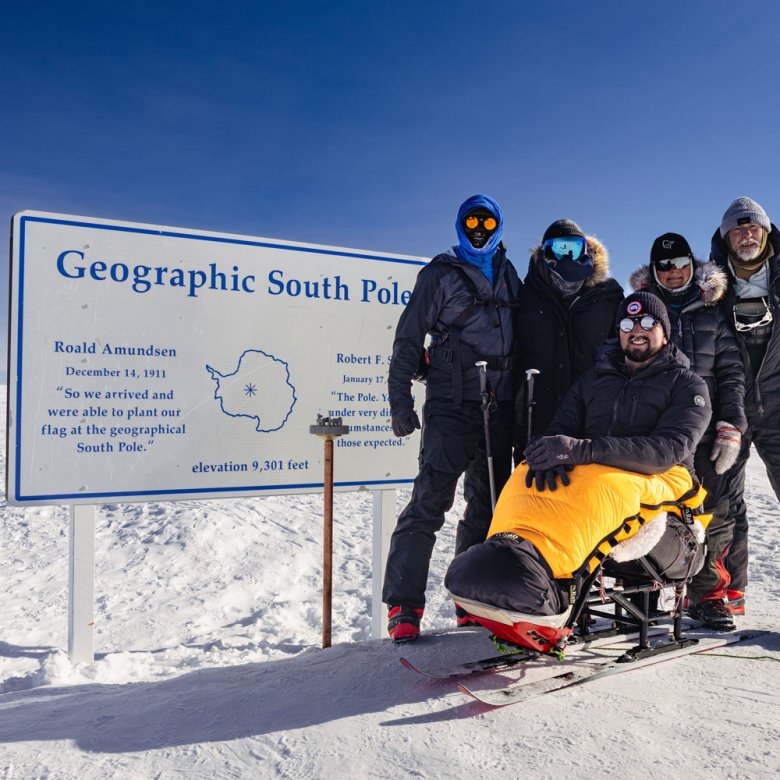
When disabled adventurer Darren Edwards set out to reach the South Pole, the goal was extraordinary. But for MA Film & Television (Online) graduate Matthew Biggar, documenting the journey was about something even bigger than the expedition itself. Redefining Impossible is a documentary rooted in resilience, mindset and the power of human potential, a film that reaches far beyond the extremes of Antarctica.
Driven by a shared experience of life-altering injury and recovery, Matthew and Darren set out to create a project that could inspire tangible change. From raising funds for spinal cord research charity Wings for Life to challenging the everyday limits people place on themselves, the film blends epic storytelling with a deeply human message: that “impossible” is often a matter of perspective.
The documentary, due to be released later this year, follows both the lead-up to the expedition and the journey itself, exploring ideas of success, failure and resilience. At its core, it looks at what happens after a life-changing setback, and how people move forward, adapt and achieve things they once thought were out of reach, even if that path looks different. It also explores themes of hope and empowerment, and asks viewers to reflect on their own version of “impossible”.
We caught up with Matthew to talk about the shoot, the extreme conditions and how studying at Falmouth equipped him to take to the Antarctic with confidence.
What drew you specifically to this project, Redefining Impossible, and Darren Edwards' story?
Let me start by sharing how Darren and I met.
Our paths crossed not long after I experienced a serious accident that changed everything for me. I lost not just my mobility, having had to relearn how to walk, but also my sense of identity. I'd left a career in the police to pursue my passion, and suddenly, with a three-week-old baby at home and being made redundant, I found myself at one of the lowest points in my life. My physicality had always been a core part of who I was, and to have that stripped away so suddenly was incredibly difficult.
Nine months into my recovery, I met Darren in a gym. We struck up a conversation, and he shared his own story of becoming a disabled adventurer and world record holder. His resilience and outlook were deeply inspiring; they helped shift my perspective and gave me hope at a time when I really needed it. From there, a friendship and working relationship developed. Darren later invited me to join him on his expeditions, both as a filmmaker and as a team member.
We quickly realised that our shared stories gave us a unique platform and a powerful purpose. Together, we envisioned a project that would do more than document an expedition. We wanted to raise awareness and support for Wings for Life, Red Bull's spinal cord research charity, which is doing groundbreaking work to develop treatments for spinal injuries. Their innovations are helping people regain movement and feeling and even prevent secondary injuries. But research like this relies heavily on funding, so our goal was to raise £100,000 to support their mission.
More than that, though, our vision was to create a project that transcends disability, and one that speaks to everyone. So many of us put limitations on ourselves and label things as "impossible." Darren and I wanted to show that those perceived limits can be challenged. Whether your "impossible" is climbing a mountain, getting healthier, being a better parent, or going back to university later in life, we wanted to show that mindset is everything.
Redefining Impossible is about strength through adversity. It's not just a film about Antarctica or breaking records. It's a deep dive into the human spirit. It explores how people overcome obstacles, redefine their narratives, and find power in persistence. Darren's attempt to reach the South Pole is the central thread, but the film also weaves in the stories of other extraordinary individuals, adventurers, endurance athletes and explorers, all of whom have pushed past personal and societal limits to achieve what many thought was impossible.
Photos below of Matthew in action, courtesy of Josh Raper Media.
Our team for this expedition was phenomenal. We welcomed two remarkable people: Lucy Shepherd, who produced and starred in Channel 4's Secret Amazon and is a trailblazer for female expedition leaders; and Dwayne Fields, who took over from Bear Grylls as the UK's Chief Scout. In 2010, Dwayne walked over 400 nautical miles to the magnetic North Pole and has since also reached the South Pole. He's featured in Endurance: Race to the Pole with Ben Fogle and continues to be a powerful voice for adventure and resilience.
So, for me, this project wasn't just a film. It was a calling. It's a message that's deeply personal, and a mission I couldn't turn down. Redefining Impossible is about showing what's possible, not just through epic physical feats, but in everyday life, through mindset, courage and community.
Filming in sub-30°C Antarctic conditions presents unique technical hurdles. What did you anticipate being your biggest equipment or logistical challenge (batteries, condensation, data management, etc.), and how did you prepare for it?
Filming in Antarctica posed significant challenges, not only technical and logistical, but also in terms of safety. As one of the coldest environments on the planet, with temperatures regularly sitting between -45 and -55°C on most days, the cold impacted nearly every aspect of production and affected the hardware in real time.
From battery performance and drone operations to condensation and kit selection, there were many challenges to overcome which we dealt with through training expeditions, and rigorous planning and testing.
Despite the complexity and risk, the opportunity to capture the expedition on film was incredibly rewarding. Through our extensive preparation, we were confident going in, and that preparation proved its worth.
How did you prepare personally to endure the conditions while also managing the demands of filming effectively?
Filming in extreme environments is undeniably challenging, but with thorough preparation, honest self-assessment and clear risk management, it's entirely possible. Success comes down to knowing your limitations, addressing weaknesses and building the right physical and mental foundation.
The first and most important step is preparing physically. This doesn't necessarily mean achieving elite athletic performance, but rather building robustness. It's about understanding the physical demands of the expedition and honestly evaluating your current capabilities. That often requires setting ego aside, identifying gaps in your skillset or conditioning, and then building a structured plan to close those gaps, or bringing in others who can.
I'd been fortunate to build a strong foundation through years of experience filming in cold and hostile environments, combined with formal hostile environment training and multiple cold weather training expeditions. My background as a reservist in the British Army infantry and my work as a serving police officer – as well as my current role as threat intelligence analyst – also equipped me with a wide range of transferable skills that proved invaluable in high-stress, physically demanding situations. That doesn't mean I didn't push creative limits, but I did so with a clear understanding of the consequences and confidence in my ability to manage them.
Physical preparation for the South Pole expedition was intensive. I trained five days a week, focusing on endurance, strength and resilience, to ensure I could perform both as a filmmaker and as a full member of the expedition team. That dual responsibility was one of the greatest challenges, knowing when to contribute to the team's efforts directly, and when to step back and capture the story as it unfolded. There was a constant tension between those two roles.
One of the hardest aspects was resisting the urge to help when I saw my teammates struggling, and instead choosing to document those moments. That decision didn't come lightly, and it carried an emotional weight. But capturing the reality of those struggles was essential to telling an authentic, powerful story. It was a delicate balance between empathy and responsibility, and one that I had to navigate carefully throughout.
Thankfully, we worked closely with world-class gear partners like Rab, Canada Goose and Vallon, who developed custom clothing solutions to help us perform safely and effectively in these extremes.
Tell us about the MA Film & Television (Online) course. What have you enjoyed most about it?
The MA Film & Television (Online) course was an incredible experience, one that not only developed my skills as a filmmaker but also completely changed how I see myself within the industry and in higher education.
I always thought university was out of reach for someone like me. It felt like an unattainable goal, a perception the enrolment team began to challenge from the very first conversation. I took a risk by applying, and that belief in myself was later reinforced by the support of my lecturers. In the beginning, I definitely struggled with imposter syndrome. Hearing about the amazing backgrounds and experiences of my peers in the cohort made me question whether I belonged. But over time, through the encouragement of both the lecturers and the students around me, that self-doubt gradually faded.
One of my biggest takeaways from the course is that university is for everyone, no matter your age, background or previous experience. The environment created by Falmouth was one of support and safety, where sharing your work and receiving constructive feedback became a vital part of the learning process. It taught me the value of collaboration and the truth behind the saying: if you want to go fast, go alone; if you want to go far, go together.
Beyond the personal growth, my development as a filmmaker was profound. Of course, my technical abilities improved, but more importantly, I learned to truly understand the core elements of storytelling: the power of structure, the importance of planning, how to write a strong treatment or create a compelling electronic press kit, and how to critically analyse film in a meaningful way. These are the tools that gave me confidence in my work, especially as someone who had always quietly battled with imposter syndrome.
This course helped me become not just a better filmmaker, but a more reflective and empowered one. I'm incredibly grateful for the experience.
External links
https://redefiningimpossible.co.uk/
https://www.justgiving.com/page/redefiningimpossible

You might also like

Film graduate shortlisted at Young Arrows for shoestring skate campaign

Meet the Drawing graduate nominated for the New Blood Emerging Art Prize

Acting alumna on forging a creative practice that's entirely your own

Product Design graduate on being shortlisted for award and having her work discussed with Queen Camilla
