Army veteran on returning to education in his 40s to study software engineering
25 September 2026
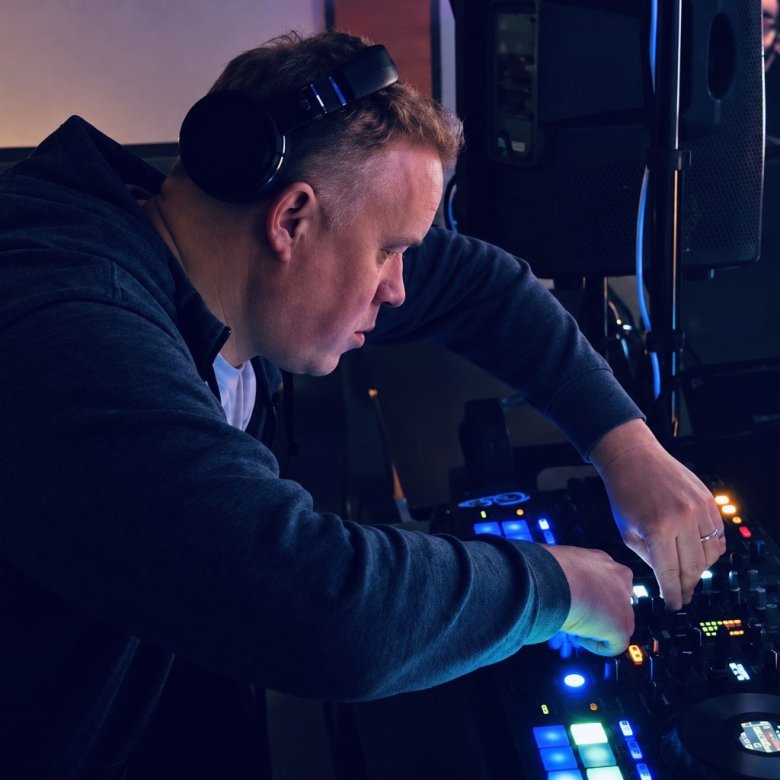
After 12 years in the Army and a career that has taken him through sales, web development and estate agency, Lee Howarth decided to return to university in his 40s to pursue his interest in software engineering. Now entering his second year of BSc Software Engineering at Falmouth, he's combining his experience in technology with a lifelong passion for music, while working towards his ambition of starting his own software business.
We caught up with him to hear about his decision to return to education, how 28 years of DJing helped shape his award-winning first-year game project Buck Up, Bubble and his plans to turn what he's learning into a business of his own.
You spent 12 years as a soldier before eventually landing on software engineering, with stops in sales, web development and estate agency along the way. What finally made you take the leap into a full-time degree?
The path to where I am now, in my mid 40s as a software engineering student, found its own natural route. On the face of it, my career probably looks like a random collection of directions, but each step actually led quite naturally to the next.
Growing up, being a soldier was the only thing I ever wanted to do. I spent 12 rewarding but challenging years in the Army. The job often called for making my own decisions in some very high pressure environments, and I know I did a lot of good during those years. There were a number of reasons I eventually decided to leave, but the one most connected to where I am now was wanting to be more creative. I wanted a bit more freedom over what I did and where it could take me, something the army understandably cannot always offer.
When I left I had an interest in technology, but no real qualifications or experience in it, so I found myself working in sales. I did well and that became my day job, but in the evenings I was always tinkering with something and spent a lot of time teaching myself web development. After a few years I had built up enough knowledge and confidence to start applying for jobs and eventually landed a role as a developer.
I spent the next few years building websites, but gradually realised what I enjoyed most was not actually the websites themselves. It was the problem solving involved in programming, particularly when I was writing JavaScript. Around the same time, the company I worked for was relocating, so I decided to leave and work out what I wanted to do next. Then Covid happened, opportunities were not exactly plentiful, and I stepped back into sales as an estate agent. It was only ever supposed to be a stopgap, but somehow I ended up staying in the industry for six years.
The interest in computing never really went away though. In 2022 I started a remote Computing degree with another university, studying part time in the evenings while working full time.
I took some time away from studying because giving up a full-time job in my 40s to become a university student needed some serious thought. Eventually I decided that I would rather take the chance than look back in another ten years and wonder what might have happened if I had.
So here I am, writing this a few days away from starting my second year of BSc(Hons) Software Engineering at Falmouth University.
You've been DJing for 28 years. How does that background in music and sound feed into your interest in programming, especially the audio side of things?
The one constant throughout my life has probably been music, and DJing more specifically. I have been a DJ since my teens, some 28 years now. I have been lucky enough to play in some incredible clubs and alongside some massive names in the industry, but it was always second fiddle to my Army career, so I never really pursued it as a full-time profession.
One thing I did not anticipate when I came to Falmouth to study software engineering was just how varied the subject topics could be. As part of COMP101 we spent some time working with audio at a fairly basic level, and suddenly there was this unexpected crossover between something I have done for most of my life and my current studies.
I would not necessarily say that means I will end up working in audio programming, but it opened my eyes to another area of software engineering that I had not really considered before. I think that is one of the things I am enjoying most about the degree. I am being introduced to areas I did not even know I would be interested in, and occasionally they connect with things I have already been doing for years.
Your award-winning group first-year project Buck Up, Bubble used triggered sound effects like footsteps in Unity. What was it like building that, and what did you learn from combining game development with sound design?
Buck Up, Bubble was probably one of the highlights of my first year. I was incredibly lucky with the team I ended up working with. We had a really good mix of skills and personalities, everyone contributed, and we genuinely worked well together. Winning best first year student project at the 2026 Games Expo was a great feeling, but it was very much a team achievement and I could not have asked for a better group of people to build my first proper game with.
With my background in music, I naturally took an interest in the audio side of the game. What was interesting was discovering that putting sound into a game is very different from simply choosing sounds that you like. Everything has to work with what the player is seeing and doing. Footsteps, for example, had to trigger directly from the character sprites and at the right point in the animation, otherwise something that should be barely noticeable suddenly feels completely wrong. The same applied to the other effects. They needed to fit what was happening visually, but also suit the style and theme we had created for the game.
That was probably the biggest thing I took from it. A game is made up of lots of individual parts, programming, art, animation, sound, level design and everything else, but none of them really exist on their own. When the team gets those different pieces working together properly, that is when it starts to feel like an actual game rather than a collection of separate things we had built.
You're working on parallel ideas for your final year project. Without giving too much away, what direction are you leaning towards and why?
I have spent a lot of this summer working on my own projects, with quite a bit of that focused on app development. It has been a good opportunity to take what I learned in first year and actually try to build things without an assignment brief telling me what to do next.
One thing that has come out of that is that I have started developing some of my own tools to help me along the way. When you are building several projects you start noticing the things you are doing repeatedly, so I have been looking at ways of making some of that easier and creating tools that I can reuse for future projects and, hopefully, some of the business ideas I have further down the line.
Oddly enough, that should also give me some useful experience when I reach my third year. I believe one of the things we will be tasked with is developing tools for similar purposes, so without intentionally working towards my final year project, some of what I am doing in my own time is already making me think about the kinds of problems those tools can solve.
I have got a lot of learning before I need to make any firm decisions though, so I am keeping an open mind about what my final year project will eventually look like.
Alongside your studies you've talked about wanting to set up your own business and work for yourself. How is that ambition shaping the choices you're making on the course?
Working for myself is definitely the main objective. I have reached a point in my life where I would really like to take everything I have learned from my previous careers, combine that with software engineering and ultimately build something of my own.
I have already started putting some of the foundations in place. The business has a name, the first version of the website is built and live, and I have spent a lot of this summer working on the first apps and ideas I hope to release through it. I am deliberately not advertising any of it yet because it is still very much a work in progress, and I would rather have something I am happy to put my name to before I start shouting about it.
That ambition definitely affects how I approach the course. Obviously my priority is learning the material and doing well academically, but I am also constantly thinking about how what we are learning applies outside university. I want to understand how to build software properly, not just enough to get something working for an assignment. My own projects then give me somewhere to test that knowledge and usually expose another ten things I still need to learn.
I have spent years working in sales, dealing with customers, managing people and taking responsibility for decisions, so I already have quite a lot of the experience that sits around running a business. The technical side was the missing piece, and that is what I am working hard to build now.
I am not waiting until I graduate to find out whether I can make it work either. One of my goals for the next 12 months is to start generating some income from the things I am building. I am realistic that it may only be modest to begin with, but getting those first products out there and proving that somebody is willing to pay for something I have created would be a pretty significant milestone for me.
By the time I graduate, I would like to have more than just the degree. My aim is to have the foundations of a real software business, products I have actually built and released.

You might also like

Creative Advertising student sees her healthy eating campaign displayed at local academy

Prosthetic Effects graduand wins global award for World of Warcraft creations


