Jessica Beechey
About the researcher
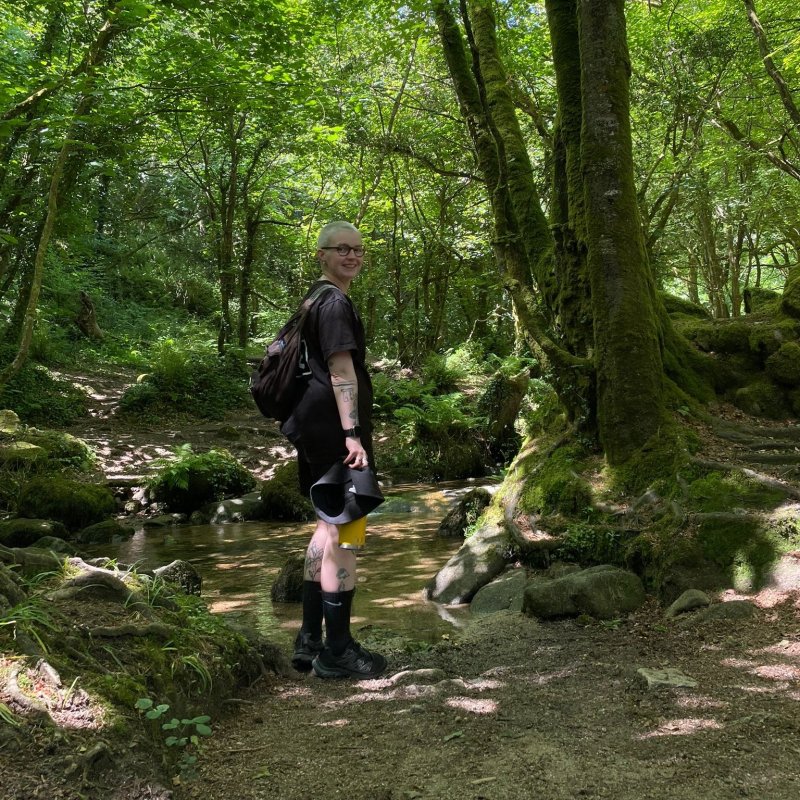
Jessica is a Cornish sound artist, composer, and practice-led researcher exploring listening as a creative and critical practice. Working across drone music, field recording, soundwalks and collaborative projects, she created immersive sonic experiences that invite audiences to engage differently with landscape, memory, and place.
Often working with underground and heritage environments, archives, and overlooked histories, her work is drawn to spaces that exist at the edges of perception. Through sustained listening she explores how sound can reveal hidden relationships between people, environments, and the more-than-human world.
Alongside her practice, Jessica is the founder of Boulderdash Zine, a DIY publication celebrating intersections of stones, drones, and noise, and performs under the moniker Yiskah, creating long-form drone compositions shaped by field recordings, synthesis, and environmental sound. She also plays synth bass in experimental noise-rock band, Thee Alcoholics.
PhD Abstract
Thesis title
Hovering at the Edge: Queer Listening in the Cornish Underground
Abstract
How might drone music and experimental listening practices offer new ways of engaging with the Cornish underground? Through queer listening, collaborative sound practice and deep listening, this research explores how subterranean heritage sites can become spaces for reimagining relationships between landscape, memory, archives, and underrepresented communities.
Subject Area, Aims and Objectives
This practice-led research bring together sound, heritage, and cultural studies through listening as both a creative practice and research methodology. Working primarily in Cornwall’s mining landscapes, it explores how drone music, deep listening, collaborative soundwalks, and composition can generate alternative ways of experiencing heritage, with particular attention to queer, neurodivergent, and other underrepresented communities.
The project looks beyond popular and definitive narratives of Cornish heritage to investigate listening as a means of uncovering traces, fragments, echoes, and overlooked perspectives. Through collaborative engagement and participatory practices, it considers how sound might challenge dominant heritage narratives and open space for more plural and embodied understandings of place.
Objectives:
- Explore drone music and queer listening as creative methodologies for engaging with Cornwall’s underground heritage
- Collaborate with queer, neurodivergent, and other underrepresented communities through workshops, soundwalks, and experimental listening practices.
- Develop site-responsive compositions and sound works informed by dialogue, archives, and embodied experiences of subterranean environments.
- Investigate how listening can reveal overlooked histories, hidden narratives and alternative relationships with heritage.
- Contribute new approaches to practice-led research through collaborative sound practice, composition and experimental listening methodologies.
Research Contexts
Cornwall’s mining landscapes are sites of rich industrial, cultural, and social histories that continue to shape contemporary understandings of place and identity. While these histories are often represented through established heritage narratives, my interest lies in the spaces between them – the fragments, silences, echoes, and voices that remain less visible in conventional archives.
Drawing on concepts from sound studies, acoustemology, Deep Listening, queer theory and emerging ideas surrounding quantum listening and black quantum futurism, the project considers listening as a way of engaging with multiple temporalities simultaneously. Where heritage is often treated as fixed or complete, my research approaches the underground as a space where histories, memories, and imagined futures can coexist through sound.
Inspired by practitioners such as Pauline Oliveros, D Ferrett and Moor Mother, alongside contemporary practices in drone music, soundwalking, and experimental composition, the research contributed new approaches to listening and collaboration within sonic heritage.
Methodology
The research employs Participatory Action Research (PAR) alongside practice-led artistic enquiry. Through collaborative workshops, soundwalks, deep listening exercises and experimental composition, participants contribute to an evolving body of sonic, visual and written material. Listening, reflection and dialogue form the core of the research process, supported by audio recordings, participant notebooks, interviews, surveys, and reflective journals.
Drone music and listening practices have become methods of enquiry. These processes inform the development of an evolving archive of recordings, compositions, and participant responses that collectively explore relationships between sound, landscape, heritage, and community.
Research outputs will include site-responsive compositions, soundwalks, installations, exhibitions, and written critical reflection, contributing new understandings of listening as a collaborative, creative and research practice within the Cornish mining landscape.
Qualifications, outputs & expertise
Research interests
- Listening as a creative and critical practice, with interests in drone music, Deep Listening, soundwalking, and experimental composition.
- Queer listening, darkness, and the Cornish underground as methodologies for exploring heritage, memory, archives and more-than-human relationships.
- Collaborative and participatory approaches to sound practice, including Participatory Action Research (PAR), soundwalks, and community-led listening.
- Experimental approaches to heritage that foreground traces, echoes, voice, and overlooked narratives through sound.
- Quantum listening, black quantum futurism, and alternative understandings of time and place in sonic practice.
Qualifications
- MMus Sonic Arts (Distinction), Goldsmith's University, 2023
- BA(Hons) Creative Music Technology (First Class), Falmouth University, 2016
Grants & awards
- Network Exchange Commission, Outlands Network, 2025