Disability Support

The Accessibility Team is here to provide information and advice on disability issues and facilitate support for those with, for example, sensory or mobility impairments, long-term health conditions, specific learning differences, autistic spectrum conditions or mental health conditions.
The Accessibility team is made up of a team of specialist advisors who provide information and advice on disability issues, Individual Learning Plans and Disabled Students’ Allowance.
We encourage you to apply for an Individual Learning Plan (ILP) and Disabled Students’ Allowance (DSA) as soon as possible.
Tell us about a disability
To help you settle into university life smoothly, please share with us any disability as soon as possible. Setting up support can take time, so early disclosure allows us to arrange the right assistance before you arrive at Falmouth.
If you decide not to share initially but later realise you need support, we’re still here to help. Don’t hesitate to reach out, even if you’re unsure about the type of support you need - we’re here to make sure you have what you need to succeed.
Universal reasonable adjustments are embedded in teaching and learning activities for all students as part of our commitment to an inclusive learning environment.
The universal adjustments for on campus courses are:
- Ensuring you have as much notice as possible when anything changes in relation to your teaching sessions, assessments, live webinars, field trips or other planned activities.
- Sharing full assessment details as early as possible, always from the start of the Study Block so you know exactly what work is due and when.
- Using clear, simple and unambiguous language in both spoken and written communication
- Important verbal instructions will be followed up in writing
- Lecture slides and notes are uploaded 24 hours before teaching sessions where possible to support the use of assistive note taking tools
- You can leave and re-enter the classroom quietly and without needing to explain or draw attention to yourself
- Ensuring there are planned breaks in longer teaching session so you can have time to rest and refocus
- Making it clear which resources are essential or most important and highlighting key texts within module materials where possible
- Allowing you to make audio recordings (not video) of teaching sessions where possible, and where agreed in advance, 1:1 sessions
- Allowing you to use noise-reducing headphones or ear loops, as long as you can still hear and engage with teaching
- Supporting the use of stimming, fidget tools and movement in the classroom
The universal adjustments for online courses are:
- Ensuring you have as much notice as possible when anything changes in relation to your teaching sessions, assessments, live webinars, field trips or other planned activities.
- Sharing full assessment details as early as possible, always from the start of the Study Block so you know exactly what work is due and when.
- Using clear, simple and unambiguous language in both spoken and written communication
- Important verbal instructions will be followed up in writing
- Allowing you to engage online without your camera on and to communicate via chat if necessary
- Lecture slides and notes are uploaded 24 hours before teaching sessions where possible to support the use of assistive note taking tools
- Using closed captioning (CC) or subtitles on any AV resources
- Making it clear which resources are essential or most important and highlighting key texts within module materials where possible
- Allowing you to make audio recordings (not video) of teaching sessions where possible, and where agreed in advance 1:1 sessions
An Individual Learning Plan (ILP) is a document that tells your course team about any reasonable adjustments which are recommended to support your learning. To get an ILP, you will need to have a disability, long term health or mental health condition or learning difference which meets the definition of disability under the Equality Act 2010.
You will need to provide supporting information of your condition, for example, medical evidence or a diagnostic assessment. Your Accessibility adviser will liaise with you to create the ILP and this will be shared with you and your lecturers and tutors.
Please upload to My Falmouth any supporting information that you have, even if it is not in English, as we can always request a translation later.
ILPs are important because they recommend individual reasonable adjustments to minimise or remove barriers that may prevent you from taking part in university life and studies.
Some examples of reasonable adjustments are:
- assessment adjustments (e.g. alternative assessment format; adjusted deadlines)
- provision of ergonomic equipment
- accommodation adaptions. (these will be shared with the accommodation team but will not appear on your ILP)
ILPs can be set up before you start your studies with us or at any point during your time at university. You can also ask for them to be reviewed at any time if anything changes.
How to apply for an ILP
You apply for an ILP through My Falmouth. After logging into My Falmouth, click on the Apply for an Individual Learning Plan tile and follow the instructions. Watch the video below to see how.
Once you have submitted your application, your Accessibility adviser will review your application and provided supporting information to create your ILP which will be agreed with you and shared with your course team. You can view your ILP in My Falmouth.
Supporting Information
To create an ILP, we will request supporting information that outlines your disability or health condition. This should ideally include a diagnosis or working diagnosis, the main symptoms and any relevant medication side effects and details of any previous support or adjustments. Supporting information should be written by a suitably qualified medical professional, be dated, and clearly describe the condition. Evidence of historic adjustments and medication specifically related to the declared disability may also be included.
If you need DSA the threshold to be eligible for DSA differs from that for an ILP, further information can be found on the DSA website You can choose to have the DSA Medical Evidence Form completed by a doctor or medical professional, and support can be offered to obtain UK evidence through a local GP if needed.
See the links below for the forms for each funding body:
- England DSA Disability Evidence Form
- Scotland DSA Disability Evidence Form
- Wales DSA Disability Evidence Form
- Northern Ireland DSA Disability Evidence Form
Different supporting information is required for students with specific learning differences. See the ‘Getting a formal assessment of autism, ADHD, dyslexia and/or dyspraxia page’.
Disabled Students’ Allowance (DSA) can provide you with funding for extra study-related costs due to mental or physical health conditions, learning differences or any other disabilities.
You can apply for DSA as soon as student finance applications open; you don’t need to have started your course. We’d encourage you to apply early so you can get your support in place at the start of your studies. For postgraduate researchers, the process for applying may differ slightly.
DSA funding isn’t a loan, so you don’t have to pay this money back.
Please note: Personal Care cannot be funded through DSA, although Adult Services in your area may be able to help.
Disability Rights UK has a factsheet on Applying for Disabled Students' Allowance (DSA) and the ‘Save the Student' website also has a clear DSA Guide.
To be eligible you must:
- be a UK resident
- be studying on an undergraduate or postgraduate course lasting at least a year
- be eligible for Student Finance
- have a disability, health condition (physical or mental), autistic spectrum condition or specific learning difference (such as dyslexia, dyspraxia or ADHD), which affects your ability to study.
DSA only covers costs that are directly linked to aspects of your condition which affect your ability to study. This might include:
- non-medical helpers (NMHs), such as specialist study skills tutors, mentors or assistive technology trainers
- specialist equipment, for example a laptop* and assistive software if you need this because of your disability
- extra travel costs because of your disability
- other disability-related costs of studying, such as extra printing and photocopying.
*Students must pay a contribution of £200 towards the laptop, which is provided to run DSA-recommended software, rather than course-related software. You can choose to pay more to upgrade this, if desired.
Below are the different DSA pages for each UK country. Click the link for your home country to read detailed guidance on how to apply and find the forms you need to fill in.
- England Student Finance England
- Scotland Student Awards Agency Scotland
- Wales Student Finance Wales
- Northern Ireland Student Finance NI.
If you are an international student, there is alternative support available. Please contact the Accessibility team for more information.
Applying for DSA
Below, you'll find a flowchart of the DSA application process.
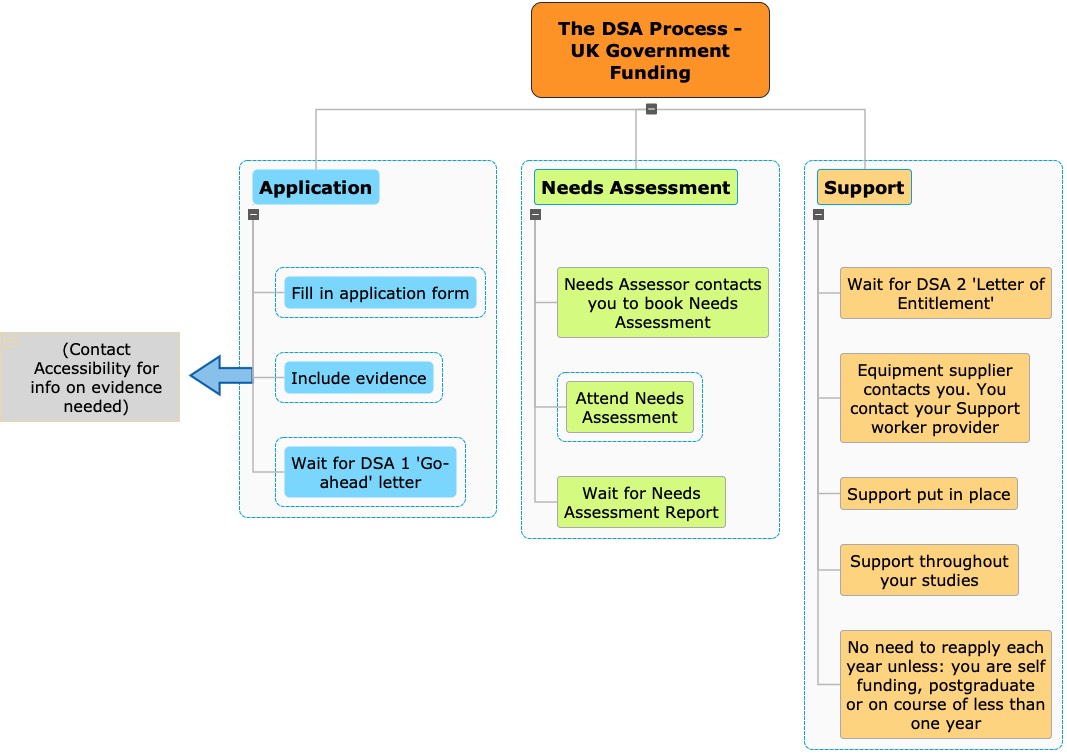
You can also watch this video which talks you through each step: 'Applying for DSA'.
Supporting evidence
For disabilities, long-term health conditions and mental health conditions, you will need a copy of a report or letter from your doctor or consultant. Or you can ask your doctor to fill out a medical evidence form. See the links below for the forms for each funding body:
- England DSA Disability Evidence Form
- Scotland DSA Disability Evidence Form
- Wales DSA Disability Evidence Form
- Northern Ireland DSA Disability Evidence Form
Different evidence is required for students with specific learning differences. See the ‘Getting a formal assessment of autism, ADHD, dyslexia and/or dyspraxia page’.
Get in touch
- Student email: accessibility@fxplus.ac.uk
- Telephone 01326 370 460 (via Student Helpdesk service)
- Book an online or in-person appointment (for students)
We're committed to taking care of any personal data you share with us. For more information, please see our Confidentiality Policy.
Please note, the Student Helpdesk was formerly known as The Compass.
Further support

Academic Support
Discover the academic support available to our students.

Student Support
Discover all the support services and wellbeing resources available to Falmouth University students....
Hear from our students

Being a neurodivergent student at Falmouth University
18 March 2025
Starting university as a neurodivergent student can feel stressful, especially with the uncertainty ...

My experience with the Support Services at Falmouth
01 February 2024
Hi, I’m Caitlin and I’m a second year Musical Theatre student. In this blog post I’m going to ...

Studying online as a neurodivergent student
20 February 2023
Creative Writing BA(Hons) (Online) student Daniel Whitaker shares his experiences studying online as...