The Design Compass
Evaluating a new tool for sustainable product design with students
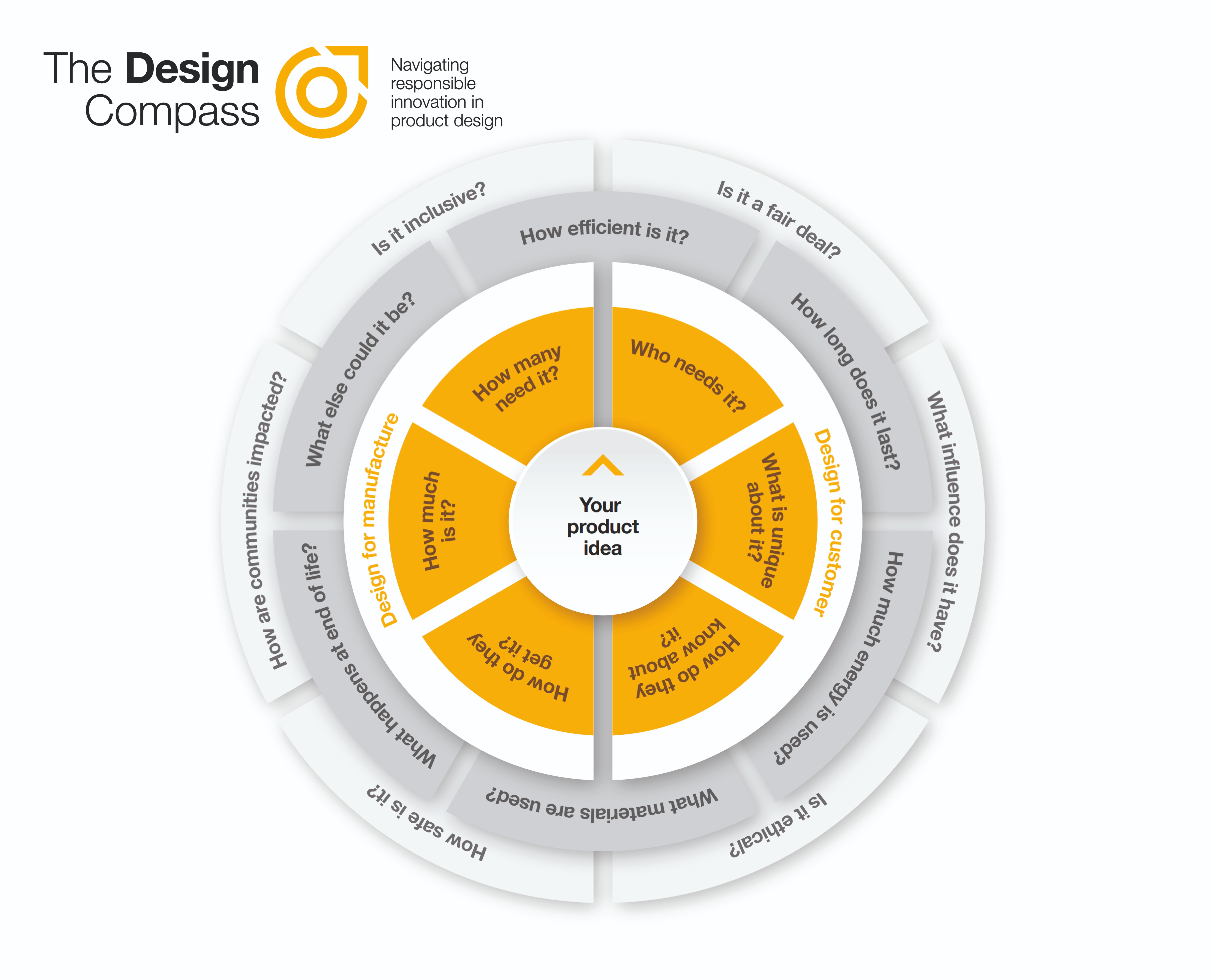
The Design Compass helps to develop commercially viable products whilst navigating environmental sustainability and social impacts. This project evaluates The Design Compass for sustainable product design with students.
Project details
| Project lead | Simon Andrews |
|---|---|
| Start date | January 2025 |
| End date | September 2025 |
| Department alignment | School of Architecture, Design & Interiors |
| Website | design-compass.co.uk |
The project saw cross-institutional collaboration between students, academics, and the Design Compass developers, Bang Creations Ltd. Qualitative research focused on the students’ experience of using the tool, their design process and outcomes developed. The study demonstrates the benefits of the Design Compass in a learning and teaching, and advantages over other eco-design tools. Student feedback was also helpful in providing suggestions for improvements for the tool. Some of these suggestions have already been implemented by Bang Creations in a later iteration of the Design Compass.
This was a pilot study to explore the value of using the Design Compass in higher education. To gather feedback on the usability and effectiveness of the Design Compass, the tool was integrated into 2nd year taught modules on the BA(Hons) Sustainable Product Design course at Falmouth University and the BA(Hons) Product Design course at the University of Chester. Both courses had independently worked on live project briefs supported by Bang Creations in the past, but this project presented an excellent opportunity to extend the collaboration as a cross-institutional approach.
Tools such as the Life Cycle Design Strategy (LiDS) wheel (Brezet and Van Hemel 1997) and the Okala Ecodesign strategy wheel (Okala 2012), are used by designers to explore opportunities to reduce environmental impacts across the life cycle of the product. For global sustainable development, the 'Three Pillars of Sustainability' (Brundtland 1987) highlight the need to consider the interrelated social and economic impacts as well as environmental impacts. The Design Compass helps to navigate these three interrelated issues simultaneously.
Qualitative research was conducted at the beginning and end of the project in response to three specific questions:
- How have you used the Design Compass?
- What did you find most useful about the Design Compass?
- What would you change to improve the Design Compass?
The students’ responses were collated and coded to analyse the frequency of themes reported. Course teams were able to review how the students had used the tool to learn sustainable design strategies, generate and evaluate design ideas, and how effectively they had benchmarked their concepts against existing products.
Project team

Project lead - Simon Andrews
Simon Andrews is course leader on the Sustainable Product Design programme at Falmouth University and an AHRC studentship PhD researcher. His research practice focuses on the relationship between design and health and wellbeing, in particular the opportunities to empower people through inclusive design. He recently collaborated with local charity, Cornwall Mobility, to design a beach wheelchair to make access to the Cornish coast more inclusive. Through his PhD research project, he is currently working with people at risk of falls to design clothes and accessories that provide protection from hip fractures.
Read moreAdditional team members
Falmouth staff:
- Evy Dutheil
External staff:
- Rebecca Falcon
- Stefan Knox
- Kirstin Knox
Partners
- Bang Creations Ltd – the developers and owners of The Design Compass. Bang Creations directors, Stefan Knox and Kirstin Knox, contributed to the work by introducing the students to the tool and running workshops with design examples. Stefan also contributed to writing the paper.
- University of Chester – Senior Lecturer, Rebecca Falcon, managed the research project with her students on their BA(Hons) Product Design course. She collaborated with Falmouth University academics on the interpretation and writing up of the project.
Funders
The research project was awarded funding through Falmouth University’s Research & Knowledge Exchange support scheme. This allowed staff to attend the Sustainable Innovation conference to present the research paper.
Project news & media
The Design Compass featured at the Sustainable Innovation Conference 2025.